
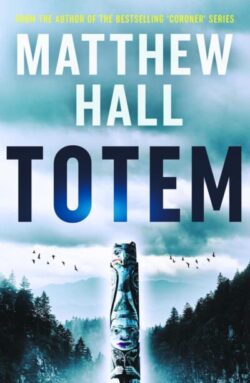
An expedition to the mountainous wilderness of British Columbia and encounters with indigenous people in remote outposts inspired my latest novel, Totem – a very different kind of book to the UK-based legal thrillers I had previously written. It wasn’t just the strange thrill of hiking through country only accessible by float plane and not being top of the food chain – grizzlies and mountain lions abound – it was also the fact that some of this landscape is the hottest of hot political potatoes.
Many of Canada’s indigenous people – they comprise 1.8 of the 40 million population – are trying to reclaim their ancestral lands and culture. While not conquered in quite the same way as their counterparts in the USA, those in Canada were nevertheless exploited, betrayed, marginalised and corralled into reservations overseen by government Indian Agents.
From 1876, many indigenous children were forcibly sent to residential schools and so began more than a century of cultural destruction, loss of tradition and languages.
Now, thanks to Canada’s 1982 Constitution Act, indigenous communities have been able to negotiate treaties granting expanded rights to ancestral lands, including revenue sharing over natural resources that could make Canada the richest country in the world; but the question of who has the right to exploit them casts a dark shadow over the country’s politics.
Beneath the window dressing of land acknowledgements and ceremonial handshakes is the most sensitive of issues: modernity vs the right of indigenous people to live apart from it. And more complex still, some Canadian First Nations who have negotiated treaties, are willing participants in the industrial world, sharing in oil extraction projects, for example.
A perfect setting for a legal thriller and love story, I thought: an outsider who finds herself involved with an indigenous community in the midst of a treaty negotiation which is at the same time being undermined and corrupted by venal, corporate forces. An opportunity to dramatise continuing abuses while exploring the competing desires of culturally and financially marooned native people.
I researched deeply and drew significantly on the experiences of Charles Joseph, a celebrated native wood carver, whose harrowing life story involved his sexual abuse, aged only five, by a nun at his residential school.
Charles was very encouraging about the book. I read it aloud and sent him the recording, which he listened to while carving in his workshop. He was clear that he and others like him, want their stories told. The indigenous artistic tradition is not a literary one – it is chiefly expressed in carving, painting, music and dance – and he welcomed me as a British outsider adding my form of expression to his.
Naively, given Charles’ endorsement, I thought I would be able to find a publisher. My previous books had been published by two of the top houses and I hoped for the same again. In the event, there was a string of rejections and advice that the market was currently more interested in cosy crime. This stung on several levels: I also work (or try to) as a screenwriter in television, where the game is chasing ephemeral fads and I had allowed myself to believe publishing was where riskier creations were welcomed. There was also the pain familiar to so many writers – writing this book had taken everything I had. It was written just after our youngest son died suddenly aged 23 and had become a testament of sorts and a reason to keep going through the darkest of times.
Lurking beneath some of the rejections, I guessed, was a fear of consequences and all the noise and fury around issues of cultural appropriation. On deeper reflection, I could see the problem. The instinct to erect hard cultural boundaries and ‘ownership’ of stories is an expression of something legitimate: deeply precious things require protection and profound respect.
The manuscript lay heavily on my desk for over a year before fate intervened in an unexpected way. My aunt, an artist who lived in Canada, developed motor neurone disease and asked me to be present as she ended her life through euthanasia. I pleaded with her not to do it, as did her son and young granddaughters, but she was resolved.
In May 2024, three days before she left this life for the next, we made a final trip to the beach at Lake Huron and my cousin took us to a fish smokery on a nearby reserve where a painting which had caught his eye was hanging. Its creator was Ojibway indigenous artist, Jeff ‘Red’ George. The moment I saw it, I knew I had to meet him and on the eve of my aunt’s death, I did.
We formed an instant rapport, perhaps due to the fact that we had both weathered our share of traumas. I started to speak about the book and unbidden, Jeff started to draw the mother bear and her cub which appear in the first chapter. This became the first of a number of beautiful illustrations he added to the text.
Jeff’s contribution was the water that brought the seed to life. The book had become a collaboration; a bridge between his world and mine and the basis, we hope, for more books together.
A smaller publisher, Eye Books, took the now illustrated Totem on. Their USP is going to uncharted places and doing what true creativity demands – taking risks others are not prepared to shoulder, along with the possibility of criticism and failure.
Totem began with the idea that we are all bound by our common humanity yet live in a world of constantly shifting, unknowable boundaries and unlikely connections of the kind that bind my two central characters and which now link me and Jeff. The story gently explores the meeting of two people from vastly different worlds but offers no pat answers, just the thought that there is no ideology that can square the circle of cultural collision, only individuals meeting, communing and responding to the best in each other.
Totem by Matthew Hall is out now, published by Eye Books.