
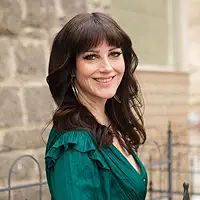
When readers ask me why I write thrillers based on true events, the short answer is that true crime takes up around 90 percent of the hard drive in my brain.
The longer answer began when I was a little girl watching Dateline and realizing that my parents had been very incorrect when they told me monsters weren’t real.
Monsters were abso-freaking-lutely real. They just had ordinary names and faces like Ted Bundy. Charles Manson. Richard Ramirez. John Wayne Gacy. Dennis Rader.
I learned that monsters wore casts and asked for help loading sailboats. They volunteered and went to church. They had wives and kids and jobs and neighbors.
I became a little bit obsessed with true crime after that. Partly because I was scared and partly because I was curious. But mostly because, overwhelmingly, the monsters seemed to target girls who looked like me, my sisters, and my third-grade best friend Katie, who once grabbed my arm and hissed, “Run,” when a man in a shiny red truck slowed to a crawl beside us, beckoning while he asked for directions.
As a teenager, I inhaled every true-crime book and TV special I could find. The Stranger Beside Me. The Sociopath Next Door. Dateline. America’s Most Wanted. I thought that if I kept going, I’d reach the end at some point. That if I studied enough stories, I could figure out the pattern. I could learn the signs. I could make myself safe.
But there was no end to the stories.
There was always another missing woman, another smiling school picture, another grainy convenience store video. Another woman’s name that became inseparable from the man who harmed her.
Eventually, I stopped believing that studying true crime could make me feel safe. But I never stopped being drawn to it. And ultimately, I decided to funnel my anxiety into writing thrillers.
At first, I sort of expected the process to ramp up my fear level. After all, I was writing in first person, putting myself in my protagonists’ shoes again and again (because I almost always write from the point of view of an ordinary woman thrown into a nightmare situation).
Instead, it did the opposite. And that’s the truest reason I write these books.
Because the world can certainly be a dark place. But it is also full of light and live coals in the form of ordinary women who have mustered extraordinary grit and courage and power in situations straight out of a nightmare. Women like Kari Swenson, Aundria Bowman, Karen Sparks, Lynda Healy, Roberta Parks, Brenda Ball, Janice Ott, Debra Kent, and Samantha Koenig.
Their names often become sidenotes to the men who stole their innocence, their sense of safety, and sometimes their lives when in fact, they should always, always be the headline. These women remind me again and again that even in the face of the steepest odds—even in the face of death—there is room for hope, resilience, and power.
Those women are the truest part of my books. Not the men who hunted and harmed them. Not the violence or crime itself. The women. Their intelligence, their fight, their humor, their humanity.
That’s also one of the reasons I choose fiction as my medium.
Because in the real world, many of these women are not portrayed in media and news as the heroines they deserve to be in their own stories. Sometimes, we simply don’t know what happened. Because too often, their lives are cut short in obscurity, their cases remain unsolved, and their families are left with questions no one can answer. Justice, if it comes at all, comes late and incomplete. And even if the monster is caught, that doesn’t begin to undo what happened.
I can’t fix any of that with fiction, but I can weave depth, meaning, justice, empathy, completeness, insight, and power into stories that so often don’t get enough of those elements in real life. I can help center the person who was harmed instead of the person who caused it. I can make her the protagonist instead of the sidenote.
Sometimes, fiction even gives me a way to return a voice to someone who had it taken away completely.
That was one of the driving forces behind Ask for Andrea, my novel inspired by Ted Bundy’s victims that, in many ways, launched my career. I didn’t really want to write about him. I wanted to write about them.
It’s also part of what drew me to None Left to Tell, which portrays the little-known mass murder that took place in Southern Utah. More than one hundred and twenty people were killed, most of them women and children. Only seventeen survived. And yet, in many ways, that part of history remains a footnote.
I couldn’t stand to let that story to be a footnote anymore.
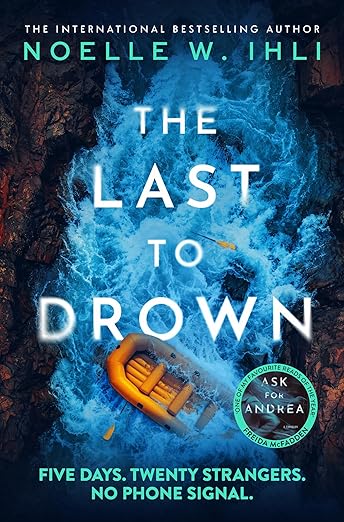
Even The Last to Drown, my newest release, traces back to true crime. Thankfully, there is no true event that closely mirrors the kind of disaster that takes place on the whitewater rafting trip in my novel. But I wrote it thinking about Israel Keyes planting “kill kits” in the wilderness. And more importantly, I wrote it with Samantha Koenig in my mind.
She was his final victim. She is the reason he was finally captured. And her life meant so much more than his.
The world will never stop being full of monsters. I wish it would. And I wish women could walk and travel and date and work and live without calculating the risk. I wish mothers did not have to teach their daughters how to hold keys between their fingers, how to check back seats, how to cover their drinks.
But the world will also never stop being full of bravery and grit and power. And at the end of the day, that is what I choose to focus on when I write.
It is my greatest honor when readers send me messages and emails, to confide stories about loved ones they’ve lost to violence, or violence and near-misses they’ve experienced themselves, When they tell me they were afraid to read one of my books because it mirrored something awful that had happened to them—but took a chance and felt seen instead.
Those messages are the ultimate reason I write novels based on true crime. Not because of the monsters, but in spite of them.
Because I refuse to let them have the last word.
The Last to Drown by Noelle Ihli is published by Pan 16th July.