
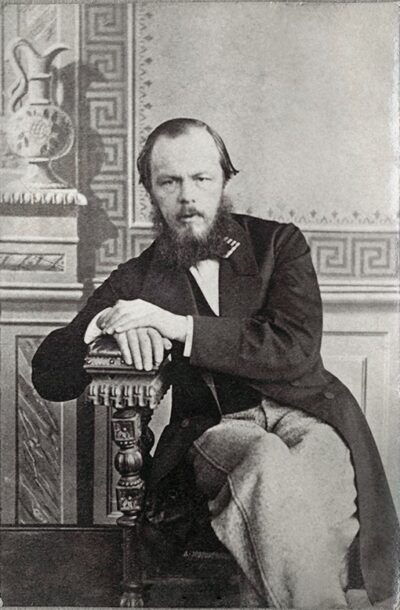
If podcasts had existed in the 19th century, I have no doubt that Fyodor Dostoevsky would have been a fan. Especially of the true crime variety. He might even have turned his hand to producing one.
Dostoevsky was fascinated by crime and criminals. And as a writer, he knew there was a market for this kind of thing, the darker, gorier, stranger and more sensational the better.
But for Dostoevsky, true crime was more than just a consuming, if morbid, interest. It was part of his personal history.
It began in 1839 when his father was murdered. True to the best traditions of the genre, the murder was covered up, and there is still doubt over what really happened. The official cause of death was given as apoplexy. Rumours quickly spread that the truth was something far darker. Dostoevsky Senior had been murdered by his own serfs, with a gang of up to 15 men laying into him. There was no clear motive, but by all accounts Dostoevsky’s father, a cantankerous drunk, was not the easiest of masters.
At the time, Dostoevsky was 17 years old. The violent crime must have cast a shadow over his young life.
His next brush with the genre was even more traumatising, as it put Dostoevsky himself at the centre of the case. In 1849, he was arrested for taking part in a revolutionary society called the Petrashevsky Circle and sentenced to death. This was commuted to four years’ penal servitude in Siberia followed by indefinite military service, but only after Dostoevsky had been subjected to the cruel pantomime of a mock execution.
Although Dostoevsky’s crime was political, he served time alongside regular criminals. He used the same latrines as them, and drank water from the same ladles, as he describes in his autobiographical gulag novel, The House of the Dead.
The experience gave him a unique insight into the criminal mind, allowing him to pick the brains, amongst others, of a man who decapitated his own father and a bemused serial killer. It was a rich source of material, which many modern crime writers would give their eyeteeth for.
After his release, Dostoevsky eventually returned to St Petersburg, where he fed his true crime obsession by avidly poring over the crime pages of the newspapers and reading accounts of historic cases. One that caught his attention was that of the French double murderer, Pierre François Lacenaire.
By now the editor of his own journal Time, Dostoevsky covered the Lacenaire trial in a series of features about notorious French criminal cases. If you’d stuck a microphone in front of him, you would have had a podcast.
Lacenaire was not your standard murderer. For one thing, he was a poet. Cultured, educated and articulate, he dressed up his otherwise motiveless crimes in lofty philosophical justifications. At his 1835 trial, society women crowded into the courtroom for a glimpse of the charismatic killer. He claimed to feel no remorse. “I kill a man as I drink a glass of wine,” he once famously quipped.
As Kevin Birmingham explains in his brilliant book The Sinner and the Saint, Dostoevsky was obsessed by Lacenaire. Something about the nihilistic criminal took hold of the writer’s imagination and wouldn’t let go.
In 1866, this obsession resulted in Dostoevsky’s masterpiece Crime and Punishment. It’s not that Dostoevsky’s killer Raskolnikov is a Russian Lacenaire, exactly, but there are certainly parallels between the fictional double-murderer and his true crime model.
In a letter he wrote to his editor Mikhail Katkov, Dostoevsky hinted that newspaper accounts of more recent crimes were also an influence. He cited the case of a seminary student who “made a pact with a young girl to kill her, killed her in a barn, and was picked up one hour later while he was eating his lunch.” The novel he was writing would explain such horrible acts, he pitched.
It was an ambitious promise. But if any writer was qualified to make it, that writer was Dostoevsky.

Roger Morris is the author of several acclaimed historical novels, including A Gentle Axe, the first in the St Petersburg Mysteries series.