
Ghosts and the supernatural in fiction, crime or otherwise, have a disruptive role to play. They are wonderfully persistent, because the dead can never die, of course. Adaptable to fit plot or atmosphere, from a delicate, fleeting presence to a full-blown, crockery-hurling poltergeist. Ghosts point spectral fingers and in this way are eminently suitable for the exploration of the hidden motivations that preoccupy a crime story. In my writing, ghosts go hand-in-hand with the committing of crimes. Sometimes my ghosts are just chilling glimpses, a patch of cold air on the staircase, an uneasy feeling at lights-out. Sometimes they are the plain-speaking, down-to-earth ghosts that inhabited the tales I heard as a child (reared as I was by a big, wild, London-Irish family). The latter variety of ghost is no corner-of-the-eye affair, they are liable to stand up at the bar next to you and try and drink your pint. They are frequent visitors, giving prosaic instructions to relatives about the rats in the barn, or who should inherit their trousers. In fiction, ghosts, in all their guises, are predominately stubborn mementos of repressed guilt and traumatic history. They embody (a strange way to put this, I know) the past in the present, the return of unwelcome memories, the secrets and stories people struggle to tell or not to tell. They are the unburied corpses, the silenced witnesses who will return to haunt the perpetrator, or the community, or any old perceptive bystander, until justice is done by them and their story heard. They haunt to redress the balance, to hold the wicked and powerful accountable. In this, ghosts are wonderfully subversive, blurring boundaries of time, space and reality to get their point across. They provide marvellous knots and tangles in the sleekest of plotlines. Ghosts can be gritty and folkloric, or chilling wisps. Spectral collaborators, malevolent presences, or even canine horrors. From Carnacki the Ghost-finder to The Woman in Black, via The Hound of the Baskervilles – ghosts are the unsung, largely unseen, (anti) heroes of many a mystery narrative.
Calibrating ghosts is an art and depends on their job on the level of the page, as much as the intended response of the reader. A Gothic ghost is the closely-wound tension at the heart of the story, an uncanny wellspring of sublimated secrets with the power to disquiet characters and readers alike. The best response to the Gothic ghost (of the kind to haunt Shirley Jackson’s Hill House) is uneasiness, dread, and ideally, terror. For jump-scares it helps if this variety of spectre keeps mostly to the shadows. A magical realist ghost (the ghosts of my childhood that populate, in particular, my debut Himself) is not primarily designed to provoke fear. A few of my favourite apparitions are found in the novel Ironweed by the American writer William Kennedy. Set during the Great Depression, Ironweed recounts the crimes and misdemeanours, accidental and otherwise, of Francis Phelan, forgotten baseball hero, bereaved father, survivor of alcohol addiction and years of wandering. When Francis meets the ghost of his infant son, the baby is granted a supernatural power to communicate, despite leaving the mortal world knowing only baby babbles. But in reality, all fictional ghosts have a communicative function, giving testimony to those denied a voice, a life, a decent burial.
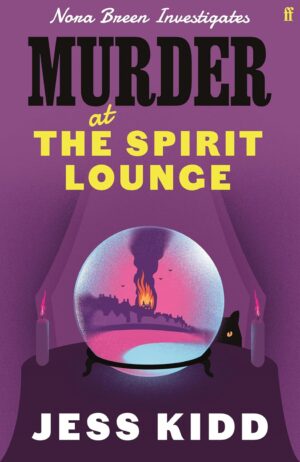
Another central and fascinating aspect of ghosts in stories – especially stories of a crime persuasion – is the extent to which they are debunked. Or not. My latest novel, the second in the Nora Breen Investigates series, Murder at the Spirit Lounge walks this tightrope. Former Carmelite-nun-and-monastery-nurse-turned-amateur-detective, Nora Breen, remains sceptical of the claims of Dolores Chimes, a famous stage medium new to town. While Nora’s sidekick, Detective Inspector Hilary Rideout, succumbs to the promise of messages from the afterlife. Rideout has survived active service as an RAF pilot during the Second World War. We meet him in the early 1950s, when like many, he is trying to rebuild his life in the shadow of trauma. The séance appeals to him as a way to contact lost loved ones and make sense of loss. However, the reading goes disastrously wrong, striking the medium dead and subjecting each of the sitters to supernatural peril by unleashing a spectral serial killer to stalk the seaside town. Nora struggles to apply rational methods of detection to the seemingly irrational (i.e. supernatural) happenings. This sets up an interesting tension when the sifting of testimonies, the application of reason and the discernment of the veracity of the evidence, falters in the face of a ghostly killer who defies logic. But really this speaks to the duality at the core of many good detectives who combine reason and logic with a dab of intuition – and Nora Breen is no different. Murder at the Spirit Lounge pays homage to the ‘Golden Age’ of detective fiction typified by Agatha Christie. Most obviously, in the choice of Nora Breen as the protagonist. Nora, like Miss Marple, is in the tradition of the older woman amateur detective; gleefully subversive, using age and gender expectations (or lack thereof) to her advantage. The message here: underestimate a sharp-minded, middle-aged, former nun at your peril. The genre rules Christie adhered to would prevent Miss Marple from accepting the supernatural as a reality: in St. Mary Mead ghosts do not really exist. For Nora, I feel the line is a little more blurred. As the case unravels, we see how Nora struggles to remain objective and unbiased, to question her own motivations, to honour the beliefs of others, even if she holds no truck with them. Christie was not the only writer of detective fiction who eschewed the supernatural in their puzzles. Ghosts are frequently debunked in crime fiction of all flavours, ostensibly by the application of logic. Police procedurals and novels of the gritty or thriller ilk, usually set up a firm dynamic of ‘it’s not the dead you should fear, but the living.’ Add a layer of forensics and you’ve the narrative equivalent of a fluorescent tube light, leaving few shadows for the supernatural to skulk and drift about in. My earlier books, which all have a mystery plot of sorts, offer multiple ways of knowing things. In this way, a detective can be eminently rational and methodical in their investigation, even while their sidekick is the ghost of a dead bare-knuckle fighter.
I can’t say (without spoilers) whether Nora Breen would agree with me on this one or not, but the question as to whether the supernatural is ‘real’ doesn’t need to be resolved. For me it’s enough that ghosts can aid or obstruct a crime trajectory, often in deliciously subversive ways by offering spectral sleights of hand. Nevertheless, ghosts and detectives – to my mind – generally share an inclination to uncover rather than mislead. The supernatural, whether debunked or not, is useful in that it allows us to question and disrupt received notions of the world to expose what is hidden. To unearth what twisted motives and horrible secrets lie behind the respectable facade of a community, whether they are gathered together in a desolate house, or tramping about Dartmoor, or the flotsam and jetsam of a post-war, Kentish seaside town.
Murder at the Spirit Lounge is published by Faber & Faber on 21st May.