
When I was about ten years old we lived in Westport in the West of Ireland. There I was introduced to the works of Sherlock Holmes and Dr Watson. I must have come across Mycroft too though I have no memories of it. One day, as was inevitable I came across ‘The Final Problem’ at the end of Sherlock Holmes, wrapped in his deadly embrace with Professor Moriarty at the Reichenbach Falls. I burst into tears and would not be comforted. My father met me on the stairs.
“What’s the matter, David? What’s wrong?” “It’s Sherlock Holmes, Daddy. He’s dead. And he’s not coming back.”
“But that’s just what he does do. He comes back. He was such an important character the author couldn’t let him go. You’ll see. I’ll get you the next story when he returns.”
I don’t know if my father possessed magical powers but the story with the return of Sherlock was in my hands after school the following day. Heaven knows how he got hold of it. Westport was not renowned for its bookshops, rather for the number of ordinary shops with bars attached, grocer and bar, butcher and bar, greengrocer and bar. But one small boy was very excited. He could see a dozen new stories waiting for him after ‘The Empty Hearse’. Mycroft does not appear in these last days except to drive the cab that took Dr Watson to Victoria.
Dozens of years later in 2011 or so I was working with Richard Foreman, arch publicist and consigliere for aspiring authors and one evening he handed a list of literary impersonations for his clients. He himself was bringing Raffles back to life. Somebody else got Graham Greene. A third – heaven help her! – got Virginia Woolf. And I got Mycroft Holmes. For me he was the most attractive candidate on offer and that evening at home I read ‘The Greek Interpreter’, the first of the Holmes stories in which Mycroft and the Diogenes Club are introduced.
It doesn’t take long to read the four Mycroft stories. You are then left with a blank sheet of paper. And Mycroft. His position as Auditor of all Government Departments gave a clue as to what the first story might be about. I wrote the blurb before I wrote the story. I felt it would suit the interests of Mycroft Holmes and the world he moved in. In my imagination at least.
“The Commissioner of the Metropolitan Police and the Governor of the Bank of England had learnt through a variety of sources – a private bank in Vienna, an Anglophile moneylender in Munich, a reliable tip off from the Casino in Monte Carlo that Britain’s enemies were trying to debase the currency.”
The blurb turned into a short story called ‘Mycroft Holmes and the Adventure of the Silver Birches’ – the title an echo of the Conan Doyle story of ‘The Adventure the Copper Beeches’. Mycroft was the star of the show, organising the search for the identity and location of the forgers. But who is the mysterious stranger who led them to the gang’s final hiding place and then vanished, last seen striding rapidly into the fog? The shadow of Sherlock hovers over the first and second bursts of Mycroft stories I have written. In the current one Mycroft has been to Sussex to consult about a question of naval intelligence. There were six short Mycroft stories in that first burst, all, I like to think, with Conan Doyle-like titles, ‘The Adventure of the Naval Engineer’, ‘The Case of the Missing Popes’ – paintings not pontiffs – ‘The Bankers Conclave’, ‘Murder at the Diogenes Club’, and ‘The Case of the Romanov Pearls’.
It was 15 years before I returned to Mycroft. My own series about an Anglo-Irish detective called Lord Francis Powerscourt had come to an end. I was wondering what to when I remembered Richard Foreman and Mycroft Holmes. Would he want any more Mycroft?
Could I write any more Mycroft? He did. Indeed, he wanted quite a lot of Mycroft, 60,000 words of Mycroft to be delivered at a later date. I am working on it now.
Anybody trying to write in the manner of a dead person or a famous living author, has to decide how much of the original world in the original stories they should keep. Obviously in Mycroft’s case with so little material in the originals, you keep the lot. What can you ask that your readers recognise as being typical of Mycroft, or an example of how he would behave in certain circumstances when there’s so little to go on.
I kept some of the minor characters, Or rather, for a start, I kept Dr Watson who makes regular appearances as a kind of keeper of the Holmesian flame and a voice of common sense in tricky situations.
I kept two of the Sherlock Inspectors, Inspector Lestrade, promoted to the role of elder in his local Presbyterian Church, and Inspector Gregson, saving for a cottage by the sea for his imminent retirement. I have kept Mrs Hudson, transplanted from 221b Baker Street to Pall Mall and Mycroft. I have also made her a sort of honorary member of the Wine Society, officially open only to male members, but circumvented by Mrs Hudson through her friendship with a butler at the north end of Eaton Square. I have said nothing about the nature of the housekeeper butler alliance. We can draw our own conclusions. I like to imagine Mrs Hudson, when the day is done and her gentlemen or gentleman have retired for the night, enjoying a glass of Wine Society claret before bedtime with her feet up before the last embers of the dying fire.
I have added a club and a young assistant to Mycroft’s world. The assistant is called Tobias. He lives with his mother near Tottenham Hotspur Football Ground. He is Senior Wrangler for his year at Cambridge, the cleverest young mathematician of his day. He can keep up with Mycroft’s arithmetic and he is a diligent researcher able to work out what Mycroft wants from some particular query. His greatest friend from the year below, JMK, also from King’s College, is working in the Treasury. Tobias works at his own desk in the bottom corner of Mycroft’s enormous room in Whitehall, his desk strewn with reports, newspapers, articles and random thoughts of Mycroft himself scribbled down on scraps of paper in a near illegible hand.
I have added another club to Mycroft’s world. It is a club to prevent drunkenness. If you are reported as drunk three times you are liable to expulsion. There is a test to stay in the club which involves saying the Lord’s Prayer backwards and walking along a straight line. Its name is too close to the Diogenes, for it is called the Dionysus Club in memory of the Greek god who partied too hard. I realised after I had invented it and put it on paper that it is actually a club for recovering alcoholics. Good luck to them.
In the longer story I am working on now, Mycroft is called on to enter a competition whose prize is called the Ozymandias Cup. Various tests, some deeply orthodox, some wildly eccentric, are to be undertaken to find the best mathematician in the land. The winner takes the Ozymandias Cup. There are multiplication tests and a competition for who can work out the number of spectators at a football match.
In one of his short stories Sherlock Holmes disappears to a secret location and comes back with some sort of present which he will not disclose. Mycroft goes one better. Thanks to the good offices of Dr Watson and his friendship with the Queen’s Private Secretary, Sir Arthur Bigge, Mycroft Holmes meets the Queen of England. She gives him a special title and tries to persuade him to join the contest. There is one quality shared by the two Holmes brothers. They are both devoted subjects of Her Majesty the Queen. Her persuasive powers and Mycroft’s respect for her are enough to see him agree to join the entrants for the Ozymandias Club. It is to be staged in Trinity Hall, Cambridge when the undergraduates are still on holiday in September 1896. To the horror of the participants the proceedings are marred by murder. Mycroft has to solve, not only mathematical puzzles, but murder in the heart of Cambridge. Inspector Gregson is brought back to the colours. Lestrade is left waiting for the call. Mycroft distinguishes himself from Sherlock in one episode. A college porter is shaking him on the shoulder to wake him up and tell him about the incident. It is three o’clock in the morning. Mycroft questions him about the murder. Dr Watson appears and presumes that Mycroft is about to get out of bed and go down to inspect the murder scene. He refuses: “That’s just what my brother would have done. By this time he’d be down there in the Old Library where the body was found, microscope in hand, crawling around the floor looking for the make of shoe and the length of trouser leg. That’s all a waste of time.”
Mycroft or Sherlock? It’s a silly question really. There’s only one answer. Both of them.
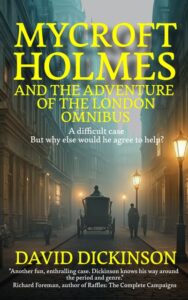
David Dickinson is the author of detective fiction, including Mycroft Holmes and the Adventure of the London Omnibus, published by Marshal Books.