
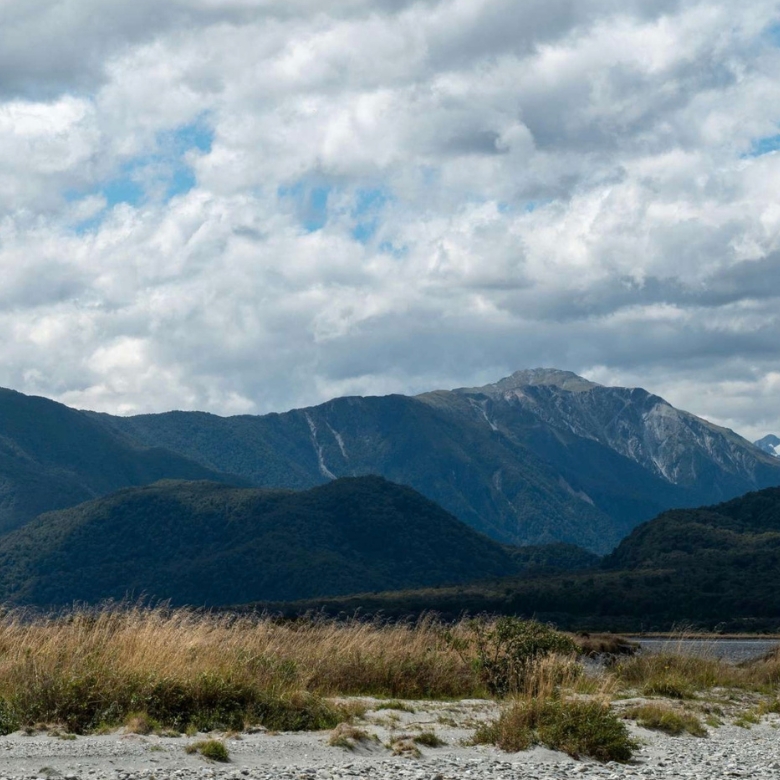
The wild and haunting setting of the New Zealand bush is the beating heart of my debut, The Vanishing Place. The setting both inspired the story, and it moves through the pages as a living breathing character.
I come from Scotland, where the mountains have been stripped bare of trees and where you can see for miles. But, in New Zealand, where I live now, vast areas of the country remain cloaked in thick forest, known as ‘the bush.’ It’s hard to comprehend the vastness and density of the native forest in New Zealand, it’s almost otherworldly – a place of a thousand greens that is both beautiful and daunting. The trees and foliage twist and grow into an untamed, often impenetrable, wall that can swallow you whole. In our modern world, where every human movement and interaction is recorded, this remote location – a wilderness at the bottom of the world where you can completely disappear – felt like the perfect setting for a psychological thriller.
The ability to be totally immersed in the wilderness, to cut ties with civilisation and to live off-grid, fascinates me. This deep connection with the bush is something that sits in the hearts of many New Zealanders and, for some, the notion of disappearing into the trees is a lived reality. It is not unheard of for families to live wild in the deep New Zealand bush, some stories happy and others laced with tragedy.
While I was writing the first draft of The Vanishing Place there was a wanted man who had been hiding in the bush with his three children for four years. Tom Philips had evaded all efforts by the police to be found, from drones and helicopters, to massive searches on foot with dogs. While The Vanishing Place wasn’t directly inspired by this real-life story, the unsuccessful manhunt for Tom Phillips illustrates how vast and dense the New Zealand bush is, and it legitimises the idea that you can truly vanish in the trees. Somewhat eerily, the week after my debut released in New Zealand, Tom Phillips was fatally shot by police when, by sheer coincidence, he was caught robbing a commercial property. While the children were found safe and alive the following day, the tragic end to this story has shaken the country and left people divided.
A family whose story did loosely inspire some of the moments in The Vanishing Place is the legendary Long family – the most isolated family in New Zealand. Over forty years ago, Robert Long found an abandoned hut on the coast of the South Island, two days’ hike from the nearest road, and decided to stay. He has been living there ever since with his wife, Catherine. Robert Long and Catherine Stewart also raised two children off-grid, with their only contact with the outside world being a monthly supply helicopter and two trips a year to the nearest village, a multi-day hike that involved navigating dangerous river crossings, rough terrain, and harsh weather. The Long family have written three books about their experiences living self-sufficiently and using the natural environment to survive. The wild West Coast setting is a crucial and integral part of the Long family’s story. It is a part of who they are, and it impacts the direction that their lives take. This is what I wanted to achieve with The Vanishing Place. Rather than the setting being a passive backdrop, I wanted the bush and the wildness to be at the forefront, influencing the plot, challenging the characters, and impacting the mood and course of the story. The Vanishing Place is a thriller where the narrative is driven forward by the remote unforgiving setting, and where the trees feel like a participant in the story.
I live in the North Island of New Zealand, where I spend a lot of time biking and hiking in the bush. For me, it is an environment that I feel both comfortable in and know to be respectful of. When doing research for my novel, I would walk into the bush and take the time to experience it with all five senses, looking down and up as well as around. I also took my two young children with me, aged two and four, and I watched how they interacted with the bush, and how their experience of the environment was different to mine. The way they interacted with the natural setting was more intimate and playful, and there was a complete lack of fear.
I have also spent a lot of time on the West Coast of the South Island, where the novel is set, and while the village of Koraha, and the family’s hut, are fictional, they are both inspired by real places. Koraha is based on a village called Haast, and the hut is an amalgamation of many of the different backcountry huts that I have stayed in. All of the other locations, however, from rivers to hills to bridges, are real. To ensure that I was capturing the setting as best as I could, I spent hours reading topographic maps, measuring out routes and distances, and I was in touch with a local Département of Conservation ranger who helped me with the correct names of the West Coat foliage and fauna.
I think, when the setting plays such a focal point in the story it’s important, as the writer, to feel and breathe it for yourself. There are two poignant scenes in the novel, one on a 737-meter-long single-lane bridge, and the other at the crossing point on the Haast River, that I knew I absolutely had to stand in, in real life, with my own two feet. In January, I went on holiday to the West Coast and it was the most emotional and surreal moment, standing on the banks of the river that Effie and her family had to cross, and looking over the edge of the bridge that Anya clung to. My whole body was shaking, and I could see my characters in front of me. It was incredible, to feel like I was standing inside the pages of the story that I’d written, watching the scene unfold around me.
I hope, by bringing the setting to life, that the reader will feel like they are transported to the wild New Zealand bush. I want the reader to feel like they are there, in the trees, both entranced and haunted by them.
Zoë Rankin grew up in Scotland and travelled the world before settling in New Zealand. The Vanishing Place published by Viper in paperback is her debut novel.