
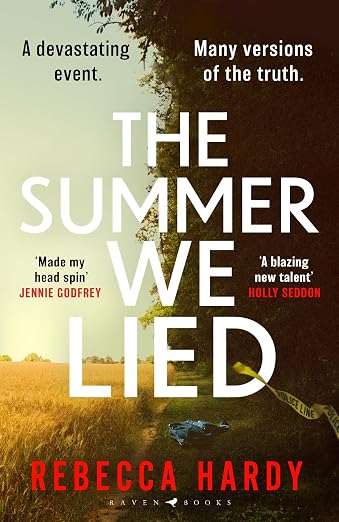
Three fictional teenage friends provide the hook and the heart of my debut novel, The
Summer We Lie, a mystery thriller set between rural East Sussex in the heatwave summer of
1989, and London in 2007. This dual timeline, multi-voice structure – whilst an absolute
headache to write – provided me the opportunity to engage with my long-held fascination
with moral ambiguity; the grey areas that bleed between right and wrong, where blame and
guilt exist alongside virtue, love and friendship. Where else does that complexity first
emerge, if not in childhood?

Like so many others, the memories of my own teenage years remain acute and powerful. If
you’re anything like me, you may still cringe over all the embarrassing things you said or did,
as though they happened only yesterday. You may still shake your head at the clothes you
chose to wear, the make-up you experimented with, the truly inexplicable hairstyles (my God,
the hairstyles) But also, if you’re anything like me, the memory of those years can bring
bursts of painful nostalgia, the truly heartbreaking beauty of hindsight. Although I couldn’t
quite see it in the moment, those childhood years were simpler times; a period when the
future felt infinite and tantalisingly within reach. A period when all our cultural references
were entirely collective, driven by a limited suite of television shows and an unmissable – but
recordable in person – weekly Top 40. When we could leave the house for hours without our
parents knowing exactly where we were, or how to contact us. When, without mobile phones,
we remained a law unto ourselves and any manner of adventure might, and very often did,
await us. Especially if we were willing to tell a few little lies.
Becoming a teacher, surrounded by teenagers five days a week, I remained relatively close to
the teenage experience for decades, even as the distance between my adult life and my own
childhood grew ever wider. I can remember, all too well, that sinking feeling after being
caught out in a lie; the prickle of sweat breaking across my forehead, the creeping blush
rising to my cheeks, colouring me with guilt. How could I forget those childish mistakes,
when I saw them reflected back to me through my students every day? Saw, again and again,
the lies they were willing to tell in order to keep themselves from trouble. Saw precisely how
far they were prepared to go for a friend; loyalties that were both misguided and entirely
relatable. We’ve all been there, haven’t we.
Perhaps it’s this inability to walk away from my childhood self, along with an unshakeable
nostalgia for the past, that draws me repeatedly to books that reveal the poetry and pain of
adolescence. Books such as Sweet Sorrow by David Nicolls, The Crow Road by Iain Banks
and The Virgin Suicides by Jeffrey Eugenides. Novels I return to over and over that, for me,
explore the rippling consequences of a meeting or a moment, that could or should have
remained in one time or place, but that go on to leave an indelible mark on a character’s life.
Over the years, I’ve found that stories that reflect the past often allow me to make sense of
my present, to the why and what of who I am. I wanted to harness that innate connection to
the past, in some small way, through my own storytelling. To explore the psychology of how
our childhood experiences, all those ill-advised adolescent choices and actions, shape the
adults we later become. Teenagers are fallible and flawed, but ultimately sympathetic. What
better characters to behave almost unforgivably – and to place at the centre of a twisty crime
thriller – than those who are ultimately not quite old enough to understand the consequences
of their actions?
It should perhaps come as no surprise, then, that when the inspiration for The Summer We
Lied appeared, it was a teenage character who first announced themselves. Fifteen-year-old
Jonathan arrived fully formed, with all the complicated issues of a schoolboy in the 1980s,
plus a few other painful secrets he was desperate not to share. Jonathan was quickly followed
by two female characters, Alex and Rachel, to form a triangle of friends who were
impenetrable but also slightly off balance. I knew that, whatever my adult characters were
going to do later in the story, it would be shaped by their earliest mistakes; the ones they tried
desperately to hide from each other, as well as those they couldn’t hope to escape.
By the time I had to write these characters as adults, they were already layered and rounded;
each one broken in a different way by their shared experiences and unable to move away
from the children they were. Had I not started with their teenage selves, I don’t think I could
have understood their conflicts and motivations so precisely, or with such emotion.
Eventually, draft after draft, The Summer We Lied became a mystery thriller about secrets and
lies, about the complex relationships between parents and children, and about the lasting
impact of domestic violence and trauma. But, at its heart, it remains a story of early
friendships; the bonds we forge in childhood – and particularly as teenagers – that can be both
a burden and a blessing. I hope, by doing so, I have created characters a reader can believe in,
and ones who might just spark nostalgic recognition of their own, long-forgotten, teenage-
selves.
The Summer We Lied by Rebecca Hardy is published by Raven Books