

When a fiction book is published, in many ways that’s literally the end of the story. But when a true crime book hits the shelves, that’s often just one step in the writer’s plan to correct a miscarriage of justice, or shine a light on an unsolved case.
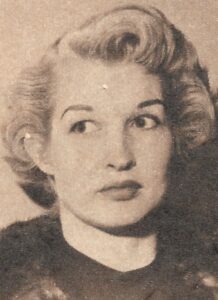
Headshot of Diane from Official Detective Stories Magazine
Closure for the victim’s friends and family is a priority too, and that was certainly the case in my book, The Alaskan Blonde, which reexamined the unsolved murder of Fairbanks businessman Cecil Wells in Alaska in 1953, and the suicide of his wife – and prime suspect – Diane in a Hollywood hotel room a month before the trial.
I had first come across the case as part of research into the second of my Gourmet Ghosts books, a series that looked at the history of bars, restaurants and hotels in Los Angeles, and it had never quite left my mind.
I always wondered what had happened to four-year-old Mark, Cecil and Diane’s son (who was not at home at the time of the murder), and what became of Johnny Warren, Diane’s alleged Black lover who was charged alongside her with first-degree murder.
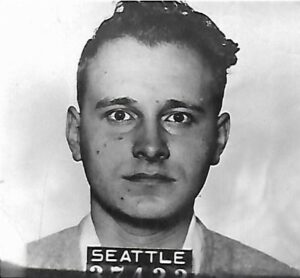
Mugshot of William Colombany
Such a scandalous story from territorial, far-off Alaska – and the elements of sex, murder, money and an inter-racial relationship in the Jim Crow era – made me think it had surely been comprehensively covered, so I vowed to pick up the book on the case one day.
Cut to five years later. It’s 2022, and The Alaskan Blonde is published.
In the preceding years I had learned that the friends and family of almost everyone involved saw the case as a black hole: a missing gap in their history. The case was unsolved, and it had never been talked about, at least not to the children, but these grown-up grandparents and great-grandparents still wondered about what had really happened.
The Wells family had been unhappy with the investigation at the time, and briefly engaged the Pinkerton Detective Agency. That seemingly came to nothing, and they contacted Erle Stanley Gardner, the creator of Perry Mason, and asked him to recommend a private eye.
As I wrote about recently for Crime Reads, since 1948 Gardner had been writing about miscarriages of justice for Argosy magazine. His assembled group of volunteer experts that looked into these cases was called The Court of Last Resort, and it led to a best-selling book and later a television series.
Gardner was completing his Argosy version of the case of Emma Jo Johnson when he got the call from the Wells family, and he had no hesitation in recommending a man who helped secure the early 1954 release of Johnson, who had been convicted of murdering her landlady in Las Vegas several years earlier.
“A man whose life would have been far from gentle, who carries several bullet scars, and would no sooner think of going out without his gun than without his shoes,” was how Gardner summed up his choice, Glen E. Bodell.
Known to all as “Bud,” Bodell was a lifelong bruiser, his reputation first earned when he and his team marshaled the hundreds of employees working on the Hoover Dam. He had a long career in law enforcement, and was the first registered private eye in Sin City.
Bodell’s papers at the Nevada State Museum: Las Vegas include a handwritten note that says a phone line was installed between Fairbanks and Seattle so he could talk directly to two “on vacation” Seattle police detectives that the Wells family had also hired. It was reported that the detectives had administered lie detector tests during a visit to Fairbanks, and a Los Angeles Times clipping about the tests was found in Diane Wells’s possessions.
Bodell was en route to Fairbanks – a long, multi-stop trip – when he learned about Diane’s suicide. Her death all but sunk the already-circumstantial case, though Johnny Warren endured several more postponements as law enforcement officials tried desperately to find the murder weapon. Warren was eventually exonerated in 1960, after Alaska had obtained statehood.
Despite Bodell’s predictable failure to crack the Wells case, my recent research into his career seems to be leading me into writing a book about his colorful life, and that’s something I could never have imagined.
Still, as many true crime writers will admit, the desire to find out more about your subject never truly goes away. You can’t just leave the story behind, and always go on high alert when an email or text message arrives from someone who says they were connected to the case, or a random online search unearths an old newspaper article or archive document.
This happened several other times after the book was published.
Firstly, an email from the daughter of the man who was the executor for Cecil Wells’s estate told me that he had insisted Cecil’s murder was a mobster hit, and that he had been frightened enough to go into hiding.
Then there was the man in his eighties who quietly came up to me after a talk I gave at the Noel Wien Library in Fairbanks and uttered the words a true crime researcher always hopes to hear: “I have never told anyone this, but…”. However, his story was only that as a teenager he had broken into Cecil Wells’s car lot garage.
Just a few weeks ago I got a Facebook message from someone in Fairbanks that went to school with one of Cecil’s children, and that this Wells child was adamant Johnny was Diane’s pimp, and that Cecil had been blackmailed into marrying her. Moreover, he was sure that they were both later murdered.
Quite a story, though I replied politely that Johnny died in 1997 of natural causes, that Diane’s death was definitely suicide, and that, even with how badly the case was handled, I doubt the FBI, Fairbanks Police, pulp magazines and assorted reporters would have failed to follow up on even the mere suggestion of such a promising lead.
Perhaps the most important moment during my research came when the daughter of a US deputy marshal that was heavily involved in the case sent me his unpublished memoir notes. They revealed where he thought the murder weapon ended up, and a mugshot of the man he called both publicly and privately “The Third Suspect.”
That “Third Suspect” was a Guatemalan named William Colombany. He had a fascinating and mysterious life story, and was intricately involved in the case. He even identified Diane’s body following her suicide, as he had moved down to Los Angeles to join her.
As you might imagine, I was desperate to talk to Colombany’s now-elderly daughter, but, despite her own daughter asking repeatedly on my behalf, she would not say a word: the past was a black hole to her too, but she did not want to know about it.
Of course, short of a time machine or a deathbed confession I was never going to know for sure who killed Cecil Wells, but at least after talking to so many people and finding out almost every document I could about the case, I could make my best guess in the final chapter of the book.
Finally, I want to mention how often people ask me what happened to young Mark Wells. He was in fact almost the first person I managed to track down, and was initially very enthusiastic. But then I got a polite letter saying he didn’t wish to be involved – and there were several reasons for that.
Perhaps the most amazing thing that happened during the research, writing and promoting of the book was something that really had nothing to do with the case at all.
I had been surprised to learn that Diane had been interred at Hollywood Forever, and not taken back to her birthplace of Portland, Oregon, so – being necessarily obsessive about the story – I decided to find out which mortuary she had been taken to after her suicide.
It was of course listed on her death certificate, and I entered the address into Google to see what that building was today. It was now the location of Book Soup, a famous store in West Hollywood. Not only had The Alaskan Blonde been on sale there, but back in 2017 they had put out calls for writers to sit in their window as “living exhibits” and work on their latest book.
My wife is a mystery novelist, so she and I had both been accepted, and she took several pictures of me during my stint. On the desk beside me was a picture of Diane Wells, because of course I was working on The Alaskan Blonde, never for a second imagining that some 63 years earlier, Diane had been here too.
—-
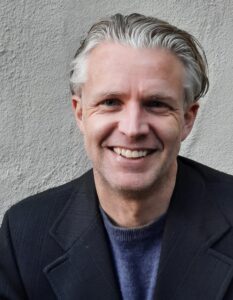
James T. Bartlett’s Anthony Award-nominated book The Alaskan Blonde can be found on Amazon, with more details of the crime and the investigation at www.thealaskanblonde.com