

I grew up without a television in the house. So whatever movies and TV I watched, I watched with my Grandmother. The ultimate auto-didact and cinephile, our homes were separated by a laundry room. A sign on her door would indicate if Gramz was “in” and ready to receive visitors, or “out” and wanting some alone time.
I’d sneak into her house to watch things my peace-loving, hippie mother would likely not approve of. Gramz’s house, with its floor to ceiling bookshelves was packed with not only thousands of books, but thousands of films. They were carefully recorded off the TV far before DVR existed in heavy VHS’s that barely exist anymore, organized painstakingly by a numbered code only a few knew and every film was recorded in card catalogue that is still one of my prized possessions as I barrel towards 40. Sometimes I trace the sweeps of her sharpie on the card or open the catalogue just to see the little notes to herself she scribbled about the films (on “The Sound of Music” she writes “Oh that sound!”).
My Grandmother was born in 1918, worked in the war office during World War II, lost the love of her life in the action and that era defined her tastes in media and therefore mine. From the novels of Nevil Shute to the Noirs of the 1940s, she exposed me to the classics, but also to the lesser known: to the silent films that are hard to get now and the pre-Hays code films that ended up defining my narrative style and pacing as a novelist to the British films that taught me humour that was distinctly not American.
My movie world was black and white for a long time, so when Gramz deemed a “modern” (at the time) 90’s movie worthy of her attention it always drew my attention. My mother would’ve thrown a fit if she had known I was sitting there at the foot of her silver upholstered armchair watching Fargo and Raising Arizona, but it was our little secret. There, without knowing it, she gave me the building blocks to my future as a novelist and screenwriter.
A child of the Great Depression and a woman who endured a war where she lost so much, my Gramz taught me that necessity is the mother of invention. I found myself with a pocket of time two years ago and a book to write that I realized I could not write while also developing a TV pitch that was a little too similar. The writer in me worried about voice bleed. The granddaughter she helped raise asked herself: “What else can you write during this time that is different?”
The answer became NO BODY NO CRIME, a novel that echoes the pacing of a pre-code film that’s an ode to the zany action and crime films of the 90’s that my Gramz deemed worthy to add to her collection of classics as they were being released. Fargo, Raising Arizona, Romancing the Stone, Fried Green Tomatoes at the Whistlestop Cafe and Thelma and Louise. A novel where I take everything I normally take seriously—crime families, murder, drugs, the unique danger and flavor of the backwoods of Northern California—and turn it on its head to poke fun at it. The dark humor that both the writers in our family inherited from her was teased out of me in bits and pieces as I spun out my tale of a rural PI on the hunt of the one who got away—with her heart and with murder—and the political crime family chasing both of them.
When you step outside the typical boundaries of your work, you find new parts of not just yourself, but of your characters, of your craft, and in my case, of the rural way of life you’ve always written of and lived yourself. We are so used to brilliant criminals but go on any rural county’s Facebook group and you’ll see a bevy of petty and serious crimes reported and no criminal masterminds to be found. But what you will find is crime ignored by law enforcement who can’t be bothered to drive out to the boonies, who say things like “What do you want me to do?” when you call it in. Who have drones to drive out the homeless in the bourgie areas of town, but who won’t do domestic violence standbys at all as a rule. Priorities, you know?
A rural community is a disenfranchised one. One ignored by politicians unless it’s election time, one that finds itself solving its own community problems because who else will? One that comes together or can be torn apart by the simplest things or grievances.
This can-do, fix-it-ourselves spirit is at the core of NO BODY NO CRIME if you look at it sideways. And you’ve got to look at it sideways. It’s a sideways kind of book. My heroines find themselves in a nightmare at 16, chased in the woods by a boy who’s poured terror and death on their loved ones and they find themselves reduced to the most basic need: survival. It’s him or them. And they choose themselves. They choose the protection of their community by ridding the community of that good for nothing boy. But that choice has repercussions. Because in a small town, nothing stays buried forever. Even dead bodies…and the things we accidentally buried with those bodies.
My Gramz’s influence is threaded through all my novels, a not so invisible string. She is threaded through my very being. The narrative lessons she taught me through books and film that I soaked up at the foot of her silver chair live forever within me. She is 23 years gone from us, but she beats in my heart, in the creative pulse of my fingers as I type too fast to keep up with my thoughts. She didn’t get to see both of her youngest grandchildren become novelists, but they did.
I like to think that this one, this book born out of a quirk necessity that became a personal delight, would be her favourite of mine.
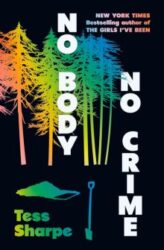
No Body No Crime by Tess Sharpe is Published by Dead Ink Books. It is available here.