
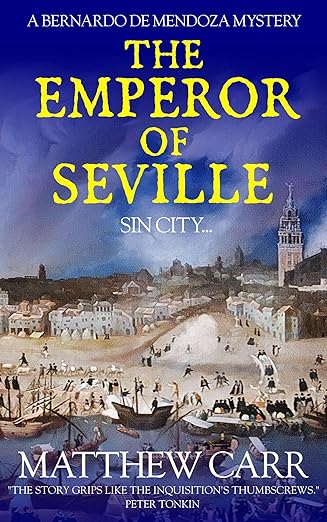
For much of the sixteenth century, Seville was Spain’s emblematic imperial city. It was the main port of entry for silver, gold and other treasures from Spain’s overseas empire, and the port of embarkation for ships supplying the Spanish colonies. Twice a year, the treasure fleets from the Americas unloaded silver on the marshy beach known as the Arenal on the edge of the Guadalquivir River, before being refitted with goods and provision for the Spanish colonies.
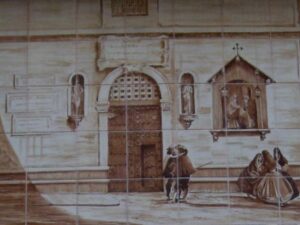
The 16th-century Cárcel Real (Royal Prison) in Seville.
All this gave Seville a special place in the Spanish Golden Age. On the one hand, it was the city of wealth and culture, the city of Velázquez, Zurbarán and Murillo, famous for its Royal Mint, its fashionable shops, the beauty of its women, and its lavish religious processions. But sixteenth century Seville also enjoyed a less salubrious reputation. To many Spaniards, Seville was known as Babilonia – the Great Babylon – because of its rampant vice and criminality.
If the city attracted merchants, sea captains, bankers, moneylenders and sailors, it was also the stamping ground of the pícaro (ruffian); of cardsharks, cape thieves, and cutpurses; of embezzlers, and assassins-for-hire, where law-abiding Sevillanos locked themselves in their homes on winter nights, and ventured into the dark, and often stinking streets at their peril.
This was a city with over three thousand brothels; where gangsters and assassins-for-hire plied their trades in broad daylight in the patios outside the main cathedral, only a few hundred metres from the House of Trade that managed Spain’s maritime empire. The authorities struggled to prevent such activities. According to one historian, there were 28 separate law enforcement agencies in Seville, with their own bureaucracies, jurisdictions and responsibilities. These included the secular authorities of the Real Audiencia (Royal Court), the Cabildo or town council, the ecclesiastical courts, the Inquisition, the House of Trade, and the Military Orders.
Under-resourced, under-paid, and corrupt, the city’s secular alcaldes de crimen (criminal magistrates) and alguaciles (constables) were often at odds with other organizations. Many of them were easily bribed, in a city where the wealthy could usually buy their way out of punishment, and criminals could seek asylum in the cathedral, in order to delay and sometimes prevent their arrest and conviction.
The authorities attempted to impose order with a range of punishments, from incarceration, and galley service, to penal servitude and execution. Even capeadores (cape thieves) were sometimes hanged, and their bodies hung from the walls of the Royal Court in the main square. Murderers could also expect the noose, or a single slash across the throat with the executioner’s knife – delivered from the front or behind depending on their social status.
The city’s main prison was the notorious Royal Prison of Seville, an overcrowded, dissolute hellhole on the Calle Sierpes, where between 500 to 1000 prisoners, and sometimes considerably more, were held at any one time. The Royal Prison became famous, partly because some famous people from the Spanish Golden Age were imprisoned there, and wrote about it. Cervantes was imprisoned twice in what he called a ‘university of ruffians’, probably for non-payment of debts – prompting an unproven legend that he first began to write Don Quixote there. The writer Mateo Alemán also spent time in a prison that he later described as ‘ a confused republic, a brief hell, a long death, a port of sighs, a valley of tears, a madhouse where each one screams and tries only for his madness.’
Contemporary chroniclers from the period confirm these damning depictions. The prison consisted of a large central patio, overlooked by three floors of corridors where the cells were located. The main entrance to the prison was known as the Golden Gate, where prisoners with means could negotiate relatively comfortable terms of imprisonment with the wardens. Most prisoners were led up a stairway through an interior door known as the Iron or Copper Gate, where they were ritually punched by the doormen and assigned to different sections of the prison, according to their crimes. Prisoners then passed through the Silver Gate, where further payments were required, in order to avoid sharing a cell with 300 people and perhaps find a less crowded cell or even a mattress.
The prison did not provide food, and prisoners either had to buy it from the taverns which rented space in the main patio, or had food brought in from outside. Those without money or help from outside went hungry, or performed services for the powerful gangs that controlled the prison. Many prisoners carried swords and knives openly, or sharpened sticks to make their own, and assaults and murders were not uncommon. Control over the prison was lax, and prisoners, lawyers, priests, criminal bosses, and family members brought food or money, or passed freely through the gates that were left open at all hours of the day and sometimes during the night.
On arrival, prisoners were frequently interrogated, often brutally, by ‘tribunals’ made up of fellow-prisoners, who would ask them to name their boss or the organization they were part of, and confess to their crimes. Prisoners who gave up these details were described as ‘musicians’, and punished by death or isolation. Those who resisted were celebrated as heroes. Prisoners condemned to death were often given a hero’s send-off, and were sometimes paraded by the wardens and a priest on their way to execution, brandishing crucifixes and proclaiming their repentance and their devotion to the Virgin Mary.
The prison hierarchy was also reflected in its latrines, which were located on a raised dais in the middle of a pond of excrement in the main patio. Prisoners with money could pay to walk on stepping stones, and avoid soiling their shoes and feet; those without were obliged to walk into the pond and climb the stone steps. The prison also housed between 100 to 150 female prisoners, who were kept in their own compound. In the evenings, their presence provided unlikely romantic moments, as male prisoners sang to them from their cells, accompanied by guitars. Some of these women were already engaged in prostitution, and were able to continue their profession inside the prison.
As many as 18,000 men and women may have passed through the Royal Prison every year. Though rehabilitation was very far from the minds of the authorities or of the prisoners themselves, priests and members of religious brotherhoods routinely visited prisoners to take confession or urge repentance, and sometimes these objectives were achieved. There is no evidence to suggest that the Royal Prison or any of the other prisons of the period had any significant impact in stemming the tide of criminality in the city.
At best, the Royal Prison functioned as a temporary holding pen, rather than a prison in the modern sense, with fixed sentences and the aspirational goal that prisoners will be integrated into society. It was not easy to guide prisoners back to the path of virtue, amid the brutal chaos of a prison that mirrored Seville itself, with its rigid social hierarchies, its corruption and violence, and its dreams of wealth that continued to attract a turbulent and transient population intent on making a living however it could.
The prison continued to function long after the Golden Age had passed, in a state of semi-ruin and disrepair. In the nineteenth century, it was demolished. Today, the place where it once stood is occupied by a branch of the Caixa bank. Only a ceramic tile recalls how the prison once looked in the sixteenth century, when it served as the centrepiece in the Spanish Crown’s failed attempts to impose order on the Great Babylon and its tumultuous population.
The Emperor of Seville by Matthew Carr is available from Sharpe Books.