
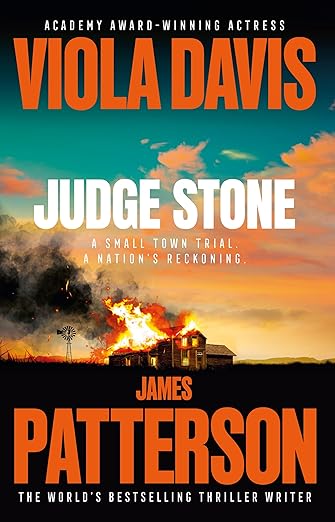
In Judge Stone, award-winning actress Viola Davis teams up with bestselling author James Patterson to craft an engaging legal thriller that tackles the divisive issues of women’s reproductive rights and race relations. The novel takes place in contemporary Union Springs, a small town in Alabama’s “Black Belt,” known for its fertile land and Civil Rights history. Much of the story is told from the first-person perspective of Mary Stone, a Black circuit court judge who, in her fight for justice, pushes the boundaries of her judicial role.

Not content to preside impassively over the proceedings, Judge Stone will kneecap disrespectful attorneys with contempt-of-court threats, question witnesses directly, and toss unruly spectators from the Bullock County Courthouse. Stone’s brand of fierce judicial activism doesn’t sit well with District Attorney Robert Reeves, an arrogant white prosecutor who frequently draws her ire.
Judge Stone is a complex woman, sprung from deep family roots in Union Springs and struggling with repressed personal traumas. In her downtime, Stone looks after her two younger sisters and cares for the family farm, where she mucks stables and tends to her meddlesome rooster Foghorn and beloved horse Tornado. She seems to know everyone in town and even hosts a weekly breakfast for a busload of impoverished folks transported to her home by the Baptist church.
Stone’s already stressful routine is stretched to the breaking point when an incendiary new matter hits her docket. It’s a criminal case against Dr. Bria Gaines, the well-regarded operator of a health clinic. Bria is charged with performing an abortion on thirteen-year-old Nova Jones, in violation of a strict Alabama anti-abortion law that carries a lengthy prison sentence. As the trial date nears, clashes between proponents of women’s rights and religious pro-lifers threaten to overwhelm the town. White supremacists stoke the fire with frightening acts of violence. Facing intense pressure from the Alabama Governor and Attorney General to recuse herself and allow the case to be tried elsewhere, how far is Judge Stone willing to go in her all-too-personal pursuit of justice for Dr. Bria Gaines?
I’m leery of co-written novels, concerned they will lack the authentic imprint of a single author. Davis and Patterson quickly put my misgivings to rest. I was immediately captivated by Judge Mary Stone’s powerful yet down-home voice and drawn into the story’s Southern small-town vibe. Like the best works of John Grisham, Judge Stone balances entertaining legal thrills with thought-provoking social commentary. The third-person chapters narrated by secondary characters are nearly as compelling as the first-person chapters narrated by Judge Stone, a point-of-view juggle that could slip through lesser authors’ hands. As a retired attorney, Duke-educated like the out-of-towner Ben Meyers who takes over Bria’s defense, I’m a tough audience when it comes to legal thrillers. I would be remiss not to flag the literary license the authors take in their characterization of a key procedural rule, a sly sleight-of-hand during the climactic scene. Otherwise, the novel’s depictions of legal maneuvers and courtroom confrontations feel remarkably realistic, especially for authors with no legal training.
I expect Judge Stone to become a runaway bestseller, a staple of book clubs, and a blockbuster film down the road.
Judge Stone is published by Century and is available from 9th March.
Perpetuity by Kevin Joseph is published by Holand Books