
How did the Lizzie Hardwicke series come to be written?
One of the questions I’m asked most is, ‘Where did the idea for a prostitute-turned-sleuth come from?’ The answer is partly by design and partly by magic. I’ve always loved history (indeed, I’ve published as an academic historian), and I’ve always enjoyed historical fiction. Although it’s not my period of research, I like the mid-eighteenth century. It’s a period of tremendous change in England, but it’s often overlooked by writers who rush towards the Regency or the Victorian age, with which more of us are familiar. I knew that I wanted to write a strong female protagonist in this period, I wanted a sleuth, but I realised that, to move credibly between the various strata of eighteenth-century society to do her sleuthing, she would probably need to be a prostitute. She would be sophisticated enough to meet with men of rank and wealth, but her profession would connect her with sex-workers on the streets as well. So far so carefully designed. But Lizzie herself, in way that I find hard to articulate, strode into my head one day and told me her story. She was just suddenly there. I find her bright, brave, witty, and sometimes frustrating, but I’ve lived with her for a long time, and she shows no sign of leaving.
How I research for my writing
I began researching for the series by reading general histories of eighteenth-century life. I like general surveys, as they often give me little snippets of information that I can use, such as the nature of transport, food, or shopping habits. But I’ve also needed to consult some more focussed books as well. I’ve read several works about the sex trade in London, and I’ve also read about crime and punishment and the beginnings of the London police force under Sir John Fielding. For The Corpse Played Dead, I read a lot about theatre and the person of David Garrick. For Viper in the Nest, I read about gentlemen’s clubs, and I also needed to understand how government offices were structured. The novel is set in 1759 and I discovered – to my frustration – that the political landscape of that year was exceedingly complex. Not only did I need to be clear in my head about it, but I also needed to describe it in a way that would be helpful to the reader, without the novel becoming too much of a history lecture.
I tend to begin the writing process by having an idea of the ‘feel’ of the novel. I knew that I wanted to write something about changing and conflicting attitudes to women and women’s sexuality for A Kiss from the Devil, for example. From there, I read about the Magdalen Hospital, and about the Society for the Reformation of Manners, as well as the Hell Fire Clubs.
I’m very lucky to live in Worcester, a city with a fantastic library that is both open to the public and also serves as the University library. It’s a wonderful place to work, and it’s given me chance to roam the bookshelves, discovering all sorts of delights.
My other go-to places for research are helpful websites that remind me how members of the nobility are addressed – mostly because I can never remember – and the paintings of the period. William Hogarth, in particular, populates his landscapes and street scenes with all sorts of characters and, in doing so, allows me to see how people dress, behave, live, and eat. A few of my written scenes are inspired by his images.
Getting lost down rabbit holes
The joy of researching presents two of the greatest challenges to me as a writer. Firstly, when do I stop reading and start writing? This is a tricky question. Partly, this is because I enjoy reading (as most writers do!) and I enjoy finding things out as well as reading the opinions and arguments of historians. But the question is also driven by fear: have I discovered enough about the subject to understand it in such a way as to enable my own writing to sound credible? As someone who, in my other life, must make sure that footnotes and references are accurate, I have a certain level of professional pride in making sure that my fiction is also authentic. There comes a point, though, when I have to stop researching and start writing and trust that what I’ve gleaned from the reading will inform my words. Usually, this is when the characters take over and the story emerges.
The second challenge of researching is that it is easy to get lost in it. I once spent a whole week reading about toilet arrangements. I’ve also spent far too long trying to find pictures of church interiors or different sorts of carriages – only then to discover that the plot has changed and I no longer need the information. I try not to lose sleep over this!
The balance of historical fact and writing fiction
Ultimately, in the Lizzie Hardwicke series, I’m writing fiction and not fact. I know that the story won’t flow if I keep pausing to display my research to the reader. The plot and the characters, born in my imagination, are what drive the novel and, as every reader knows, ‘information dumps’ are tedious. So, although I try to remain authentic to what I’ve discovered in the research, I write with my readers in mind. Ultimately, however juicy a piece of information I might have, if it doesn’t fit the story, then it must go.
Eighteenth-century novels are densely written and sometimes carry a heavy moral tone. The Lizzie Hardwicke readers are twenty-first century people with twenty-first century preoccupations, and they are looking for appealing characters and a pacy plot. So, although the novels are set in 1759, I try to avoid eighteenth-century pastiche and try balance the language and morality between something that is of the period with a style that is also intelligible and palatable for our own time.
I do write about real people, though, most notably John Fielding, who was instrumental in the development of the Bow Street Runners and the policing of London. I’ve also drawn into my stories some theatre actors, politicians, and philanthropists who existed in real life. I’ve tried to play fair with what I’ve learned about them and, if readers are interested to know more, I always add a historical note at the end of the novels and offer some further reading.
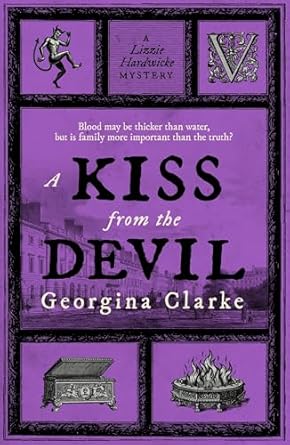
A Kiss from the Devil
In the latest Lizzie Hardwicke novel, a number of threads weave around one another concerning attitudes towards prostitution. In the first place, we encounter a society known as The Devils’ Brotherhood. This is a group of high-ranking men who gather for evenings of debauchery. Although fictious, they are based on the most notorious iteration of the Hell Fire Club operating in this period, whose secrecy and alleged blasphemy were deemed a far greater risk to society than their extravagant orgies. For men of the Hell Fire type, prostitutes were a commodity for their enjoyment. Set against them are the moralisers. My fictious Robert Gregory, stalwart and churchwarden of a fashionable Mayfair church, is typical of those who were members of the Society for the Reformation of Manners, who campaigned for the clean-up of London’s streets – mostly by the forcible removal of street walkers and the closure of brothels. Although the Society was more active in the earlier decades of the century, there were still a few vocal zealots campaigning into the 1760s. For them, prostitutes were vile, diseased, and the agents of their own destruction. A further approach emerges by the middle of the century, led by a real person, Robert Dingley, who set up the Magdalen Hospital, to care for and educate young girls who were on the edges of prostitution. To Dingley and his supporters, these women were victims of poverty as well as cruelty.
Of course, it goes without saying that the women themselves were not consulted to any extent about their lives or motivations. This is where the writer slips in. Lizzie encounters women whose lives are as varied and individual as they are. She has her own story, but in her investigations, she allows the stories of other women to emerge as well. In no small part, A Kiss from the Devil is my attempt to remind readers that the overlooked, the spoken-about, and the voiceless always have their own tales to tell – and that this is true as much in the present as in the past.
A Kiss from the Devil is the fourth instalment in Georgina Clarke’s Lizzie Hardwicke series, published by VERVE Books. The other titles in the series are Death and the Harlot, The Corpse Played Dead and Viper in the Nest. Clarke is also the author of the historical novel The Dazzle of the Light.