
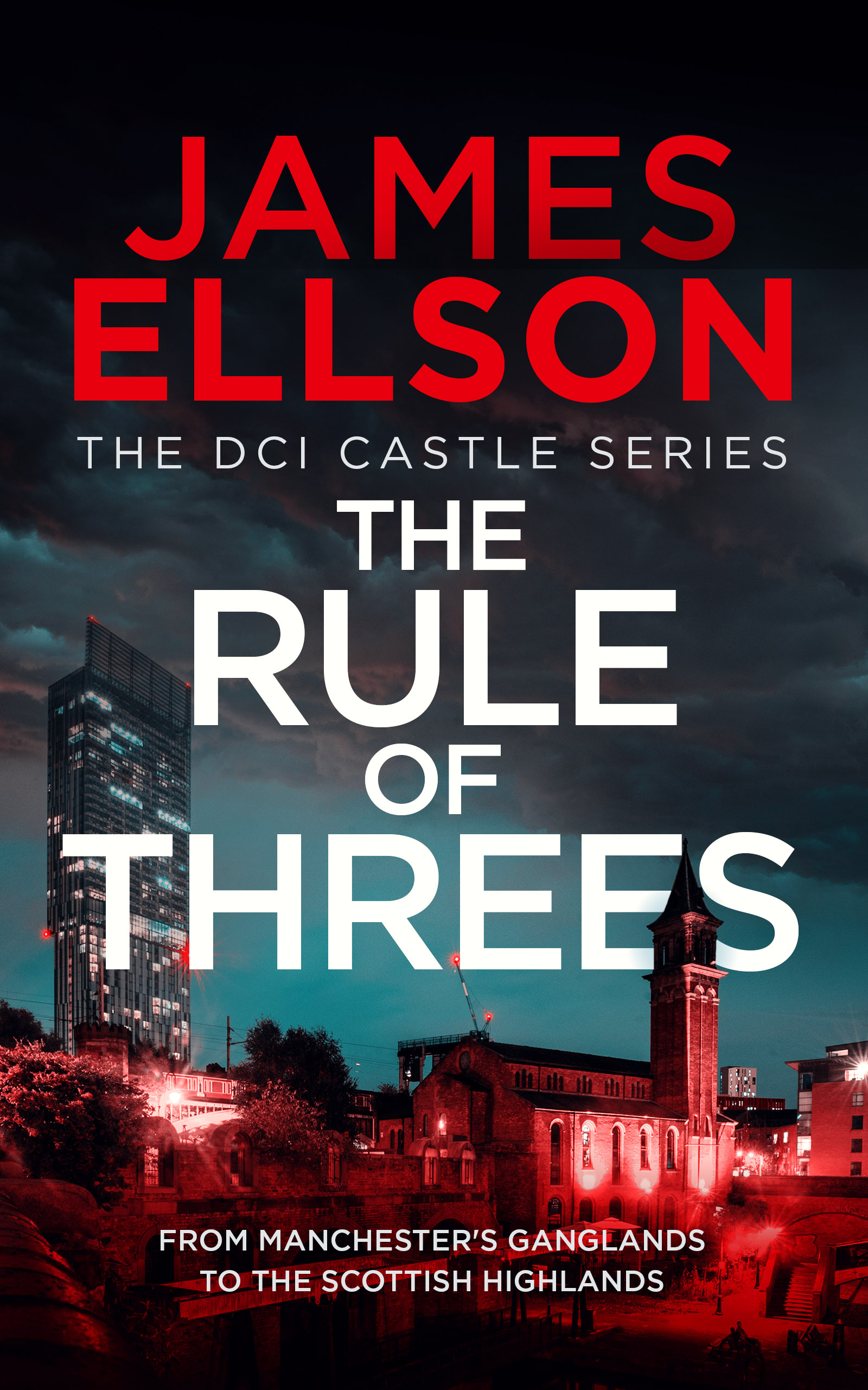
You might have your own understanding of the rule of threes (the page of a whodunnit which reveals the murderer; the structure to write a sentence or tell a joke; the optimum number of reasons to win an argument), but for Manchester DCI Rick Castle, the title of the fifth book in the Castle series refers to a principle of survival – three weeks without food, three days without water, three minutes without oxygen.
The plot of The Rule of Threes centres on a protected witness who’s gone missing. The witness was relocated from Manchester to Northwest Scotland after giving evidence at trial for a member of an organised crime group. The book is predominantly set in these two places, both of which I know well.
I am a keen mountaineer, and together with my wife, am currently climbing the Scottish munros. A munro is a Scottish hill over 3,000 feet, and there are 282. To date, we have climbed 231. Most of our holidays are spent in Scotland, including one in Knoydart where part of The Rule of Threes plays out. I have walked in the hills described in the book, caught the ferry from Mallaig to Inverie, and stayed in the bunkhouse. The first book in the Castle series, The Trail, was set in Nepal, and some readers have told me they read it on a trekking trail in the foothills of Everest. So, you may think a holiday in Northwest Scotland is the perfect place to read The Rule of Threes. It’s a tremendous place for walking and getting away from it all.
I know Manchester from working there as a detective. I was a police officer for fifteen years, starting in the Metropolitan Police in London (working at Kingston, Paddington, and Peckham) and then transferring to Greater Manchester Police, first at Stockport and finishing as a detective inspector (DI) at Moss Side.
Greater Manchester is divided into divisions, and as a DI I was responsible for the serious crimes in my area. Robberies, shootings, gang confrontations, and a lot of suspicious deaths. All the Manchester DIs take it in turns to cover night duty, so when it was my turn, I was the senior detective on duty for the whole city, and spent all night driving from one critical incident too another.
In the end, working at Moss Side finished me! It ended abruptly, and suddenly I found myself on a Monday morning wondering what I was going to do with the rest of my life.
I was given extended leave, and counselling. And we moved to a smallholding, where I started growing fruit and vegetables, and keeping chickens, and bees.
At the same time I started writing, first a memoir called From Cop to Coppicer (unpublished), then a crime thriller. I wrote down on an envelope the three things I knew about – the police, Nepal (which I know from trekking and climbing 6,800 metre Ama Dablam), and beekeeping – and wrote the first in the DCI Castle series, The Trail.
And I haven’t looked back. Cold Dawn and Cold Summer followed to complete the Nepal trilogy, then Base Line set in Manchester about a Russian sleeper cell, and out in July, The Rule of Threes.
DCI Rick Castle leads a small team at South Manchester, the Special Investigation Unit. He utilises the detective method, a process of investigation used for serious and major crime which I learnt as a Senior Investigating Officer, and is taught to every SIO in the country to tackle serious and major crime. The method is based on asking yourself four questions:
What do I know?
What are my hypotheses for what happened?
What do I need to know?
How can I find out?
These questions are employed by DCI Castle in each book, including The Rule of Threes where he harnesses the method to find the missing protected witness. I’ve not seen this in any other crime fiction.
I am not Rick Castle but there are elements of me in him, including his passion for the police (The Job) and its psychological impact.
Rick dealt with seventeen deaths in his first week of nights as a DI, and suffers flashbacks and an obsession with the number 17. He sees a psychotherapist to discuss these and other issues. The facts are different in my life, but the feelings are the same, and I mine my experiences to bring Rick to life on the page. In The Rule of Threes, Rick reports what he goes through to his boss and the CPS, but is picked apart and disbelieved. Starting to doubt himself, he meets with his psychotherapist. She asks about his childhood, and together they discuss the unreliability of memory and the power of suggestion. These scenes at the end of the book are some of the most interesting and affecting I’ve written.
I now wear three hats of smallholder, speaker, and writer. I give talks to U3As, and to book and gardening groups on subjects connected to my three main interests – the smallholding (mainly apples and bees), mountaineering, and writing crime fiction.
I’ve been writing for the same time as I was a police officer, and I feel privileged to have had two careers. There was a tricky change in the middle, but after four or five difficult years, I recovered. I loved being a police officer, and despite everything I went through, I can’t understand why everyone doesn’t want to join. It’s a fascinating job – and career.
I had some exciting moments in the police – discovering breakthroughs after months of work; arresting suspects after protracted investigations; running round in back gardens looking for burglars in the early hours – but I can genuinely say that when I’m writing a first draft, my pulse races and the hairs stand up on the back of my neck.
The Rule of Threes by James Ellson is published by Vinci Books