
My debut series was the six-book Inspector George Zammit crime-action-adventure series set in Malta and the Southern Mediterranean. The first book in the series Bodies in the Water, was published in 2022 and the last, The Car Horn Revolution, in late 2024.

As a new author emerging from the Covid lockdowns, I gave little thought to the first book, save for getting it written. The extent of my ambition was to fill the time in lockdown and endless quarantine, as I commuted between Malta and the UK to support my sick father, write about something that interested me and see the finished work on a bookshelf. If I couldn’t find a publisher, then I intended to self-publish, place the book on my own bookshelf and consider the exercise a success.
I was only semi-aware of the commercial aspects of the book world. Questions of genre, writing to market, cover design and reaching a readership were of little concern to me. The things that interested me were the geopolitics of the Southern Mediterranean and the absurd levels of crime and corruption in Malta, a place to which I had substantially relocated in 2015. These became the dominant themes of the six Inspector George Zammit books.
In Malta, the books were distributed through the main chain of twenty bookshops, where they are still available. Sales have been good by Maltese standards, but the Maltese are generally not a nation of readers (let alone readers of English-language books), so sales rely mainly on expats and the tourist trade. Sales in the UK have been steady, but modest; reviews have been encouraging, but few in number. However, I don’t think this is a unique position to be in, as an author in the middle of the pack.
In any endeavour, you have to ask the question, ‘What does success look like?’
My view changed over time, as I produced more books than I had imagined. So now, four years on, I have seven published books, one ready for submission, and a further two well past the first-draft stage. For this sort of effort, ‘success’ now looks very different. I now consider my writing as a significant part of my life, not a hobby – albeit with long lunches, later starts and more frequent holidays than a full-time occupation!
This realisation coincided with a hiatus in the Inspector George Zammit series. Over the six books, the characters have aged, died, married, and had children, and George, the principal protagonist, has been steadily promoted from a lowly inspector to an assistant commissioner. After book six, I felt the series had largely run its course. The characters had developed to where I wanted them to be and I had explored most of the themes that interested me.
My conclusion is that the first series of crime and adventure books may have kept me entertained, but I was writing about things that interested me, rather than things that might interest me and a wider readership.
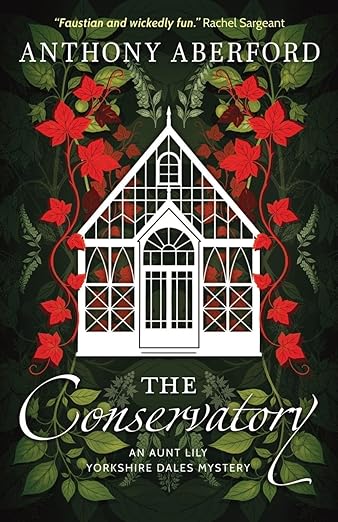
The Conservatory, my latest book, is the first of a trilogy which makes up the Aunt Lily, Yorkshire Mystery stories. What caught my attention was the growth of the ‘cosy crime’ genre, and, using that basic format as a starting point, I wondered how far it could be pushed to still fit within that space while still providing me with the opportunity to write something that would fulfil my own ambitions. The result has been described as a book that is ‘genre-bending’ or in the ‘braided-genre’ category.
In defining the cosy format, there are a few well-known basic parameters: no bad language; no gory crime scenes or graphic violence; a small community setting, with amateur sleuths; justice must be served and a clear line drawn between right and wrong.
So in The Conservatory, several additional aspects are introduced to add peril, tension and a bit of ‘bite’ to the plot. A killer conservatory with sentient, toxic plants claims its victims – but very much along the lines of Little Shop of Horrors! There are elements of witchcraft and the supernatural, but it leans more towards ‘magic realism’ than horror. There is the threat of dark forces from other worlds, although any similarities with a Young Adult magic portal plot are assiduously avoided. All this takes the traditional ‘cosy’ into different territory. Add to that a parallel historical thread from the 17th century, and there’s a story which was fun to write and landed a book in, or near to, the cosy space, but very different from the Inspector George Zammit’s crime and adventure series.
The tone is light, and humour is present throughout, making for an easier read for the more ‘nervously inclined’. The central character, Aunt Lily, is a woman of a certain age, swathed in charity shop woollens, who travels by adult tricycle and survives solely on a diet of cake. She joins a group of female friends who run the local wellness centre, as a homoeopath. Together, they investigate the death of a colleague in her conservatory and the mystery surrounding a 16th-century book of natural remedies and medicines, which also contains dark material that has made it sought after by various parties over the centuries.
I also took more time and had a bigger input into the design of the cover, which stands in stark contrast to the Detective George Zammit covers (see example below).
They say you should write what you know, so I was keen to set the new series in Yorkshire, where I still have a home. I also wanted the new series to have more female voices. So, the story has strong themes of female friendship and betrayal. The use of a wellness centre and its practitioners also brings into play the broader subject of various healing traditions and health-supporting practices that exist outside conventional Western medicine. Again, this allowed the plot to explore women’s role in healing from the dark times of the 17th century witch trials through to the work of the contemporary practitioners in the story’s wellness centre.
It is difficult at this point to discuss the plot further without giving away spoilers regarding The Conservatory or the rest of the series. However, the story features characters not from this world and ultimately revolves around control of a passageway between realms. As mentioned, the risk here was that readers might feel they’re being led into a Young Adult fantasy portal story or a tale in the horror or witchcraft genre, which was absolutely not my intention.
Rather than a simple contest between the forces of good and evil, with demons and horned devils lurking, waiting to pounce, I was more interested in developing a world drawing on the stories that every culture has about complex supernatural beings that can exist alongside us, as told in myths and legends.
The Jinn, as referenced in the Quran and the Hadith, live in communities, have free will and a quasi-human existence. In the complex Japanese mythology, before the gods took recognisable form, existence was a formless void. The gods stood on the Floating Bridge of Heaven and stirred the primordial ocean with a jewelled spear, creating the first island, from which all else flowed. Then there is the pantheon of Norse Gods that dwelt in Asgard, one of the nine worlds held together by the cosmic tree, Yggdrasil, while, arguably, Siberian and Central Asian shamanic cultures have the deepest and most direct supernatural worldview. And this is to ignore the stories and myths from the southern hemisphere.
Over the series, the friends encounter forms from one such parallel realm who, to use the sci-fi phrase, ‘walk amongst us’. The reader has to guess which character belongs with us and which belongs elsewhere!
Finally, I had to address the question of pen names. For various reasons, I wrote under the first series under the name AJ Aberford, and over the last four years, I have built a decent number of followers on social media, which is my main sales channel. I was concerned that introducing a new and very different series might surprise some readers expecting another crime-and-adventure book. But I was also loath to start again from zero on a new series of social media accounts. The best solution seemed to be to slightly change the name to Anthony Aberford while continuing to use the existing social media accounts.
The editor being willing, I will report back in twelve months or so to say whether this move from crime-adventure to cosy mystery has been a success and share the experience.
The Conservatory by Anthony Aberford was published on 21 April, 2026.