
I’ve always loved telling stories. When I was seventeen, my English teacher, Mrs Bain, told me I shouldn’t go to law school but become a writer instead. Delighted, I ran home to announce my new career plans.
So, anyway—after forty years as a defence lawyer, all I can say is that if I hadn’t listened to my mum, I’d be a lot poorer now and would have very little to write about.
One great advantage of a life spent in the criminal courts is that it makes writing about them that much easier, and there is a certain overlap between creating works of fiction and making legal submissions.
It was on my return from court one lunchtime that I was relaying the more entertaining aspects of the day’s events to some younger colleagues when one of them suggested I should write a book. The difficulty with that, I thought, was client confidentiality. If I wished to retain both my Law Society practising certificate and my kneecaps, non-fiction was out of the question.
So I decided to write from the point of view of a fictional defence lawyer who, purely coincidentally, handled cases remarkably similar to my own, but sufficiently camouflaged not to breach solicitor-client privilege or place an undue burden on the local A&E department.
As a long-time reader of crime fiction, I was influenced by writers who understood voice and character: John Mortimer and the humane irony of Rumpole; the moral clarity of Raymond Chandler’s Philip Marlowe; Michael Connelly’s procedural realism; and P. G. Wodehouse, with his perfect comic timing. All confirmed to me that commercial fiction could carry serious ideas lightly, and that entertainment and depth were not mutually exclusive.
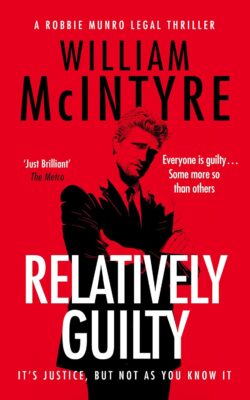
Taking this on board, I wrote Relatively Guilty: a story about Robbie Munro, a legal-aid lawyer in Linlithgow, a small town in Central Scotland, juggling numerous cases. Like Robbie, I practised in a small town, but over the years dealt with many serious and high-profile cases, most involving clients from well beyond my locality. When buying a house or making a will, people go to the nearest solicitor. When their liberty is at stake, they will travel.
Realism is important to me, but it makes writing crime harder, and I envy writers who, unencumbered by reality, can charge through a novel leaving law and procedure in their wake. But the public have a perceived notion of realism. I learned this when, armed with an inappropriate level of self-confidence and buoyed by a complete lack of understanding of the publishing industry, I sent the manuscript to a publisher and promptly encountered a problem. Fact, it seemed, was often stranger than fiction. Of the three main plotlines in Relatively Guilty, the two based on real cases were considered “too far-fetched”, and yet crime fiction was crowded with serial killers, last-chapter confessions, and suspects being asked where they were on the night of the twelfth without so much as a caution being administered, none of which appeared too far-fetched for publishers, despite being extreme rarities in real life.
From this early experience I developed the habit of including an author’s note at the end of each book explaining what lay behind many of the plotlines. Without it, scenarios such as Robbie Munro being asked by a client to remove a curse, or to advise, in his professional opinion, on the best way to commit the perfect murder or dispose of a body, might have sounded implausible.
Like the rest of the (so far) sixteen-book series, Relatively Guilty is narrated by Robbie Munro. So who is he? Well, Robbie is a character who emerged naturally from my background. He is not my alter ego, but a distillation of qualities I have observed in colleagues over the years: resourcefulness, stubbornness, moral compromise, eternal optimism, and the ability to struggle on in a system that offers little recognition, while still finding humour in the bleakest of situations.
To borrow Pontius Pilate’s words from the best-known trial of them all, Quid est veritas? Robbie understands that in court the truth is negotiable, shaped by rules of evidence and the burden of proof.
If the series has underlying themes, they are that justice is not only about the guilty being convicted, but about the innocent being acquitted; and that law and justice are two jellies not easily pinned to the wall with the same nail. If the law today is not necessarily the law tomorrow, what’s justice supposed to do in the meantime? That’s why Robbie retains his own peculiar view of how Lady Justice’s scales ought to swing.
While Robbie’s working life is steeped in crime and conflict, his personal life is where things lighten up. Across the series, his relationships provide relief from the courtroom, as well as a fair amount of trouble of their own. His chaotic love life, eventual marriage, and the realities of domestic responsibility run alongside the day job, while his ex-cop father looks on disapprovingly at a son trying to keep people out of jail after spending his own career trying to put them in.
I have been criticised, perhaps rightly, for once letting it slip that the Robbie Munro books are, in part, my antidote to maverick cops with personality defects, driving interesting motor cars while chasing serial killers. But I do think the genre could do with a few more books written from the other side of the criminal justice fence. Robbie may be, as one reader described him, “abnormally normal for crime fiction”; nonetheless, he embodies the only firewall between an accused person and the full might of the state. His job is not to uncover truth in the philosophical sense. It is to do the best for his client—and that usually means winning.
‘Relatively Guilty’ by William McIntyre is published by Vinci Books.