
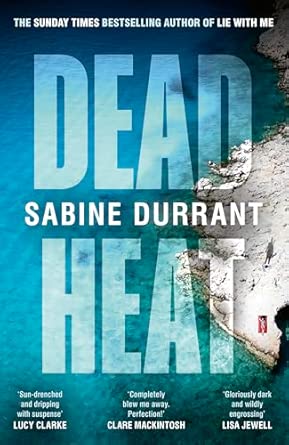
Sabine Durrant’s new novel Dead Heat is her seventh and it’s a brilliant slow burn thriller. Set in the claustrophobic heat of the Mani Peninsula in Greece during a sizzling summer. This psychological drama delves into the lives of wealthy elites, the power of money and buried secrets.
The novel’s mise-en-scène prologue opens on a trial narrated by the protagonist, Matt Grimshawe. Durrant doesn’t give much away here, but entices by interspersing apparently innocent details with hints of tragedy. The prologue doesn’t overstay its welcome; after two pages we are transported back in time to the Mani, where Matt has just arrived ahead of he friends he will be staying with.
Matt Grimshawe, 51, has just lost his job as a journalist and has also broken up with his long-time girlfriend. He is immediately a pitiful and relatable character, seeking sunshine and solace in the rickety cottage on the grounds of Villa Mimosa, owned by his wealthy best friends: Celia and Adam Murphy. This peaceful isolation is quickly thwarted by loud, extravagant parties taking place in the huge house nearby. When Celia and Adam join Matt at Villa Mimosa, they discover the owner of the new house is one of Adam’s old schoolmates, Reynash de Souza, whose sudden success has made him filthy rich.
Jealousy brews as Reynash gets closer and closer to the family, in particular with Celia, who is the centre of both Adam and Matt’s affections. Matt finds himself in the middle of a tense feud; at the same time discovers something suspicious about a recent missing person case, connecting it to de Souza. Suddenly his concern over Celia and Adam is justified; they might genuinely be in danger. As the Murphy family falls apart, Matt has to choose where his loyalties lie, and how far he’ll go to protect the ones he loves. It isn’t easy when those loved ones are as reckless and superficial as the Murphys, but Matt isn’t as downtrodden and submissive as he seems.
Dead Heat’s biggest strength is its characters. All of them are deeply unlikeable, and yet their attempts at human connection and familial stability are easy to sympathise with. Celia’s shallowness is at times infuriating, but her religious determination to keep her family together is admirable. Matt is desperate to do the right thing and desperate to be loved, but his unwavering loyalty to the Murphys drags him down a dark path. Adam is the most overtly unpleasant: often throwing casual bigotry into conversations, using Matt as a cover for his secrets, and repeatedly seeking relations with younger women. Still, I couldn’t help but become attached to this group of friends, especially since they aren’t quite as simple as they seem.
Durrant is excellent at immersing you not only into Matt’s life, but into his mind and body, to the point where it sometimes feels like your own thoughts are inseparable from his. His self-consciousness brilliantly juxtaposes the Murphy’s shallowness. His constant excuses for their behaviour are at times frustrating, and you’ll find yourself questioning why he gives so much of himself to these people, but as Durrant masterfully shows how entangled their lives are, Matt’s reasons are sad but understandable.
Dead Heat is pacy and immersive, with tight structure and complex characters. Its setting and characters are reminiscent of Rian Johnson’s Glass Onion, but grounded in realism rather than spectacle. It’s full of longing, resentment and riddled with Catholic guilt, culminating in a Gatsby-esque tragedy under the scorching Greek sun. Its exploration of wealth and class enriches the story and stops it from flying out of control, and the ending is a bittersweet twist. I found my heart literally pounding during several scenes. It’s truly an excellent thriller; if you like sun-soaked beaches, dangerous rocky cliffs, and lavish parties, you’ll probably love Dead Heat.
Dead Heat is published by Century