
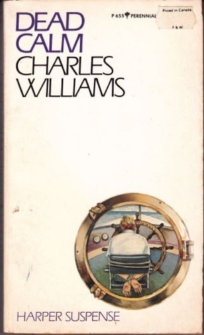
Dead Calm, the 1963 novel by Charles Williams, is a fabulous book, yet it seems to have sunk from view. The 1989 film adaptation starring Nicole Kidman is relatively well-known, but it departs significantly from the book’s story. Cineastes will know that Orson Welles attempted to make a film called The Deep, which remained unfinished, but few will realise that it is based on Charles Williams’s novel. Currently the book is out of print. Therefore, let’s celebrate it! It is one of those great works that combines a taut thriller plot with great depth and indeed a philosophical dimension, and alongside Jack’s Return Home by Ted Lewis it is the best thriller I have ever read.
Charles Williams himself came to writing late. He had served in the US merchant marine and wrote with complete authority about the sea. He loved Conrad, and like Conrad he came to writing late after a career at sea. Much of Dead Calm is about the nature of action which is a prime Conradian concern. By the time he wrote Dead Calm, Williams was a successful thriller writer. Overall he sold millions of copies of his twenty-three novels, nineteen of which were translated into French, but his career declined before the end of his life, and he died by suicide.
Yet there is nothing depressive about the main characters and how they power the plot of Dead Calm. The book starts with John Ingram and his wife Rae on their honeymoon on their yacht, the Saracen, en route for Tahiti but happily becalmed in a spot in the Pacific where privacy ‘was measurable in millions of square miles.’ The word newlyweds isn’t appropriate as they have significant backstories, Ingram with the tough life of a professional sailor and Rae with two past marriages and a son who died. But they are happily alone. Then their idyll is intruded upon by another yacht, from which a strong and good-looking young man, Hughie, rows to them.
With alarming speed, Ingram finds himself trapped on the other yacht, while Hughie overpowers Rae and, using the motor, speeds off in the Saracen. Ingram is unable to follow because the boat he finds himself on, Orpheus, has run out of fuel and is sinking because of dry rot. Both are due to Hughie’s inept seamanship. But the psychodrama Ingram finds himself in is more alarming than the physical reality.
He initially thinks Orpheus is empty, but then discovers Bellew, a tough Normandy vet whose sardonic nihilism dampens his effectiveness, and Lillian, Hughie’s older and nervously-afflicted wife. The two are in a state of inertia and will do nothing to save themselves, being locked in a conflict that has already claimed the life of Bellew’s wife. Hughie has fled to the Saracen because he has snapped under the pressure of this conflict. His desperate motoring off is pointless because he has no idea of where he is going and the fuel will soon run out. But he is physically strong and is in physical command of the boat. Rae cannot appeal to him in any logical or reasonable way. That said, being far gone in his inner world, there is no sexual threat from him. But she has to turn him and the boat around within hours, because once the fuel tank is empty there will be no way back to Ingram.
Therefore, husband and wife find themselves on different boats, unable to reach each other (radio, navigational aids, repairs and fuel supplies are all unavailable, and there is no external help). But they love each other, and with great ingenuity and effective action, one step at a time, they set out to get back to each other. I won’t give away the plot, but it is tight, convincing and exhilarating. While Ingram is a man’s man, most of the action is propelled by Rae.
Many crime novels are about unreasonable people taking extreme and unreasonable actions; that could be a definition of crime. Dead Calm, which places reasonable people in a situation that forces them into potentially fatal action, is the reverse. It is ultimately about value in a positive sense. The actions Rae and Ingram take, independently and with no recourse to each other, demonstrate that they and their marriage are valuable. In contrast, Bellew’s nihilism and Hughie’s mental collapse have nothing but destructive consequences.
One of the conceits of nihilism articulated in the novel is that somehow the nihilist is wiser than others, that they can see the supreme pointlessness of existence, while dumb conventional schmucks naively plod through their meaningless lives. The triumph of Dead Calm is that there is nothing naive about the book, which encompasses true blackness, both existential and nihilistic, yet the action shows that positive, reasonable, humane action can win and that what it can win is worthwhile.
The title of the novel has a double meaning. Yes, it signifies the two boats that are each becalmed, but it also expresses the dead calm by which the Ingram and Rae work systematically to get back together without being overwhelmed by the horror of their situation. As Ingram puts it, ‘If he lost his head, he’d have no chance at all.’
Will Fraser’s novel Cloister is published by New Generation Publishing.