

In 2023 I was lucky enough to have my book Opera listed for the CWA Ian Fleming Steel Dagger. It didn’t win, that accolade went to Agent Seventeen by John Brownlow, but I found myself in illustrious company. The book, the third in the Whitehall Trilogy featuring civil servant Cassandra Fortune, owed something to the plot of the opera Tosca by Giacomo Puccini, a performance of which features in the novel.
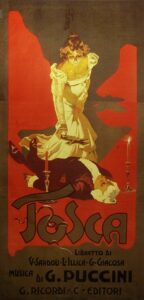
Original poster for the Opera
Opera, both my book and the musical form, depicts many types of crime. Indeed, romantic, sometimes tragic, love stories aside, I’m hard pressed to think of an opera which doesn’t include a crime of some sort. Tosca has everything; the vicious crimes of a police state, torture, murder and the final act of suicide. Don Giovanni happily goes around killing people in duels and there’s an assassination in Rigoletto. Multiple murders occur in Shostakovich’s Lady Macbeth of Msentsk. Serial killers lead in Bluebeard’s Castle by Bartok and Lucrezia Borgia by Donizetti and Jack the Ripper himself is the killer of the protagonist in Lulu by Alban Berg.
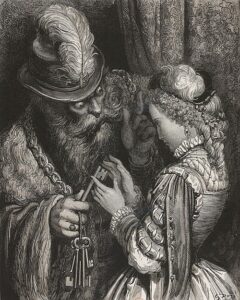
Gustave Doré illustration of Bluebeard and his wife for Charles Perrault’s La Barbe bleue
If you want psychological drama leading to multiple deaths, it would be hard to beat The Dialogue of the Carmelites by Poulenc, set in a nunnery during the French Revolution. In a different key entirely, an opera like Brittain’s Peter Grimes shows how small-town rumour and accusations of murder after the death of an apprentice boy impact upon the ‘loner’ Grimes and leads to more death.
What operas don’t have, by and large, is detection, official or otherwise. So, in Tosca Baron Scarpia is obviously the villain and everyone knows it (he’s the chief of the secret police!). Sparafucile, the assassin in Rigoletto, is a professional; we know what he does (and will do). It’s true, however, that Britten is much more ambiguous, so we don’t know what actually happened to the first apprentice in Peter Grimes and there is suspense and doubt in The Turn of the Screw. Likewise in the Poulenc.
There is, of course, The Makropolous Case by Janáček, which begins with a disputed lawsuit involving a missing will, becomes about coercive relationships and is resolved by the discovery of a three-hundred-year-old protagonist. In Dolores Claiborne by Tobias Picker, based on the 1992 novel by Stephen King, the eponymous Dolores is questioned by police as the main suspect when her wealthy employer, Vera Donovan, dies. It too has abusive relationships, a murder (though not of Vera) and a solitary and sad central female character. The police appear in both these operas and also in the aforementioned Lady Macbeth of Msensk, whose protagonist ends up in a chain gang, though there isn’t a lot of detection going on in that one.
In opera buffa, the light Italian comedies of Donizetti, for example, there are also crimes, admittedly more minor ones. I’ve been working on L’Elisir d’Amore recently, acting as historical consultant for a recent production at St Paul’s Opera in south London, which has been tremendous fun, but it too includes crime, in this case the fraudulent elixirs of Dr Dulcamara. The travelling conman, selling various forms of fake medicine or ‘cure’, is a stock character across theatre and film (see Wilson’s The Music Man or Gilbert & Sullivan’s The Sorcerer). His fate varies, from becoming part of the community he initially attempts to bamboozle (in the former), to entering the fires of hell (in the latter). Dulcamara, on the other hand, gets away with it, mainly because his ‘elixir’ appears to have worked. One of the biggest laughs of the whole production came, nightly, when the good doctor proclaimed that, not only did his elixir bring the hero love, it also made him rich (a convenient legacy has arrived).If you’re interested in my experience watching an opera take shape you can read my Rehearsal Diaries on my website at Rehearsal Diary – Julie Anderson
If it’s thievery you’re looking for in opera try La Gazza Ladra (The Thieving Magpie) by Rossini, or, on a much grander, darker scale, Das Rheingold by Wagner. Attempts to retrieve the gold stolen from the Rhein Maidens therein form the basis for the whole Ring cycle. Then there are the crimes of passion, in tragic romances like Pagliacci by Leoncavallo which has a double murder during a stage performance. Everywhere you look in opera there are crimes, of all varieties, from the blood thirsty (the walls of Bluebeard’s Castle literally ‘sweat’ blood) to the jolly, apparently successful, con artistry of Dr Dulcamara, and I haven’t even mentioned the operatic interpretations of Shakespeare, Goethe or traditional myth and legend.
Long may it continue. Bravi tutti!