
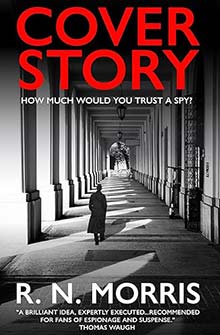
Life hasn’t been kind to Col Newton. His fleeting moment of literary celebrity has long faded, and he’s living in a dismal bedsit with millennials half his age. When his old university pal Chris Lazenby turns up offering him £50,000 to write a novel, it seems too good to be true. And that’s because it is.
Lazenby works for MI6, and he has an agent posing as a writer. But the agent can’t actually write, so Lazenby needs a professional writer – ideally talented but also desperate – to write the agent’s next novel for him. Who better than Col Newton?
Freed from the pressure of writing for publication, Col finds himself liberated and producing the best work of his career. The only problem: he can never publish it under his own name. Oh, and all the people around him who start meeting with mysterious deaths. Soon Col realises the stakes are much higher than his literary reputation.
Col is an archetype familiar to readers of espionage fiction, the friendless everyman out of his depth who can survive only through his own ingenuity and courage (both in short supply). But he never feels like a stock character. His wry self-awareness and bleak humour make him both highly individual and deeply memorable. R.N. Morris has expressed his admiration for Eric Ambler, and the line of descent is clear, and it’s a compliment to Morris that he doesn’t suffer by the comparison.
The supporting characters are equally strong. Lazenby’s louche public-school amorality rings all too true to anyone who lived through Boris Johnson’s premiership; Irish love interest Jeanette (“he couldn’t make up his mind whether he thought she was amazing or appalling”) makes a wonderfully idiosyncratic femme fatale; and if Col’s millennial flatmates are indistinguishable from each other, well there’s a reason for that too.
The novel drips a wry humour that puts the reader in mind of Mick Herron, particularly when paired with the seediness of the London milieu. And if you like Slow Horses, then Cover Story is definitely one for you.
Published by Sharpe Books
Review by T.M. Stretton