
Books
Click on any of the books covers below to either buy or get more information on Amazon
Articles
Click on the links below to read the full article
Book Reviews
Author Interviews
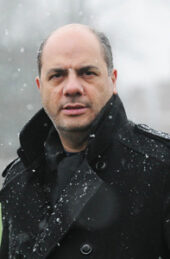
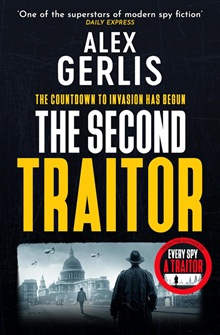
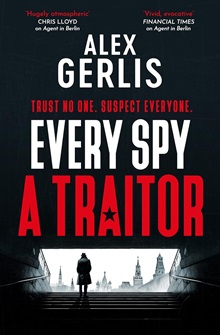
Alex, this is the second novel in the series. What has happened since the end of Every Spy a Traitor and the beginning of The Second Traitor?
The most important thing which has happened is that the Second World War is now underway – the first book ends on the day Chamberlain announces we are at war with Germany. Aside from the odd flashback, this book begins in the autumn of 1939 and the main action – two thirds of the chapters – are set in 1940.
The Second Traitor is set in during 1940, a difficult year for Britain. What kind of research did you carry out to understand the country when the threat of invasion was very real?
All my novels are set against real historical events and my research in that respect is based around studying those events in as much detail as possible. In the case of The Second Traitor, the historical backbone of the book is the planned German invasion of Great Britain. This was the subject of a Hitler Directive in July 1940, though in truth the planning for Operation Sealion as it became known began much earlier than that. It is easy to underestimate the significance of the planned Nazi invasion: the Battle of Britain was closely related to it because the Kriegsmarine – the German navy – refused to countenance an invasion until the threat of RAF attacks on their convoys was eliminated. So, in a very real sense, the Battle of Britain was not just about protecting our skies, but our seas too.
I think Sealion is significant too because perhaps for the first time in the war, Hitler’s authority as a military strategist was questioned. Very few senior officers in Germany were confident about a plan to transport thousands of barges carrying around 100,000 troops and thousands of tanks and other vehicles across the North Sea and the Channel. There was a lot of relief in Germany when Sealion was allowed to fade away in the autumn of 1940.
I was very pleased to discover a real organisation which very few appear to have heard of called the Invasion Warning sub-Committee, which was based in the Old War Office Building in Whitehall (now a luxury hotel), so I was able have my main characters working for this organisation.
In terms of actual research, I spent an interesting week in Hamburg which is where the Abwehr – German Military Intelligence – based its espionage operation which was aimed at sending spies over to this country to gather intelligence to assist an invasion. Every one of these agents – all of whom were second-rate, poorly recruited and badly trained – was captured and either executed or turned into a double agent to work for the British. The actual building where the Abwehr was based – on General-Knochenhauer-Strasse –was also the German Army HQ for the area and still exists, unscathed from the war. It has recently been turned into luxury apartments. I did manage to get in, but let’s say that my visit didn’t last long.
My other main research trip for this book was to Rotterdam, which was going to be the main German base for the invasion of Great Britain. Rotterdam is an enormous port and was ideal for gathering barges from across Europe, converting them to take tanks, armour and equipment and store them until the invasion was ready.
While in Rotterdam I was particularly interested to visit Heemraadssingel – a very pretty road with a canal running through the middle of it and weeping willows on either side. On this road during the war was both the HQ of the German Navy and the Rotterdam Gestapo. Both feature in my book.
What is The Group?
The Group is a fictional organisation of British and Irish Nazi sympathisers, a fifth column operating within the UK to assist the Nazis in gathering intelligence. It is based on the fact that there were hundreds, if not thousands, of Nazi sympathisers, especially in the early stages of the war. The existence of these people is well-documented – I recommend Nazi Spies & Collaborators in Britain 1939-1945 by Neil Storey.
This raises an interesting question around opposition groups in the country. The Battle of Britain was still raging, and we assume the entire country was in full support of Winston Churchill. Was that the case?
Broadly speaking, I think it was – with the exception of a very small number of people like the ones mentioned above. There was of course political opposition in Parliament, but I think it would be a big mistake to suggest that Churchill lacked anything other than overwhelming support throughout the country. Worth mentioning, of course, that the British Communist Party did back the Nazi-Soviet Pact in 1939!
What prompted you to include an Irish element to the story?
Irish Republicans and the IRA in particular took the view that ‘my enemy’s enemy is my friend’. The British were the sworn enemy of the IRA, which was committed to an armed struggle to bring about a united Ireland. They felt that this could be achieved if the British mainland was invaded and occupied by the Germans who they hoped would then allow a united Ireland, especially if the Republicans had been helpful to them. There may have been a good deal of wishful thinking here, but there’s no doubt that there were links between the IRA and the Nazis – their former Chief of Staff Seán Russell travelled to Germany to be trained in Hamburg as a Nazi agent and then sent back to Ireland to infiltrate the British mainland. Russell and another IRA member – Frank Ryan – were travelling on a U-boat when he died on the journey, most probably from a burst ulcer. Astonishingly, there’s a memorial to Russell in a Dublin park, even to this day.
‘Archie’, our Soviet spy and British traitor from the first novel remains a threat, but there is a new one on the scene, ‘Bertie’. Is this spy ring inspired by the Cambridge spies?
Only in the sense that they’re traitors – especially Archie, Bertie’s is a more complicated situation. I’ve not consciously tried to copy the story of the Cambridge spies who, in any case, were more of a spy ring, which is not the case here.
Is there anything about espionage during this period that we’d recognise today?
Only that human intelligence and the intuition with which intelligence officers need to operate is still very important, even at a time when technology would sometimes seem to have become more important.
When during the Second World War will you set the third novel?
It’s mostly set in 1945 as the war draws to a close. The main ‘action’ takes place in northern Italy (in the first part of the book) and then in Berlin where the race to the German capital is won by the Red Army but the British know they need to have a presence in the city as they anticipate what became the Cold War. The final book in the series will cover the start of the Cold War in Berlin.
You’ve written many bestselling novels now. Do you have a favourite?
The Second Traitor is my 13th book so that’s a hard question – I have to say I’m pleased with all of them: there’s not one which I look back on now and think I wish I’d not written it like that. The Best of Our Spies – my first novel – has sold over 150,000 copies and been optioned for the screen too, so I’d have to say that one probably.
Have you planned your next series?
Only that I’m not sure I want to write another four-book series again – keeping key plotlines and key characters going through four books while at the same time keeping the books fresh and engaging in themselves, is a big strain. I appreciate how publishers like series but, personally, I’d like to do a one-off next, maybe with a possible follow up.

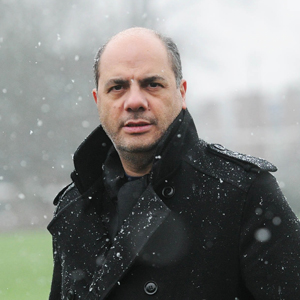
Alex Gerlis was a BBC journalist and is the author of The Second Traitor, the latest in The Double Agent series.
Oliver Webb-Carter is the Editor and Co-Founder of Aspects of History.
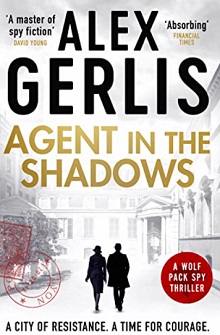
Alex Gerlis, Agent in Berlin opens with the attack on Pearl Harbor – you’ve described it brilliantly – did your research provide you with first-hand accounts of this shocking event?
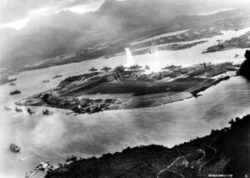
Photograph taken from a Japanese plane during the attack on Pearl Harbor.
With Pearl Harbor I was more concerned to get the details of the day correct, especially the chronology and the names and locations of the ships that were hit by the Japanese. I try to avoid eyewitness accounts of specific events because I’m always concerned that I could subconsciously use those experiences instead of those of the characters in the book. I relied on my imagination for much of this chapter, helped and inspired – by my research.
The 1936 Olympics also features. We now view it as unprecedented, a blatant propaganda exercise by Hitler. Was that how it was viewed both prior and during the Games?
My sense is that most of the participants probably realised they were being ‘played’ but didn’t really care too much about it. They were most likely just grateful that the Games were well organised and with state-of-the-art facilities. Unfortunately, we’ve seen that too often with events like the Olympics and the FIFA World Cup, where the organisers and participating countries seem happy enough to turn a blind eye to the excesses of the host country. After all, a year from now the World Cup will be taking place in Qatar, of all places.
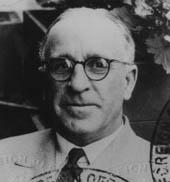
Frank Foley
Frank Foley was an amazing man, could you tell us a bit about him?
He really was quite an extraordinary man. He rose from a fairly humble background in Somerset to become an officer in the First World War and in the 1920s joined MI6, eventually becoming the head of the MI6 station in Berlin. He remained in that post until the war began, by which time he’d issued thousands of visas to German Jews desperate to leave the country – it’s estimated he saved 10,000. He was helped in this by his cover in Berlin, which was running the Passport Control section of the British diplomatic mission, which was on Tiergartenstrasse. He was expected to do this job in addition to his espionage duties. Foley also had to deal with the negative attitude of the embassy in Berlin and the Foreign Office, which was probably a combination of snobbery and an establishment disdain for espionage, unless it was to deal with communists. Frank Foley died in 1958 at the age of 73, long before his work in the 1930s became public.
The plot of the novel is set around the development of the Focke-Wulf 190 – what was the potential of this aircraft, and how could it have changed the war?
The development of the FW 190 is one of the plots of Agent in Berlin and I’d be wrong to set myself up as a military aircraft expert. I was more interested in the plane as a device for espionage rather than go into detail about its capabilities, but as I understand it, air forces took the view that they should not rely on just one model of aircraft – so the RAF had the Hurricane and the Spitfire and the Luftwaffe felt that as successful as the Messerschmitt 109 was, they needed an alternative to it too.
FC Schalke 04 was the Bayern Munich of the day, but interestingly Bayern (nowadays the archetypal Bundesliga club – hugely successful, both domestically and in Europe), at the time it was viewed very differently by the Nazi leadership, despite many of them having Munich connections. Why was that?
Bayern Munich certainly wasn’t the archetypal German club under the Nazis: 1860 Munich was the club which attracted the support of the Nazis. Although Munich didn’t have an especially large Jewish population Bayern did have strong Jewish connections and was called the Judenklub or ‘Jew club’ by the Nazis. The club had a Jewish president – Kurt Landauer – and two Jewish coaches, Richard Dombi and Otto Beer, all of whom fled to Switzerland after the Nazis came to power.
There’s rigidity in the upper or upper middle classes that you capture well in the novel – was it a challenge to get that detachment and formality right during the writing?
It is a challenge but then it’s a challenge to make all characters feel authentic. I think this is especially tricky when the story is set some eighty years ago. If the setting was hundreds of years ago that would be one thing, but with it being in the relatively ‘recent’ past I think it’s especially challenging because the reader will quickly sense if the dialogue is not quite right – they’ll be more or less familiar with the type of language used, even if they can’t quite put their finger on it. The challenge for the writer is to try and set the dialogue in that period without it coming across as parody. My background as a television producer helps, I’m quite comfortable writing the spoken word. I’m constantly checking and re-checking what I write to root out what I’d describe as contemporary language.
Pearl Harbor resulted in Hitler declaring war on America – but do you think if he hadn’t done that, America would have limited their involvement to the Pacific, thereby leading to a major problem in the European theatre?
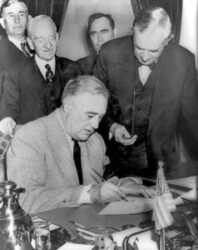
Roosevelt declares war on Germany.
I know less about the Second World War in the Pacific than I do about it in Europe – where all my novels are set. Having said that, I wonder if the United States would have entered the war at all had it not been for Pearl Harbor? It’s important to remember that while President Roosevelt was in favour of entering the war, that was not the majority view in the USA at the time. There is a theory, which is unproven but which I do allude to in Agent in Berlin, that Roosevelt knew about the attack on Pearl Harbor but was prepared to let it go ahead so as to give him an excuse to enter the war. The decision to enter the war in Europe was really taken out of Roosevelt’s hands when Hitler declared war on the USA on 11th December, just a few days after Pearl Harbor, which is regarded as a big error on Hitler’s part.
Many events are well-known to readers – how do you keep the story exciting when the reader knows the Allies win?
Good question and it probably goes to the heart of why the Second World War has such enduring appeal in terms of literature and TV/film so long after the event. I think that the fascination the war holds for readers is not the eventual outcome as such, but more the stories of what happened during it. I always look for one or two real events that happened in the war for my stories and build the plot around them, sticking as closely as I can to known facts. I’d hope that the excitement comes from the plot and the storylines and an uncertainty about the fate of the main and the secondary characters. That latter point is an important one: I don’t believe in comfortable and convenient endings; my stories don’t end happily ever after – mainly because life’s not like that.
Were there any books you used for research that you’d recommend to readers?
I’ve not dared count how many history books I have in my study but it has to be hundreds and I’d say that for each novel I use around a dozen all the time. I also have around twenty ‘reference’ books on WW2 which I refer to constantly. A few random titles from that stack of books … The Second World War (Antony Beevor); History of the Gestapo (Rupert Butler); World War Two Infographics (remarkable French book published in UK by Thames & Hudson); British Aircraft of the Second World War (John Frayn Turner); Total War (Calvocoressi/Wint); Berlin at War (Roger Moorhouse) and the official histories of MI5 (Christopher Andrew) and MI6 (Keith Jeffrey) – but there are literally dozens more. I also have half a dozen original Baedeker Guides from the 1930s, which are invaluable to my research – and my extensive map collection from that period, some originals, some reproductions.
Which other espionage writers inspire you?
I read less WW2 espionage fiction now because I worry about sub-consciously absorbing plots and characters – plus I spend so much time reading non-fiction books on the war. But I’d unhesitatingly name two other espionage writers: John le Carré and Alan Furst. Le Carré is unquestionably the master of espionage fiction, though of course he never set any of his novels in the Second World War. Alan Furst writes beautifully about Europe before and during the war. Midnight in Europe in particular is a magnificent book.
I’d like to mention two other books which have had a profound effect on me, even though neither comes into this category. Man’s Search for Meaning (Viktor Frankel) – the experience of the time this very eminent psychiatrist spent at Auschwitz and The Ghetto Speaks (Marek Edelman). I have a personal connection with the Warsaw Ghetto as we’ve relatively recently discovered that a cousin (and not that distant either) was a fighter in the Uprising and almost certainly was responsible for killing the first German troops in it. This book is the account of the Uprising by one of its leaders, one of the few to survive. Marek Edelman was orphaned at a young age, went on to be a leader of the Jewish Socialist Bund in the Ghetto and after the war became an eminent cardiologist in Poland and a leader of Solidarity.
This is the first in a series, how many more do you think you’ll write?
Three in this series – that’s the deal with my publisher Canelo, at any rate. I’m probably going to send the follow-up to Agent in Berlin to Michael Bhaskar at Canelo in a fortnight and then the notes and editing, proof-reading process etc follows. In the normal course of events, I’d start on no 3 straight away, not least because that way I feel I keep the continuity and energy and behaviour of the main characters on track. However, the plan is to set the majority of this third book in and around a city I’ve never been to (apart from when we drove through it one August Saturday by mistake many years ago, but that’s another story). I can’t write the book without going there and I’ve been planning a research trip, but I’m worried COVID may prevent that, so am thinking around a new plot for no 3 at the moment just in case …
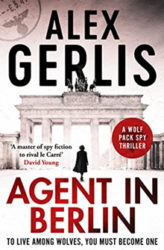
Alex Gerlis is the author of the acclaimed Spies series of four Second World War espionage thrillers. Agent in Berlin is his latest book.
Videos