

Hello Chris and welcome to Aspects of Crime. The Christmas Carol Killer is the third DI Tom Stonem novel centred around Christmas killings. What sparked the idea for this story, and when did the idea of using music and carols as part of the killer’s signature first take shape?
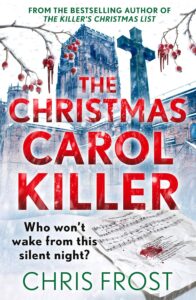
As with all the books in the series, it must pass the Die Hard test: the story must hinge on it being Christmassy, not just set at the festive period. The first book was about a Christmas List, the second was macabre presents, and when I got thinking about the third, I thought it would be fun to subvert Christmas Carols. Most people, when they hear carols, are filled with wonder. I thought it would be interesting to have a beautiful carol playing at a crime scene, and the sheet music for said carol stuffed down the victim’s throat. Already, the detective and the reader are on the backfoot, because this is clearly not a heat-of-the-moment killing, but an orchestrated one.
The opening murder is certainly a gruesome one, as I’m sure readers will discover for themselves. How important is that first crime scene in setting the tone, and how do you strike the balance between shock value and serving the wider story?
I think the first crime scene is vital in setting the tone for the book. I’ve read books that do a brilliant job of a body found in a desolate setting with little fanfare, and I’ve read others that do an excellent job of having an elaborate set piece for the discovery. Of course, it must always serve the story and not having shock value for shock value’s sake. With a Christmas-set book, I think it’s vital that any crime scene, but especially the first, has a real festive hook. The reader has picked up the book expecting snow, scarves and fairy lights, but also an investigation. The carol and the sheet music tell Tom that somebody has gone to a great deal of trouble to make sure the body is found this way!
The investigation takes Tom and Lauren into the history of a school and its sinister connections. What fascinates you about the dark secrets lurking behind respectable institutions, and how did you develop the school’s horrifying past?
Building a school with a dark past was a fun part of the writing. I used to be a teacher (a respectable one!), but we’re all aware of how education has changed. Using the cane as punishment is barbaric, but at one time that was just the norm. Teachers used to drink at lunchtime, and at my school, the maths teacher would disappear from double periods for an hour and come back with his hair cut! I think a grand building with turrets and the air of respectability is a fun thing to play with: everyone expects the best and never thinks there could be darkness behind the wrought-iron gates. I wanted to make the school, and the people who work there, central to the mystery, and to explore how a school could be a source of pride for one generation and a place some former pupils would do anything to forget.
Readers of crime fiction love a twist, but the best mysteries pepper clues for readers along the way. When plotting a novel like this, do you know who the killer is from the outset, or do you let the investigation lead you there?
I never used to be a planner, and I’d paint myself into a corner and then have so much work to do in the subsequent edits to make each suspect have a viable motive. Now, I appreciate a bit more planning, and tend to know who the killer is and their reasoning. At the start, I like to have a list of suspects, and reasons why they might be behind the crimes. That way, it’s easier to weave clues in as a go. I think a writer must always be fair to a reader, as there is nothing more frustrating than the gardener, who is mentioned once on page 34 and never again, being the mastermind behind the crimes! Equally, I never liked to be too tied to a plan, so I always know the start and the end, and a series of waypoints in between. How I get there is up for discussion. In the next thing I’m writing, I’d made the most comprehensive plan I’ve ever done. When I started writing it, a character in chapter two mentions someone who was not in the plan but was immediately clear they’d be playing a big part in the book, which just goes to show you should never plan too far ahead!!
Christmas crime fiction has become a genre in its own right. What do you think makes the festive season such a perfect backdrop for murder and suspense?
I think the setting offers readers a juxtaposition they don’t normally get. Christmas is seen as a joyful time of year, with songs and laughter and goodwill. In a crime book, these aspects of Christmas can be there, alongside a killer! Perhaps it’s a novelty that readers don’t get to experience at other times of the year. I think people like the feeling of being able to curl up on their favourite armchair with a cup of hot chocolate and know that they get to experience the darker side of Christmas in the pages of a book. Perhaps, after a particularly stressful game of Monopoly, or a day slaving over a Christmas dinner, it’s a good way to burn off the anger within, without bloodying your own hands!
Durham in December makes for a wonderfully atmospheric setting. What does the North East bring to your crime fiction, and how important is getting a strong sense of place into your stories?
Place is one of the most important things for me as a reader – I love being able to picture settings clearly, even if I haven’t been there. Setting the series in the North East offers me that – the first book opened at the Angel of the North, the second took me to the Pennine Way, and the third to Durham with its cobbled street and imposing cathedral. It’s a very crime writer thing, but when I visit a beautiful place, my initial thought is “could I find somewhere to hide a body”, and so far, in my travels, the North East has come up trumps for that. Hopefully, I can litter the area with (fictional) bodies for a long time to come!
This story is DI Tom Stonem’s third appearance. How has he evolved since the first book, and are there aspects of his character you’re keen to explore as the series develops?
Tom has blossomed, I think. In the first book, I only scratched the surface of who he was, and each subsequent book has allowed me to peel back layers and really find out who he is. He has (like may lead characters) had a traumatic past, and it’s been nice to send him to therapy to allow him to unpick how that has affected him. He is part of a close-knit team (which was important to me) who all get on, and this has allowed him to come out of his shell and show the reader who he really is. I like a hint of romance in books, and playing with this angle has been fun, too.
What do you hope readers take away from The Christmas Carol Killer? And, without giving too much away, what can DI Tom Stonem fans look forward to next?
Books are meant to be entertaining, so I really hope readers have a fun time with Tom and the team. At the time of writing, it’s just hit 100 reviews and is averaging 4.7/5, so it looks like this is the case! There is going to be a fourth book, and I’m not far into the writing of it, so can’t give too much away just yet (as I don’t know myself), but safe to say, the quiet Christmas Tom has long hoped for will once more evade him!
Chris Frost is the author of ten crime books, including his latest, The Christmas Carol Killer, the latest in the DI Tom Stonem series.
Amelia Smith is an Editorial Assistant at Aspects of Crime.