You write reviews for Aspects of Crime, Crime Time and Crime Fiction Lover. How did you get into writing about crime fiction?
My background is pretty eclectic. I worked in the private, public and voluntary sectors. I enjoyed all my jobs but nothing beats your hobby becoming your job too. It was chance that got me started. I wrote a one paragraph review for NB Magazine and the editor liked it a lot. Soon I was interviewing authors about their books and reviewing almost became an addiction. It was every book I read. I moved on to Crime Fiction Lover and Crime Time and then added the European Literature Network and, more recently, Aspects of Crime. Initially I was writing about literary fiction but soon came to realize it’s much more fun to be part of the crime and thriller community.
So is that your reading preference, crime?
It is now! I read very broadly, fact and fiction but I have a particular love for spy and crime fiction. My first hero was Sherlock Holmes, then Sam Spade but in my late teens I became a devotee of le Carré, Deighton, Charles McCarry, Ted Allbeury and a whole host of cold war spy writers. I have a love of all forms of crime fiction, from historical to contemporary, noir to cosy. Which is handy as a judge of the CWA Gold Dagger for the best crime novel of the year. Among my favourites are James Lee Burke, SA Crosby, Dom Nolan, Andrea Camilleri, Fred Vargas, SG MacLean, Vaseem Khan and Abir Mukherjee. Ask me tomorrow I’ll give you another 8 names.
Did you always want to write a book?
I suppose I had it in my mind for many years that at some point I’d write fiction. I did write an historical novel in my twenties and I made the common mistake of falling in love with the research, the book was filled with all sorts of interesting facts, in my opinion anyway, the story was slim and unfocused. That will never see the light of Day.
When I started reviewing, I didn’t really know that there was going to be a point where I’d start to think about what kind of factual book I would want to write but gradually over time it came to me. We have a lot of very good guides to crime fiction including the work of Barry Forshaw and Mike Ripley but very little really looking at the world of spy fiction. When I pitched the idea of an encyclopedia of spy fiction to publisher Oldcastle they took it on. I’m two and half years into that project.
So how come your first book is about spy films not spy novels?
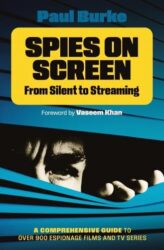
That really did come as a surprise because I was writing The Encyclopedia of Spy Fiction, a book that was getting ever bigger because it included so many authors and spanned 3500 years of history. I always planned a chapter on spy films, I expected it to be an adjunct to the main story, a brief section. It was very soon 55,000 words and still incomplete. You’ll know that is more than 3/5th of a novel. My publisher was very quick to see that this was a book in its own right and so I set about creating that book. Now 115,000 words with more than 900 entries covering the one hundred and twenty plus years of Spies on Screen; the films, TV shows and now streaming.
What would you say you learned along the way.
The first thing is always to get the book written, get it down on the page and you can work to improve and amend but if it’s not there in the first place there’s nothing to work on. Stop researching start writing. Something that I think can make the difference happens long before that though. Go to festivals, make contacts, create opportunities. Then, if you’re lucky and plans work out, you can build a reputation and a network and you can gain respect for the work you do. That gives you impetus toward publishing. Of course, it’s still down to luck, the right moment coming along, It’s down to what is in and what out on the day, and what publishers are into and feel they can sell. Still, you can get your face seen and let people know what you’re up to and then when you approach them with ideas you’re not just ‘one of the pile’, you have a profile. There is so much more to getting a book accepted and published and to generate sales selling after that. It is not just about penning the work I’m afraid. I’m always impressed by how much writers put into making their books work.
What is the best part of working in books?
I love writing about books. I certainly loved writing my own book but where that goes it’s too early to say. So far the most fun I have in this job is presenting the podcasts. I get to ask authors questions that occur to me when I read their book, what inspired them and how they feel about the world. That is a tremendous privilege.
Will you get back to writing a novel?
I think so but it won’t be soon. I have this book coming out this year and another one next year and they’re both books I’m proud of and they deserve my attention to the fullest degree for now. I do have some ideas though, from historical fiction to contemporary fiction, probably leaning into noir. It’s quite possible one of those ideas might just make me sit down and write and that’s when I will discover whether I can write fiction or not.
Who would you like to have interviewed if you could?
On my birthday in 2023 I got to interview legendary American writer Walter Mosley for the CWA. That evening he was receiving the Diamond Dagger for a life time contribution to crime fiction in English. I also deputised for the Historical Dagger Chair and got to hand the award to the winner DV Bishop. That made for a perfect day.
I do have regrets about not starting earlier, not seriously, but I would have liked to interview the Irish bad boy Ken Bruen and John le Carré or Hilary Mantel. I on emerge to Graham Greene as a teenager and he was kind enough to reply, now I understand so much more about his writing. A chat with him would be intriguing, alas not possible.
Final comment?
I was part of a community scheme and we built a community centre providing hundreds of people with the opportunity to access adult education and it was marvellous to be part of. That’s always there but it is about moving on and in July Aspects of Crime published Watching the Detectives, an anthology of crime, I edited that collection. Being able to be part of bringing short stories by some brilliant writers out into the world was a proud moment. Now it’s about my own book. Let’s see how that goes.
Thank you.