

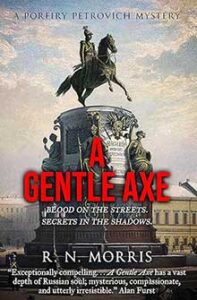
Hello Roger. Where did the idea of A Gentle Axe, our Aspects of Crime Book of the Month pick for October, come from?
From reading Crime and Punishment by Dostoevsky as a precocious teenager. I remember the blurb on the back of the Penguin Classics edition described it as “one of the first ever detective novels” or something like that. At the time, my main reading was Conan Doyle, so I was expecting a clever mystery story with a brilliant detective. But it isn’t that at all. It’s the anatomy of a double murder and the psychological impact that has on the perpetrator. There is a lot of Russian angst, melancholy, philosophy, theology, psychology thrown in for good measure. But it isn’t really a detective story. It’s not a whodunnit. We know from the outset who did it and the detective – Investigating Magistrate Porfiry Petrovich – is only in a couple of chapters. And yet he’s such a great character, he dominates the second half of the book. Raskolnikov, the student murderer, becomes obsessed by him and is convinced that Porfiry knows he is the murderer. That slightly misleading blurb made me think ‘What if you did take Porfiry Petrovich and put him at the centre of his own detective story? Give him a mystery to solve and see what happens?’ So that’s what I did.
How did you go about researching the book?
It was daunting, I’ll be honest. The story is set in St Petersburg in the 19th century, so there are two things there that I needed to get a handle on, the period and the place. I began with 19th Russian novels, Dostoevsky obviously, as well as Gogol, Tolstoy, and Turgenev, Goncharov, Saltykov-Shchedrin… I also read biographies, memoirs, history books, general histories to get a broad feel for the period, and more specialist books for the kind of granular detail that I could use to bring the story to life. I even downloaded a PhD thesis about the Tsarist legal system.
For a sense of St Petersburg at that time, I used an online resource, the Encyclopedia of St Petersburg, which has an amazing archive of photographs.
I didn’t actually go to St Petersburg until I was writing the second book in the series, A Vengeful Longing. It was a strange experience, almost hallucinatory. It felt like I had stepped into my own imagination.
Dostoevsky is obviously a big influence. How did it feel writing the book under his shadow?
Again, daunting. I mean there were times when I thought, can you do this? Should you do this? But I had pitched it to my agent and he was very encouraging and I didn’t really have any other options at the time. This was the idea I’d had. I just had to work through it until it was done. Maybe I was a little bit naïve too. You know, Dostoevsky is a towering literary figure, Crime and Punishment is one of the masterpieces of world literature, Porfiry Petrovich is a much-loved character… In many ways, it was an insane thing to do. To make it feel less daunting, I told myself that all I was doing was writing fan fiction.
As the publication date drew nearer, I braced myself for what would inevitably be a negative reaction from the Dostoevsky purists. And there was a little bit of that, but not as much as I’d feared. Many people enjoyed the game I was playing. I seemed to get away with it. In fact, in 2016, I was invited to take part in Dostoevsky Day at Leeds University and was interviewed by Sarah Hudspith, Professor of Russian there. I felt that I’d finally been accepted by the Dostoevsky community!
What’s the difference between R.N. Morris’s Porfiry Petrovich and Dostoevsky’s?
Well, the first thing to say is that Dostoevsky’s is obviously the original! There were clues to his character in the few scenes in Crime and Punishment in which he features. He’s described as a prankster, and various examples of this are given. He comes across as quite an eccentric, even odd, character. My challenge was to take these small hints and expand on them. I focused at first on the physical – almost superficial – details, his eyes and eyelashes, his cigarette addiction, his habit of blinking and winking, which becomes almost a tic, though I suspect it’s deliberate to unsettle suspects. It was a bit like one of those actors who say they have to get the walk right and then they can find the character. That’s what I was trying to do, I think.
I should also say that my Porfiry Petrovich is heavily influenced by Columbo, who I believe is based on Porfiry Petrovich!
What happens to Porfiry Petrovich after A Gentle Axe?
He has a central role in three further novels, A Vengeful Longing, A Razor Wrapped in Silk and The Cleansing Flames. More recently, I brought him back for cameo appearances in a trio of stories featuring the magistrate Pavel Pavlovich Virginsky: Law of Blood, The Crimson Child and Death of A Princess.
What are you working on now?
I’m writing a sequel to my novel Cover Story, which came out last year. It’s a contemporary spy thriller, so it couldn’t be more different to A Gentle Axe!
Roger Morris is the author of several acclaimed historical novels, including A Gentle Axe, the first in the St Petersburg Mysteries series.