

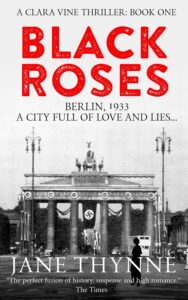
Hello Jane. Tell us briefly about Black Roses, our Aspects of Crime Book of the Month pick for November, come from?
It’s 1933, and Clara Vine, an ambitious young actress, has travelled from London to Berlin to escape a bad love affair. Although her mother was German, she knows nothing about the country, or the nascent Nazi party that has just taken power. She heads for the famous Ufa studios where a chance encounter introduces her to the circle of senior Nazi wives, among them Magda Goebbels.
Shortly afterwards Clara meets Leo Quinn, a consular official working for British intelligence. Leo sees in Clara the perfect recruit to spy on her new acquaintances, using her acting skills to win their confidence.
What was the genesis of the novel?
I was reflecting on the life of Asma al-Assad, the woman whose husband became the dictator of Syria. She was brought up in Ealing, and had a conventional London life, until her husband, a younger son, was unexpectedly catapulted into the dictatorship. I wondered what it was like to be married to a man who moved from a quiet bourgeois existence to become steeped in blood, and whether you would try to mitigate his actions. That led me to thinking about Magda Goebbels and the Nazi wives. The world is full of books about the leading Nazis, but almost nothing is known about their wives, even though in many cases these women were an important influence on their husbands. I wondered if their lives would be a gilded cage, or if these women actually supported what their husbands did. The answer was both. Some, like Annelies von Ribbentrop and Lina Heydrich, were considered more Nazi than their men. Others, like Emmy Goering, or Henny, the wife of Baldur von Schirach, actively interceded with their husbands on an occasional basis to save friends. Henny von Schirach actually remonstrated with Hitler over the treatment of Jews in Vienna and was banished from his presence thereafter.
And how did you go about researching the wives?
I tried to keep faithful, wherever possible, to established historical fact, and much of the dialogue in Black Roses is taken from letters, memoirs and diaries of the women involved. These women were close up to the action and privy to all the feuds and gossip, of which there were plenty in the Third Reich. But it was when I came across the story of Victor Arlosoroff that I saw the germ of a novel. Arlosoroff was a prominent Zionist who had become close to Magda Goebbels in her youth. He subsequently left to oppose the British mandate in Palestine, and, in 1930, Magda attended a meeting of the Nazi Party, where she was impressed by one of the speakers, Joseph Goebbels, then the Gauleiter of Berlin. Hitler encouraged the relationship, and the pair married in 1931, with Hitler as a witness. In 1933, Arlosoroff returned to Berlin seeking help with the movement of Jews to Palestine. When he discovered his former girlfriend’s marriage to Goebbels, the arch-persecutor of the Jews, he was appalled. Even so, he tried to get in touch. We don’t know if the two did meet again, but shortly afterwards Arlosoroff was murdered. This story was so intriguing, I knew there was a novel in it.
Why did you make your protagonist an actress?
Having an actress as my heroine made sense. Not only was Babelsberg the Hollywood of Europe in the 1930s, responsible for iconic movies like Metropolis and The Blue Angel, but Clara’s acting talent gives her access to VIP circles and the ability to conceal her espionage. Acting highlights the difference between how things are and how they seem; a notion that underlies much of the novel. This was a regime that was obsessed with acting and film. Hitler would watch two movies a day and Goebbels saw the visual portrayal of a powerful, orderly Nazi Germany as a vital accompaniment to Hitler’s territorial ambitions.
What was life like for German women in the Third Reich?
The extreme misogyny of that society meant that every aspect of women’s lives was patrolled, and the strictures on women’s appearance were very strong, especially in the early days of the Reich. Hitler created a Reich Fashion Bureau promoting wide-hipped traditional dresses that were intended to encourage the right body shape for fecundity. Smoking was frowned on – shops were banned from selling cigarettes to women, and storm-troopers were encouraged to dash any cigarette from women’s lips. Lipstick, hair dye, nail polish, even perfume were degenerate. But as was typical of the Nazis, the VIP women who were supposed to embody these values generally did the opposite – Eva Braun used to take Hitler perfume shopping, Hermann Goering gave out Elizabeth Arden gift sets. Clara Vine manages to exist as a single woman in the Nazi echelons because she is a glamorous actress, and they were exempt from the rules that governed the rest of Aryan female society. These ironies, hypocrisies, and mixed messages fascinated me. Double standards abounded.
Did those double standards extend to sex?
The Nazi attitude to sexuality was, typically, a mess of contradictions. The regime’s emphasis on female modesty was allied with encouragement of unmarried motherhood, and a traditionally Protestant nation was asked to welcome ideas from Himmler such as that superior men ought to have two wives. At its extreme it embodied experiments like the Lebensborn, which encouraged girls to Give A Child to the Führer through casual sex with an SS man. It also meant the criminalisation of homosexuality. The drive to increase the birth rate was so strong that the League of German Girls, the BDM, was nicknamed the Bald Deutscher Mutter – soon-to-be German mothers – and 16-year-olds would regularly return from the Nuremberg rally pregnant. Perhaps unsurprisingly, female sexual pleasure was not a priority for the politicians of the Third Reich.
How did you go about research?
Research is my favourite part of writing. For this novel, I loved walking around Berlin and picturing the buildings that were once there like a palimpsest beneath what has replaced them. Finding places like the Berlin Bride School that I never knew existed. Or discovering tiny pieces of colour – like the fact that Hermann Goering liked to keep lion cubs in his home. The problem with research, of course, is that you have to lose most of it, or you end up with a history lesson, not a thriller.
What appeals to you about espionage literature?
All the elements of life that novelists usually address – love, loyalty, betrayal, hope, sacrifice – are compressed in the universe of the spy. We all, to some extent, live double lives and present different faces to the different people in our worlds. But spies live a constant double life. They are always on stage, always acting a role, and there is always a marked gap between what they think and what they say.
In any totalitarian society, but especially Nazi Germany, there is great dramatic tension between the masses who conform, the state that polices that conformity, and the individual who slips through the cracks – the outsiders who survive in a repressive society. The Nazis put a premium on group activity – they tried to arrange it so that people spent as little time alone as possible because solitude promotes individual thinking. Clara Vine, being a spy among the elite, is an outsider posing as the ultimate insider.
And the story of Clara Vine doesn’t end with Black Roses….
I’ve now written six novels in the Clara Vine Thrillers series and have a seventh plotted out. The culture and politics of 20th-century Europe continue to exert an irresistible pull on me, not least because the Second World War shaped so much of the world we now inhabit. In one sense, if you look at the Middle East, it’s not over. It is a war whose ramifications will continue to shape our outlook and politics for a long time to come.
Jane Thynne is a bestselling writer and the author of Black Roses, the first in the Clara Vine Thrillers series.