

Len Deighton, 1929-2026.
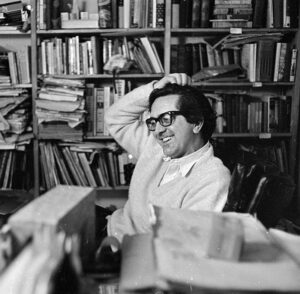
Image copyright David Cairns Getty Images, 1966.
From marketing man to illustrator, where Deighton created more than 200 book covers including the first UK edition of On the Road by Jack Kerouac. From cookery, he was a student of the science long before Heston Blumenthal, to history, Deighton’s books on WWII are much respected. Len Deighton was a key player in British cultural life and created an iconic spy to rival Bond and Smiley, the name with no name. Deighton came from the work house to become a great spy writer, his name synonymous with the genre.
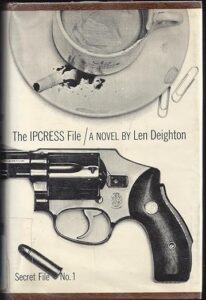
The Ipcress File, 1962, featured that nameless protagonist, he later becomes Harry Palmer in the film of the book. Deighton revolutionised the realist Cold War spy story. Together with John le Carré he set a benchmark for everything that followed and generations of writers owe a debt to these espionage titans.
It wasn’t just on the page, of course, the Ipcress File, Funeral in Berlin and Billion Dollar Brain, perhaps due a re-evaluation in the age of Trump, with Michael Caine as Palmer, brought the genre to a much wider audience. In 2022 Joe Cole reprised the role in a decent remake of the Ipcress File, which, sadly, ITV lacked the conviction to back the production. Deighton’s trilogy showed an awareness of the history of the genre, of Ambler and Greene, but fed off the Cold War and a changing society to bring more urgency, new political insight and an understanding of 1960s Britain, as well as grit and a deeper moral ambiguity to the genre.
Like Smiley, Palmer was an antidote to Bond, a reaction to the playboy in the sun, he lived in rundown Britain, didn’t own a car and was constantly and painfully aware ‘they’, the establishment, did not like him. Only he was smart, damned smart and they hated him all the more for that. Unlike le Carré, Deighton’s novels are witty, he enjoyed the antiestablishment sniping, the us against them. And just as the kitchen sink dramas and the social realist novels defined the era so did Deighton’s spy stories.
Spy writer Alex Gerlis, author of The Second Traitor, said: “Len Deighton was a master storyteller and a very clever and skilled writer of espionage novels. His books have stood the test of time and helped define the genre of espionage fiction. He’s always been held in high regard among current writers of espionage fiction, who’d happily admit to admiring his plots, his characters, writing style – and his output.”
Born in a work house in Marylebone, Deighton was a Graduate of St. Martins Art School, he did his national service in the RAF (Special Investigations Branch), before becoming an advertising illustrator, then cookery writer, journalist, screenwriter, spy writer and non-fiction author. His histories of WWII – Bomber (a novel), 1970, Fighter, 1977 and Blitzkrieg, 1979 were all well received.
In 1940, as an 11-year-old, Deighton witnessed the arrest and internment of Russian émigré and spy, Anna Wolkoff. She opposed the war as a member of the Right Club, an anti-Semitic fascist organisation. Deighton’s mother had worked for Wolkoff as a cleaner. That was an experience he later described as ‘a major factor in my decision to write a spy story at my first attempt at fiction.’
By the early 1960s the times were a-changing, there was a new optimism, youth and working class voices were being heard, austerity was beginning to be put behind Britain and consumers had more money to spend. This was empowering for working class writers, and Deighton saw his opportunity. He disliked the class system, later he was more sanguine about it, but then he questioned the established order.
Crucially, this ground breaking work fed off the existential threat of nuclear Armageddon which hung in the air. The Cold War was ripe for forensic fictional examination, a world in which everything was grey, not black and white like much of WWII.
Deighton’s writing is stylistically fresh, irreverent, wryly comic, mildly leftish, solidly working class. The writing is elegant yet complex, Julian Symons called him ‘the poet of spy fiction.’ his work was psychologically rich and insightful of society’s mores. Who would have thought a debut novelist, a book written on holiday in France, would change spy fiction permanently but, like his contemporary le Carré, Deighton was an original voice.
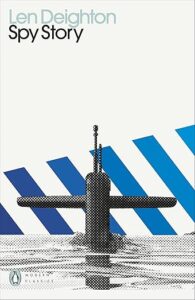
Among his other significant spy novels are An Expensive Place to Die, 1967, Spy Story, 1974, Yesterday’s Spy, 1975, SS-GB 1978 (an alt-history) and XPD 1981. Then there was Bernie Samson. The Bernie Samson novels chronicle a decade of Cold War espionage in the 1980s, nine novels, and a ‘sort of’ prequel, Winter, 1987 (a chronicle of a German family). For my money the best of the trilogy of trilogies are the first three novels; Berlin Game, 1983, Mexico Set, 1984, and London Match, 1985. Bernie like Deighton’s earlier anti-hero Palmer is an outsider. The same public school boys run the service and their distain of him is as vivid as his hatred of them. Bernie is married to Fiona, who comes from money and is also MI6. She soon surpasses Bernie in the hierarchy thanks to her computer background. She achieves a coup by breaking Karlshorst communications, thus accessing Russian and East German secrets but she is really a mole. The computerisation of the service here is one of the earliest examples of how that changed things in the spy world. This is a series of complex and satisfying spy stories of moles, double agents, field operatives, internal politics, geopolitical issues and the London/Moscow rivalry. Yet the heart of the story is in Bernie’s character and his relationship with Fiona, the children and in-laws. Also in the series are Hook, Line & Sinker, 1988-90, and Faith Hope & Charity, 1994-1996, all featuring Bernie Samson. Deighton did not like the ITV version of the Samson stories featuring Ian Holm, though it is not as bad as some would suggest and the leads are strong.
Later novels Mamista 1991 and City of Gold 1992 were poor fare by the standards Deighton had set but this body of work rivals the very, very best.
Spy Story was filmed in 1976 and SSGB in 2017. While Michael Caine appeared in the forgettable return of Harry Palmer in Bullet to Beijing, 1995, and Midnight St Petersburg, 1996, to be fair their failings cannot be laid at Deighton’s door.
Every contemporary writer of serious espionage fiction owes a debt of gratitude to Deighton, whether first hand or through intermediary writers channelling his spirit, they will have learned a lot. As a reader I got immense pleasure from Deighton’s novels. Sadly with Frederick Forsyth dying in June last year there are few left of the best of the Cold War generation. RIP the legend that is LEN DEIGHTON.
This article is an abbreviated version of the Obit appearing in the Aspects of Crime March/April magazine.
Len Deighton Books are available as Penguin Modern Classics.