
Your screen James Bond is like your favourite Dr. Who, probably the one you grew up with. For me that was Sean Connery, thanks to regular TV replays I know his films well enough to quote the dialogue verbatim. Strangely, Lazenby’s On Her Majesty’s Secret Service passed me by but in retrospect I think he did his job well enough and wisely quit while he was ahead.
Roger Moore was the first Bond I saw in the cinema, it was Octopussy and it was great fun, I liked his easy charm. That said, I don’t really dislike any of the Bonds, again, like Dr. Who, we tend to go with the flow. I admire Timothy Dalton for his dark soul, Pearce Brosnan for his style and wit and Daniel Craig for his cold-crushed humanity and modernism.
The action has just ramped up over the years and now the opening segment of a Craig movie is a movie in itself, exhilarating and gripping. For 20 years we have had a titanic battle between Bond and Bourne and Mission Impossible and, to a lesser degree, Jack Ryan. This has led to harder, faster, sharper thrillers. However, the 007 movies were a phenomenon long before anybody started talking about the battle of the high-octane franchises and my guess is the next Bond movie will break box office records. We’re still waiting to find out who the new superspy will be but the announcements of the director Denis Villeneuve and the writer Steven Knight have gone down well with the public. The excitement is already mounting and yet we are still at least two years from seeing the film on the screen.
In the early days the suave, sophisticated but deadly spy played by Sean Connery flew the flag for Britain as one of our best exports, he still is. The flamboyance, exoticism and opulence of the movies countered that post-WWII image of Britain of declining empire and austerity. Now Bond is more than a British hero, he stands for a world that needs a hero, he is beloved in India and China and America. He’s the screen King Arthur; cometh the hour, cometh the man.
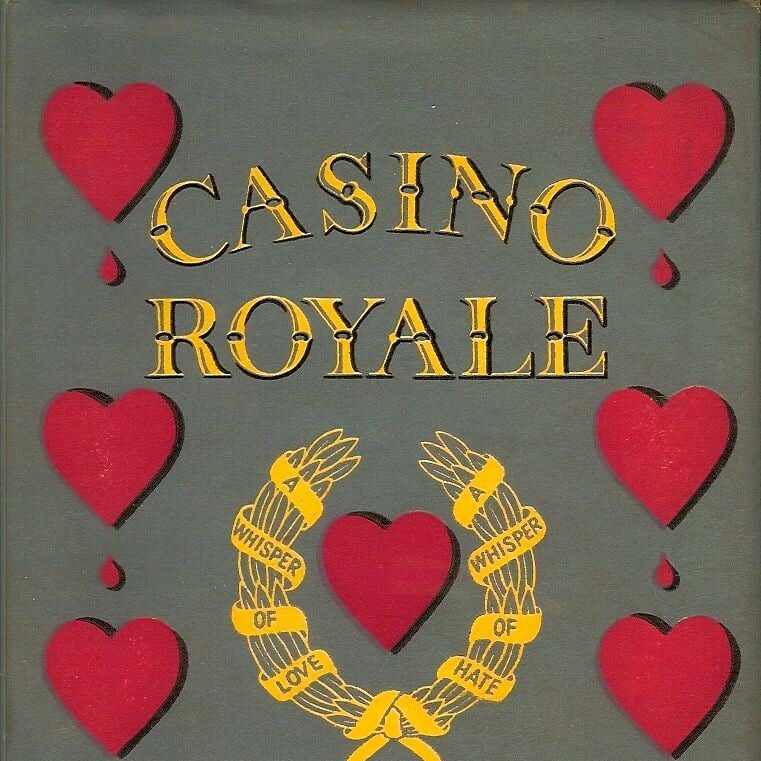
It all started a decade before the first film with the first book Casino Royale (1953). I came across the books long after the films. Frankly, it’s a shock to see how different he is from the screen representations. Fleming was clear, Bond was no hero merely a blunt tool of government. An antihero for a world of danger and threat. In Casino Royale James Bond is sent to the Royale-les-Eaux casino in northern France by M, Head of the Secret Service. his mission is to play Baccarat against a SMERSH backed union financier Le Chiffre. SMERSH is a Russian spy network based on the very real Soviet counterspy organisation known by the epithet ‘Death to Spies.’ Bond assumes the role of a playboy and, it’s a tough life, with the help of Vesper Lynd, assistant to the head of the Russia desk, he takes on his target at Baccarat. The CIA and French intelligence are watching on. When Le Chiffre beats Bond at the table the CIA must stake him so that he can enter the next round. Fleming actually lost at the gaming tables to German officers at a casino in Portugal during WWII. Despite an attempt to kill him, Bond eventually bankrupts Le Chiffre. As revenge Le Chiffre kidnaps Bond and tortures him, the famously gruesome scene. Bond owes his life to a SMERSH killer who has come for Le Chiffre as punishment for losing the Russian’s money. He spares Bond because he has no orders to kill him but marks him so that other enemy spies can identify him in the future. Lynd is by Bond’s side during his recovery. They fall for each other but in a twist, Lynd is an agent of the Russian Ministry of Internal Affairs. When they come for her the only way she can save Bond is by committing suicide to free him. The embittered Bond professes his satisfaction that she is dead. And thus a legend was born.
For lots of complicated reasons Casino Royale did not become an ‘official’ Bond movie until Daniel Craig played 007 in 2006. There is a David Niven spoof, best forgotten now, which was made in 1967. Dr No was the first in the film franchise and it was an instant success. The movies produced by Cubby Broccoli were pure box office from then on. The only way to compete was not to compete which meant film makers went with the spoof; Matt Helm, Flint and, even, Otley.
Craig’s Casino Royale is his best and one of the whole franchise’s finest too. There are significant differences from the book. We move to Montenegro for the game at Casino Royale. Le Chiffre, played by Mads Mikkelson, loses the money of an African warlord, Eva Green is a wonderfully seductive Vesper Lynd and ‘M’ is a woman but overall the story is pretty faithful to the novel. Craig made four movies, No Time to Die a rather controversial end thanks to the death of Bond.
As we wait for his resurrection we always have the old movies to look back on. Dr. No is very good, it has a strong story, plenty of British humour and Connery hits the ground running as a plausible cool state sanctioned killer. My favourite is From Russia with Love, directed by Terence Young in 1963, written by Richard Maibaum and Johanna Harwood. It stars Bernard Lee as M, Pedro Armendariz as Turkish ally Kerim Bey, Robert Shaw as Grant/Nash, Lotte Lenya as Rosa Klebb, Lois Maxwell as Miss Moneypenny and Daniela Bianchi as Tatiana. The movie sticks pretty faithfully to the plot of the novel. Though the order of events deviates, these scenes lifted from the book lifted represent the best action in the film. The prospect of obtaining a Russian Lektor decoding machine and the alure of Tatiana, a junior consulate clerk at the Russian Embassy, lead Bond to Istanbul. Klebb, a former SMERSH Colonel, the Russian counterintelligence agency, now works for SPECTRE. Détente meant playing down the idea of the Russians as the nemesis of the West. A supranational evil organisation is a prefect replacement. Klebb’s plan is to eliminate Bond and capture the Lektor. For this she has recruited Grant. Once Bond has Tatiana and the Lektor, Grant poses as a British agent to hunt Bond. Bond also crosses swords, or at least a poison tipped shoe, with Klebb in Venice. Has he managed to convince Tatiana to switch allegiance? His life depends upon it. Engaging and enjoyable, the movie hangs together as a story. Notable for the contribution of Johana Harwood as a writer, who had become a key part of the team in these early years, sometimes uncredited. The Lektor was a nod to the work that Fleming did in intelligence during WWII securing German communication equipment. A close second is Goldfinger, Directed by Guy Hamilton in 1964, written by Richard Maibaum and Paul Dehn. Desmond Llewellyn joins as Q, striking up a sparky, humorous relationship with Bond. The former wartime despatch rider, Honor Blackman, the leader of Pussy Galore’s Flying Circus has graduated to wing commander in the film. Gert Fröbe is Auric Goldfinger, Shirley Eaton is gold-plated Jill Masterson. Goldfinger is smuggling gold out of Britain as part of a plot to hoard his supply. Already substantial this will increase in value with operation Grand Slam, a plan to attack the gold bullion reserves of the US at Fort Knox, obliterating its value with the help of a Chinese dirty bomb. The film turns the best of the book into an action-packed international thriller with a scintillating denouement. Who could forget the moment when the countdown stops on the bomb? China was a ready-fit second-string villain. Bond gets to drive an Aston Martin BD5 and double-entendres abound. For modesty’s sake, Pussy Galore became known as Miss Galore for promotions in the US.
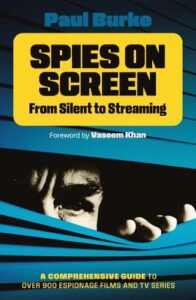
I could go on, but my book, Spies on Screen, covers all the Bond movies and Bourne, Mission Impossible and Jack Ryan, but also le Carré and Deighton adaptations. Slow Horses, Fauda, Sandbaggers, Atomic Blond and The Day of the Jackal, film and series too, and over 100+ years of espionage on film, TV and streaming. It is an uber-popular genre but Bond has made it top the world box office. What From Russia with Love, Goldfinger and nearly all the other Bond movies have in common is that they can be watched again and again, enjoyed as escapist fun. Who doesn’t love the megalomaniacs, assorted odd-ball killers and dastardly plots. Just allow yourself to forget your troubles. I would say Bond should be seen on the big screen. Every first encounter with the new movie needs to be larger than life because Bond is.
Paul Burke is the former editor of Aspects of Crime and the author of Spies on Screen: From Silent to Streaming.