
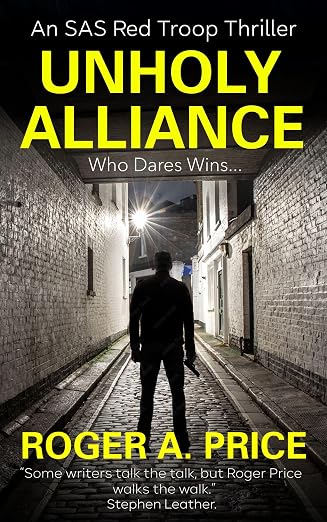
Unholy Alliance is the last in the trilogy of thrillers set in Northern Ireland during the Troubles. The first – With Prejudice – introduced SAS Red Troop which is led by Captain Vernon Jackson and headed by MI5 Intelligence Officer, Bertram Hastings. In real life MI5 often brief Special Forces, then sit back while the soldiers do all the dirty and dangerous stuff; often termed ‘Wet Work’!
After the bombing of the Grand Hotel in Brighton in 1984, Prime Minister Margaret Thatcher wanted revenge – in the novel – and SAS Red Troop was born. In the book she wanted to fashion a better working relationship between the intelligence services and the soldiers which is how Jackson and Hastings were brought together. To my knowledge, this has never been done in real life, and provided a great area for conflict and initial mistrust.
As with all my novels which are serials, I write them so that they can be read as standalones, so that a reader who picks one up mid-series is not disadvantaged by reading a book in the wrong order, and if enjoyed, then they can go back over the series backlist with no meaningful loss of thread. I also try to give each novel an over-arching thematic under which the story lives.
In With Prejudice, the first in the series, the theme was a well-placed tout within the Provisional IRA, hidden in plain sight. Not in a senior position, but with access to those who held such roles, but this tout was operating with their own private agenda: as informants at any level, often do. Many firmly believe it was the number of touts hidden within the Provisionals that eventually led them to the negotiating table. They just didn’t know who to trust within their organisation anymore.
In Shoot to Kill, the sequel set in 1988, the theme revolved around the use of ‘Honeytraps’ used in real life to lure unsuspecting RUC Officers and soldiers by attractive young women who were bait. Leading them to their deaths rather than a night of passion, or a private party or whatever had been promised. They were often approached in local bars and pubs. Many on the Catholic and Republican side thought the tactic immoral; a step too far. It was controversial and when it was stopped, mainly because it was becoming too well known, many of the women involved fled to the south of Ireland to escape justice.
Unholy Alliance wraps up the trilogy in 1992 – themed by collusion – inspired by real events; some of which I have first-hand knowledge of; allow me to explain.
I’m going to fudge some of the dates and locations in order so not to identify real events should some of those involved happen to read this.
In the late 1990s, I was a Detective Sergeant/Acting Detective Inspector on the National Crime Squad; which was the founder and forerunner of today’s National Crime Agency. Intelligence was received that the Provisional IRA wished to import a substantial amount of drugs into Ulster for no other reason than to make money. What people don’t always realise, is that many within both Republican and Loyalist terrorist outfits, are just common criminals. Money was raised for their respective causes by many, and the pockets of many were filled with cash for no cause other than their own.
I found the hypocrisy startling. Whilst gangs of Republican thugs were roaming the streets of Belfast and kneecapping young men for selling bits of weed, PIRA wished to import tonnage of the drug for their own purposes. But they had a fatal flaw. They didn’t know how to go about it. They didn’t have the criminal connections to facilitate an importation. They were forced to engage with drug-dealing criminals; that was their error. That was where the National Crime Squad came in.
Suffice to say, that a covert surveillance operation was put together which resulted in the importation being compromised at the correct point in time, and in a covert way. PIRA never got the drugs on that occasion, but it is inconceivable that they didn’t manage it at other times. One can only deal with what one knows about. Nevertheless, the duplicity and shameful affrontery of the plot stayed with me and was the embryo of the thematic I wanted to create for the final novel in the SAS Red Troop thrillers.
Then I started my research. As the author of nine police procedurals novels previous to the Red Troop series, I had mainly got away with light research. Those wonderful crime writers with no police/detective experience always worked much harder than me when it came to research. But here I was out of my comfort zone needing to do the hard yards of study for a change. I did have some transferrable skills, as the National Crime Squad’s covert tactics were similar to those used by the SAS and The Det (Intelligence Corps) in Northern Ireland in the 1980s and 90s. In fact, the army used to train some of our detectives in some specific surveillance skills which I will not go into.
Having lived through the troubled times, having met and chatted with many RUC of the day, and carrying the first-hand knowledge mentioned above and more, I felt I had a good grasp of things. I did not. What I uncovered shocked me. I have read documented accounts of where Loyalist and Republican terrorists actively worked together combining their knowledge and skills to commit crime for their own pockets. ‘Robbing banks together during the day, lobbing bombs at each other during the night.’
But the collusion went much deeper. These most unholy of relationships brewed a perverse understanding. An unacknowledged friendship even. One where a level of trust, in some areas, was established. It was not uncommon where one side would have a problem that was politically sensitive or difficult to sort out, so a favour would be asked of the other side. The originator would provide the details of the specifics, the when and where, and the how to, and even assist from the shadows. These ‘favours’ included anything from a beating, all the way up to murder. And once a favour has been done, the requestor was then indebted to the other side. And debts were nearly always called in.
Extrapolating from the above got me thinking as to how far I could push these erroneous relationships for the good of the story, and where it could meander from as well. Unholy Alliance’s synopsis was beginning to write itself, and the book of which was born. I can’t give any more away without risk of serious story spoilers. I’ve probably said too much already!
I can only therefore invite you to try Unholy Alliance in order to discover more, and should you do so, I hope this insight adds to your enjoyment of the book. I’d love to hear what you think if you are tempted.
Unholy Alliance by Roger A Price is available from Sharpe Books now