
The screenwriter and novelist, William Goldman, famously said: “Nobody knows anything.” I think that’s a useful place to begin when we’re talking about what crime fiction heroes will look like five years from now.
I’d like to tell you three ways in which I believe published crime fiction will change. I say published, because there is a difference between what writers are write, and what publishers decide to publish.
Writers are writers because we write, but authors are published because acquisitions departments say ‘yes’ to a manuscript. How they decide is anyone’s guess.
If any of us could reliably predict which crime-thriller protagonist was going to create the next bestseller, we wouldn’t be sitting here talking about it. We’d have built the algorithm and retired.
So, none of what I’m about to say should deter you from writing the story you want to write. Writing has to come from passion, curiosity and heart.
Publishing moves slowly. A novel can take two years to get from acquisition to publication. In two years, the world can change dramatically.
Take my debut novel, The Khan. That manuscript was effectively unsellable for seven years. Then a series of completely unconnected events, beginning with a Guardian essay of mine going viral and culminating in the murder of George Floyd and a profound change in the cultural conversation, suddenly created a space for a novel about a British Pakistani woman inheriting a criminal empire.
The book was critically acclaimed and became a Times bestseller.
Crime fiction is a form of soft power. We put ideas inside stories and allow readers to encounter different ways of seeing the world without demanding that they agree with us. These stories are shaped by circumstance.
The circumstances point to several changes that I believe will colour the future of crimewriting and crime publishing. The first and most obvious of these changes is technology.
Whilst writers will be able to hark back to a time before mobile devices and AI to create plot twists, and drama, as they have done in novels like Fingersmith which was set in the 1860s, others will lean into the future of general intelligence, robotics, and gene therapy.
This was once the realm of science fiction. Crimewriting being a broad church has encompassed that in stories like Under the Skin by Michael Faber, where the protagonist is an alien, and a killer.
In the coming days, much of what was science fiction will be science fact. We are heading into a world that is volatile, uncertain, complex, and ambiguous. Leadership experts call this VUCA. Crimewriters call it life! We have reached a point where the pace of change is greater than the pace of learning, and for all other industries that spells trouble, but for fiction writers, this is gold.
We will increasingly see protagonists wield digital knowledge rather than weapons. AI, deepfakes, surveillance, facial recognition, DNA databases and the enormous digital footprints we all leave behind have changed what power looks like. You only have to listen to Meredith Whittaker, the president of Signal to understand what is coming.
The future crime protagonist may not carry a gun, she will control information. Imagine all the messages you ever sent, even the innocuous ones complaining about a family member, colleague, or even your child being held by one person.
Then, there are the challenges. AI creates an extraordinary problem for crime fiction. For generations, the detective has searched for evidence. But what happens when evidence itself becomes unreliable?
When voices can be cloned, photographs manufactured, video generated and documents fabricated, the protagonist has to establish not simply who is lying, but also what is real.
To paraphrase Marcus Aurelius, the obstacle is the way, and through handling these obstacles we will see great crimewriting coming from writers who have wrestled with this idea.
The next shift will be connected to something much bigger: our declining faith in institutions.
The US President Donald Trump has been one of the most visible expressions of that in politics, but the phenomenon is much wider than one politician or one country.
Faith in the police, government, journalism and even the courts has weakened. Across democracies we have seen the rise of populist movements built partly on the argument that established institutions cannot be trusted, that the experts, the media, the political class and sometimes the justice system itself are rigged against ordinary people.
For crime writers, the interesting point is not whether we agree with those claims. It is what happens to a society when large numbers of people believe them.
I became a cub reporter in West Yorkshire, was just after the Bradford riots. Newspapers had carried pictures of men police were interested in in connection with the devastation seen by the city. Mothers encouraged their sons to hand themselves in, believing the justice system would treat them fairly. It didn’t, and this was something that subsequent inquiries confirmed.
The harsh sentences that were handed down had shocking repercussions that were seen years later. After the terror attacks that claimed the lives of 52 people on 7/7, I interviewed the families of the men responsible, and academics, to try and piece together what drives such hate that it pushes a man to take his own life and that of innocents. One professor I spoke to at Leeds University told me that he believed the spark of radicalisation could be traced back to those prison sentences.
When people stop believing that institutions will deliver justice, you create fertile territory for criminal activity that perpetrators perceive to be justice That’s fascinating territory for a crime writer developing a character.
The hero of the future might be a journalist or a janitor, a judge or a juvenile delinquent. They may simply be somebody who has access to information that powerful people don’t want them to have. Their morals will be compromised and the question they ask will not be ‘How do we get justice?’ It will be, ‘Who gets to decide what justice is?’
The next big change will be the rise of the anti-hero.
Our understanding of human behaviour has changed over the last decade. Popular culture has discovered people like Brené Brown, Esther Perel and Gabor Maté. These are experts who have brought ideas of trauma, attachment and intergenerational damage into the mainstream.
They encourage us to ask not simply what somebody did, but why they did it.
Think about Batman. Arguably one of the most famous crime-fighting heroes in popular culture. He is a man formed entirely by trauma. What makes him a hero is he decides to make sure no one else experiences the pain he does.
But crime fiction can ask a more uncomfortable question – what if they choose crime? And what if their reasons make sense? We will move away from simply asking ‘Who did it?’ and will ask ‘Why did they do it?’. And eventually towards the question I find most delicious as a novelist: ‘Were they actually wrong?’
That will give us protagonists who are thieves, fraudsters, gang leaders, hackers, vigilantes and even killers, but whose moral logic we understand. You can already see that shift in Mick Herron’s Slough House novels. Jackson Lamb and the “slow horses” are not sleek, infallible Bond figures. They are disgraced, damaged, compromised intelligence officers people the institution itself has decided are failures. Herron makes the very people the system has discarded the ones we trust to see the system most clearly. That feels significant.
The future hero will not be the person at the centre of the institution, but the person pushed to its edge.The next change will be who gets to occupy the centre of the story.
More protagonists will come from communities historically treated as the setting for crime rather than the solver of it.
Think about the teenagers who grew up during Black Lives Matter, #MeToo and intense public conversations about race, gender, sexuality and inequality. In five years, many of those teenagers will be adult book buyers.
Nadine Matheson’s DI Anjelica Henley, in The Jigsaw Man, is a black woman leading within the police rather than appearing at its margins. She returns to active duty carrying the psychological consequences of an earlier case, but she is never reduced to them. She is authoritative, flawed, professionally formidable and allowed a complicated interior life.
Representation is interesting when a protagonist is not there simply to symbolise progress, but is allowed to be as difficult, damaged and contradictory as anybody else.
In five years time, our readers will be the TikTok generation, raised on global popular culture. The old boundaries that publishing assumes will be gone, and we’ll see more sexually fluid characters, people with disabilities, British Asian and Black protagonists, immigrants, working-class women, older women and characters traditionally pushed to the margins. Think of Will Dean and his protagonist Tuva Moodyson. She is a deaf reporter on a small-time local paper. Her bisexuality is a smooth, realistic part of her personality rather than a forced plot device.
But here’s the most important bit: five years from now, these protagonists won’t have to be good representatives of their communities. They’ll be allowed to be dangerous, compromised, ambitious, and powerful.
Readers are hungry for this kind of storytelling, and are much more adventurous than we sometimes give them credit for. Crime fiction has always known this.
Think of The Godfather. Michael Corleone is not compelling because he is morally good; he is compelling because we understand the logic of the world he inhabits. He is dapper, Italian American, and comes from a world that was rarely written about before Puzo’s novel was published.
He is far removed from the demographic that publishing tells us reads fiction, but he is an icon, because we all understand family loyalty, love, and power. The achievement of the story is not that it convinces us that the Corleones are innocent. It is that, for a time, it persuades us to see the world from inside their moral universe.
The Khan does the same for modern Britain. It takes the architecture of The Godfather, that of the immigrant family, the criminal dynasty, the tension between family loyalty and the law, and the idea of an alternative system of power operating alongside the state, and asks what happens if you change who gets to inherit it.
That, for me, is one of the ways crime fiction is heading: not abandoning its great archetypes, but reinterpreting them through protagonists who were previously never allowed to occupy those roles.
My final thoughts on this are related to a question I was asked on Radio 4’s Woman’s Hour a few weeks ago. The story was that 9 out of 10 of the bestselling books that week featured murdered girls. The question was why we like to read these stories. My answer was that we don’t. We love crime fiction, and dead girls are what we are being offered.
As I said earlier, our audience has been steeped in much more interesting waters, and as a result, I believe our protagonists will be overwhelmingly female and will become more morally unsettling.
We’ve seen the traumatised woman in The Girl with the Dragon Tattoo by Stieg Larsson, we’ve had the unreliable woman in Gone Girl by Gillian Flynn. We’ve had the woman seeking revenge in books like How to Kill Your Family by Bella Mackie
The next evolution is the woman who wants power and doesn’t need trauma to justify it.
She won’t have to be likeable, she won’t have been a victim, and she won’t necessarily have to be punished at the end. She will be ambitious, violent, sexual, maternal, ageing, selfish, loving and ruthless, and all at the same time.
Because perhaps one of the last great frontiers in crime fiction is simply allowing women the full moral complexity that male crime protagonists have enjoyed for decades.
And perhaps that is what the crime hero of the future really looks like, not necessarily a detective or police officer, morally ambiguous, and maybe even bad. Maybe it’s time we gave all our protagonists permission to be as complex as they are in real life.
And that way, maybe we will find ourselves with a character whose moral code is compelling enough that, for 300 pages, we’re prepared to follow them into the dark.
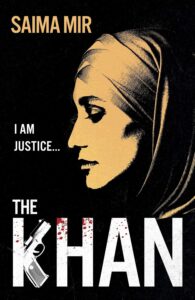
Saima Mir is a journalist who has written for the Times, Guardian and Independent, and her debut novel The Khan