
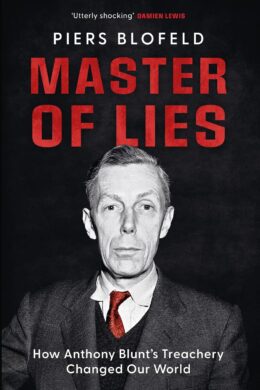
Sir Anthony Blunt is as famous today for having a walk on part in The Crown as anything else. The traditional story about him goes something like this: gay art historian who became surveyor of the Queen’s pictures, knighted by her in 1956, he had worked for MI5 in the second world war and in 1979 Margaret Thatcher outed him on the floor of the House of Commons for having passed over British secrets to the Russians during the war, when they were our allies in the fight against the Nazis.
In other words, he was a naughty boy. Helping the Russians help us to win the war against Hitler might have been against the rules, but in many people’s books it is hardly a major crime. Even if Stalin did turn out to be as big a monster as Hitler, there were plenty of people who took a long time to acknowledge that fact – and during the war it made sense to fight one battle at a time.
When they were briefing Margaret Thatcher, the Cabinet Office (who have oversight of the secret services) were keen to stress that not only did it seem as if no one (other than Nazis) had died as a result of Blunt’s actions but, crucially, what he did was not the capital crime of High Treason. That involves helping an enemy to wage war against us.
But what if that is a comforting fable. What if what Blunt did was infinitely worse than that and he was in fact passing secrets to the Nazis in order to help Stalin? What if tens of thousands of British and Allied troops died as a result of his treachery – and countless thousand more innocent civilians both in Britain and in Europe?
For most people the word spy evokes an image of a James Bond/Jason Bourne type of figure – athletic and fearless, the sort who can break into the enemy’s secret compound, snap a few necks and abscond with the blueprints to Project X before anyone is any the wiser.
This of course is complete fantasy– but it is a fantasy with one small foot in reality: at its most basic spying is about stealing your enemy’s secrets. But in truth that is entry level stuff – potentially useful in times of war, but much less significant in times of peace.
Those who develop a taste for the spy genre soon move beyond James Bond and on to the more psychologically complex worlds of John Le Carre and Mick Herron. Deeper into what James Angleton called the ‘wilderness of mirrors’ (he was quoting T.S. Eliot). These books at least start to recognise that a far more effective and dangerous tool of espionage is deception: fooling your enemy into believing the wrong thing and taking the wrong course of action as a result. That can have devastating impact. It is also a process which can take place over decades, performed by people who may never be recognised as spies and never do anything as obvious as photograph a document.
As I was writing my book about Anthony Blunt, Master of Lies which focuses on just this aspect of the Russian penetration of British Secret Services and Blunt’s central role in deceiving the people we pay not to be fooled by the enemy – one of the things which puzzled me most was how little the many books I read on the subject deal with this more serious aspect of espionage.
It’s a real oddity. By common consent the crown jewels of the British secret war against the Nazis are famous deception operations such as Operation Mincemeat – aka the man who never was and Operation Fortitude, the D-Day plan which fooled the Nazis into believing that the Normandy landings were a feint and so as a result they kept a huge part of their army in reserve to counter a threat that never materialised.
If deception is what we are most proud of, it is hardly unreasonable to suppose that is also true of the Russians. After all they had spies in senior positions all four branches of British Intelligence – MI5, MI6, SOE and GC & CS (aka the code breakers at Bletchley). British intelligence was wide open and yet the literature, the histories of these events tend to focus on the quantities of documents stolen – as if treachery can be measured by the kilo.
Tellingly though there is one exception – a book I only discovered after I had written Master of Lies. It was written in the 1980s and the fate which befell it hints very strongly at the reason why Anthony Blunt’s crimes have remained hidden until now.
Secrets of the Service was written by a young academic called Anthony Glees and it patiently and painstakingly asks exactly the kinds of questions that I ask above: if deception is the serious end of spying, then what kinds of deception did Stalin’s Englishmen perpetrate on the British secret services and, therefore, the British Government.
In 1985 these were questions which it was still dangerous to ask. As soon as it was published Anthony Glees found himself and his book under attack. A very senior and eminent official historian M.R.D. Foot wrote a deliberately damaging review rubbishing the book’s findings and then, the coup de grace, one of Glees’ sources, an MI6 officer called Stephen de Mowbray, had second thoughts about his support for the book and sued the author and publisher for libel.
Secrets of the Service was pulled from sale and although the libel case never went anywhere the damage had been done. The book disappeared from view and with it anyone asking the wrong kinds of questions about Russian penetration of the British state.
Blunt’s crimes are terrible – he is, in my view, soaked in blood, arguably the greatest mass murderer in British history. The secret state has never been more powerful or unaccountable and today we find ourselves mired in spy scandal after spy scandal. ‘Secrets are addictive’ Herbert Hoover famously said. Seen in that light, the cover up of Blunt’s crimes and the secret services failure to acknowledge their own failings is a shadow which looms over us to this day.
Master of Lies: How Anthony Blunt’s Treachery Shaped Our World is published by Quercus.