
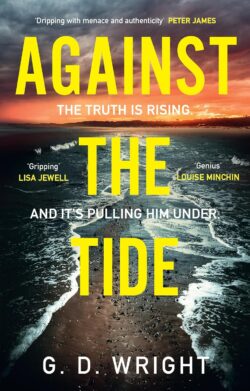
Skeletons emerging from the closet is something that I explored in my previous book, INTO THE FIRE, and something that I’ve dived in on again in my latest offering, AGAINST THE TIDE. It’s one of those age old questions – what happens when events of the past catch up with us in the present day? Is it better for things to be out in the open? Or should those things be consigned to the history from whence they came?
Context, I suppose, is everything. Take any historical and serious crime of note, murders most notably, where an offender has been living under the shadow of their offending, but where they are the only one who can see the veil of gloom that cloaks them. It is pretty cut and dry that them being exposed is a good thing. Of that, I am sure that there is universal accord. But what about where the water is a bit murkier? Where the context invites us to consider a whole range of narratives, rather than simply being for the public good. What then? That’s where I think that things get a whole lot more interesting.
Let’s set up an example (purely fictional, I hasten to add!). A dad, who is the best father to his kids. A wonderful husband to his wife. A family man, through and through, who volunteers at the local football club and has never so much as had a speeding ticket.
He’s also a murderer, at least in the eyes of the law.
His mother was in a care home, suffering badly from some kind of terminal illness, and she was in her last days. Our family man was on his own with her and, entirely at the end of his wits with seeing his dear old mum suffering, he took hold of a pillow and did the deed. She was dying, right? She didn’t suffer – the medication made sure of that. All he did was adjust the timescales a little bit, to hasten the inevitable. There’ll never be a post-mortem – her death was imminent and would be signed off by a doctor in a heartbeat. He can sleep at night with a clear conscience and has never, ever told anyone. Is that something that needs to be dredged up years later? The laws of the land say yes, probably. You and I, though? Who knows. An entirely fictional scenario but, I dare say, one that has probably been enacted on numerous occasions across the land.
I find these questions fascinating, and that’s why I write about them. In AGAINST THE TIDE, the tagline is ‘if the truth could destroy you, would you choose to know it?’ We focus on DC Vinny Robson, and a set of diaries written by his mum some forty years prior. Those words, those sentences, they take him to the very brink, and have him questioning everything about his life. It poses the fundamental question I ask above – would it have been better for Vinny to have never found out the things that he did? I’d suggest probably, but who am I to answer for him. I only wrote it!
Let’s return to our fictional family man, who has had a couple of beers and has let slip to his wife what happened over a few glasses of wine down the pub. His conscience was clear, but that didn’t mean that it didn’t eat away at him. The two things aren’t mutually exclusive, after all. So he lets her know what he has done, and why he did so. She totally gets it. Who wouldn’t? Well, the bloke at the table next to them who loves a gossip, that’s who. He knows them. He knows everyone who lives in the area. More importantly, that wine our family man had been drinking had made his voice a couple of decibels louder than he meant, and our nosy parker has heard them, too. Within hours, it’s all over the manor. Within days, the police come knocking. Handcuffs. Meat wagon. Police cell. Interview. The whole damned show. Court is inevitable, and our family man is hauled in front of a judge with the world’s media watching, as the debate around assisted dying swirls around the television breakfast sofas and at the water coolers in workplaces up and down the land. Our family man gets convicted of the lesser crime of manslaughter, and serves five years in jail. Is that right?
Or, in an alternative universe, he didn’t speak to his wife in the pub. The nosy neighbour didn’t hear what they were talking about. There was no arrest, no interview, no custody, no trial, no debate in news rooms. He just got on with his life, with the story about how his mum died tucked up under lock and key in his heart. No-one was any the wiser, and everyone got on with their lives.
Which outcome best serves justice, do we think? Which best serves the public? In my eyes, there is no right or wrong answer. Perspective is everything. You and I may have totally different opinions based on a whole range of factors, from lived experience to moral or religious beliefs.
It is in these grey areas that I love to write. It’s where I find myself getting absorbed in the characters as much as the story, and where I pull on my readers’ heartstrings as much as they’ll allow me to get away with. Writing is part of my identity, and putting it into stories like these is where I am at my happiest.
Against the Tide by GD Wright is published by Avon on June 18th.