

Research is the most time consuming but also the most important part of my writing process. And to my delighted horror, delving into the world of true crime is an essential part of researching a thriller. Until I started writing Five, which is my third book but my first thriller, I did not think that the myriad of true crime podcasts and documentaries was for me. I am the sort of person who can’t watch scary movies, I have to shut my eyes during violent scenes in TV shows, and I don’t like gory or graphic details of any kind. I was also put off by the normalisation of violence against women as entertainment, particularly sexual violence, and the constant portrayal of young women as helpless victims in many of the more salacious stories.
But I quickly learned that there is much more to the world of true crime than murder and mayhem. And there is a reason why so many people are drawn into these stories. It’s because they’re true. And the extraordinary humanity of ordinary people who survive terrible things is too compelling to turn away from, because at our core, we hope we possess that strength too. We hope they are reflecting our humanity and who we could be in a crisis. Betrayal, scheming, greed, double lives, abandonment, and scams are what may draw us into true crime at first. But we stay because of the people, their bravery, their strength, and their instincts which we know all of us possess, or we at least we hope we do. ‘You can’t make this stuff up,’ is what is often said about these stories, which is exactly why I, as someone who makes stuff up for a living, finds true crime stories to be so important for research and it’s where I turned for inspiration for Five.
The characters in Five have been most often described by readers as unlikable and dark. I will also accept unhinged, narcissistic, selfish, and psychopathic as fair descriptors. They are a child, a mother, a businessman, and old woman and a gambler. We are told by the narrator that they are all standing on a train platform, and that in five minutes, one of them will die. The idea came to me on a London bus. I was thinking about stories, and I thought that if you lined up everyone on the bus on the street and asked them to tell their life story, you wouldn’t believe what you would hear – the triumph and tragedy, the joy and grief, the successes, the failures, the heartache, the love. If you wrote those stories down readers would say that it just wasn’t plausible, they would be so much more fantastical and unbelievable than any fiction you could invent. So I wanted to present five lives that were completely different from each other and that appeared ordinary at first but were far from it when you dug down into them.
But how to do that? How could I invent life stories that surprised readers, unsettled them and challenged their assumptions? Whenever I doubted whether something I wrote was believable I would listen to a true crime podcast and then I’d get the boost I needed to push the characters further, to make their stories darker. When I thought I had delved into the darkest corners of my own heart to pull up gripping emotions that make you want to turn the page, I would listen to some true crime while driving or making dinner and realise that I could take it even deeper, because real people are deeper than you can imagine. In writing Five I learned that things that happen to people in real life can be so extraordinary and so unimaginable. The trick was to take risks with my characters and to push the lives I imagined for them to the brink of real humanity to get them to match the depth of the emotion that real people live with every day.
The other trick is to make sure that lightness exists somewhere, even in the darkest story. That’s another reason we love true crime and why it was so helpful in my research. They are tragic stories, but they all contain slivers of hope, sometimes even redemption, and often survival. They remind us of our resilience, our strength, and our ability to overcome. People can surmount enormous difficulties as long as we can still see the light. While leaning into the darkness can be fun sometimes and is part of the entertaining aspect of true crime stories, unrelenting darkness is not the point. Introducing light is important to tell a good story. And the light is also real. As heartbreaking or shocking as true crime stories can be, they also teach us so much about forgiveness, redemption, and the human spirit.
I hope that light exists for each of my five passengers. For some of them, it comes later in life, after learning many lessons. For others, it is hard to see even though it is there all along. I hope too that readers feel that as we walk the twisted paths of these characters’ lives over the wreckage of bad decisions and through the aftermath of life’s catastrophes that we are walking with them toward the light.
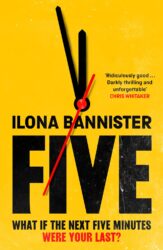
Five by Ilona Bannister is published by Juniper.