
As I read the posts, messages, and occasional moans of fellow writers, one question keeps surfacing: how do you get an agent to respond, let alone sign you?
I have mixed views. What follows is purely personal and, may ensure I never get representation unless it’s from a defence lawyer. In simple terms, I’d rather dispense with an agent than a publisher. I write to be published, not represented.
In my former life as a film and TV producer, I occasionally locked horns with the great and the good from WME (original talent agency) and CAA (Creative Artists Agency). The fiercest agents of all, armed with telephone books of riders, representing major acting talent. I once had to park Donald Sutherland’s trailer at a precise angle to accommodate local feng shui lines.
Scriptwriters’ agents, though highly commercial, were less onerous. What they did secure for their clients, however, was respect. Back then, no script got read without an agent. Today, that gatekeeping feels less absolute. In terms of book publishers, some now accept direct submissions, particularly outside the orbit of the majors. These publishers are smart, commercial, fast-moving, and thriving in a competitive market. In other words, everything you’d expect from an agent.
Signing with an agent doesn’t guarantee a publishing deal. I’d be fascinated to see how many represented authors still remain unpublished. Contrast that with the roughly 250,000 self-published books landing on Amazon each month, and almost none have agents. It’s enough to squeeze out a drop of sympathy: agents must be inundated, forced into brutal shortcuts and rejected before reading a word.
So why the struggle to find an agent?
Top-tier agents can still exert pressure on publishers and spark bidding wars – if you’re that client, congratulations. The question is, are you?
Many younger agents seem to be hunting for the one career-defining discovery, sometimes overlooking solid, commercial work that may be less glamorous but more reliable. That may not serve the agency, or the industry, particularly well.
Of course, everyone dreams of finding The Alchemist, Life of Pi, or Zen and the Art of Motorcycle Maintenance. But those are lightning-in-a-bottle moments. How many Spielbergs, Stings, or Hilary Mantels are there? An agent might encounter one in a lifetime, if they are lucky. You keep an eye out for brilliance, certainly, but not at the expense of bread-and-butter publishing.
Because here’s the unfashionable truth: many bestselling books are, structurally at least, achievable for those dusted with a little creative ooffle-dust. They are the industry’s engine. And right now, that engine feels oddly undervalued.
I remember early in my TV career when everyone wanted another Twin Peaks while quietly making fortunes from Murder She Wrote, Dallas, and Law & Order. Prestige is lovely. Profit keeps the lights on.
When I shifted to writing, I was surprised how often agents asked not for examples of the manuscript but for a one-page letter and synopsis. It felt like reviewing a restaurant by reading recipes. Equally puzzling was a strong focus on topics reflecting personal interests: environment, social themes and latest trends.
Important? Of course. But a good agent should track the breadth of reader interest, not just their own. Otherwise, you narrow the field and potentially miss the unexpected voice. Quality of storytelling should be the constant.
Television offers a parallel. The explosion of platforms has produced a wave of quirky, offbeat series, much like the books agents say they want. Everyone wants the next Breaking Bad. Yet the failure rate has been eye-watering. Meanwhile, the consistent successes? Knives Out, Reacher, The Lincoln Lawyer, Cross, and much of Reese Witherspoon’s Hello Sunshine slate; largely rooted in bestselling, accessible storytelling. The misfires? Often ambitious, left-field originals like Vinyl, Sense8 or The Get Down.
I would suggest that publishing has its equivalents and here you can fill in your own blanks… I’m not going to kick an author when they are down.
There are moments I’m surprised by what achieves representation or is published. This opinion is not out of sour grapes but as a wide reader. Increasingly, the kind of commercially driven storytelling that once dominated feels less visible. Perhaps that’s just age talking, perhaps I’m becoming the frame rather than the picture?
Either way, my advice to aspiring authors would be this: worry less about securing an agent and more about your route to readers, whether that’s self-publishing (and joining 250,000 others each month) or finding a sharp, committed publisher.
And if success comes, and it does for some, the agents will find you. For your own amusement, make them wait for a reply!
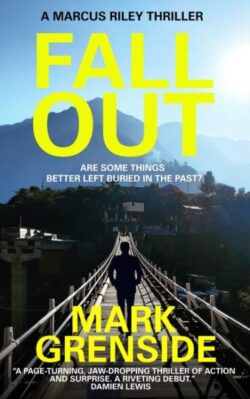
Fall Out, The Bastion & Sunset Circus and by Mark Grenside will be published by Sharpe Books.