
A non-crime writer’s perspective
Col-umn 3.
Over my dead body
I know what you’re thinking. “Who is Col Newton?” and “Why is he writing a column for Aspects of Crime?”
To answer the second question first, that’s something you’re going to have to take up with the esteemed editor of this publication. He offered me the gig. I took it. As far as I’m concerned, that’s all there is to it. I’m a writer. I’ve got to earn a living somehow.
Some may say that churning out content for one of the more obscure corners of the internet is beneath me. After all, I’m the author of the critically acclaimed literary novel, Solstice (“extraordinarily… crafted…” TLS). But believe it or not, it’s ten years since that book came out. Each year, the “TOTAL RECEIVED” figure on my Royalties Payment Advice has mysteriously dwindled, until this year there was no payment advice at all.
At this rate, I’m never going to pay off my £450 advance.
So, to return to the question of my motivation for writing this column, desperation obviously plays a part. The advent of generative AI has not made the life of the jobbing writer any easier. Of course, there are those who tell me I should bow to the inevitable and get Claude to write these columns for me. If it’s good enough for Take-A-Break Fiction Feast, then it’s good enough for you*, they say.
I’ve got one thing to say in response. Over my dead body.
To my loyal readers, I make this promise: this column is now and always will be written by a human being. Namely, me. If you ever suspect the soulless “hand” of AI, there can only be one explanation. That’s right. I’ve been got. Murdered, probably. Or at the very least locked in a basement somewhere, my wrists zip-tied behind my back, a gunny sack over my head.
If that sounds paranoid, understand that there are powerful forces at work here. Vested interests with a lot to lose. I’m not in a position to name names. Let me just say I suspect a cabal of Silicon Valley tech bros and the British crime writing establishment. (I have been reliably informed that the latter is less than happy about a non-crime writer landing arguably the top punditry job within the crime fiction world.)
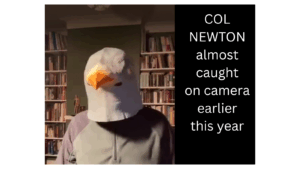
Right now, I’m standing in front of a wall filled with headshots of the country’s most prominent crime writers and American tech CEOs. A criss-cross of Sharpie-drawn lines connects them.
If you ever read a Col’s Column that contains the construction “it’s not just X, it’s Y…”, all the evidence you will need to bring the guilty to justice is here.
*Bauer Media recently contacted regular contributors to Take-A-Break Fiction Feast notifying them that from now on all stories will be generated by AI. Ed.
Col-umn 2.
Suffer for your art
“The only truth is forged in fire.” These words from The Witcher Series Four came to mind today when I was searching for quotes about the relationship between art and suffering. Others have expressed similar sentiments, including the Buddha, who allegedly said “Life is suffering”, although many believe he said something else entirely. What is almost certainly true is that Kafka wrote “Art for the artist is only suffering, through which he releases himself for further suffering.” But we can all Google.
The idea of the tortured artist has been criticised as a romantic myth. The truth is, it’s very difficult to write when you are in pain, as I discovered recently when a waitress tripped and spilled some boiling water on my hand. The initial pain was bad enough but then the burn got infected, probably because of my poor wound hygiene.
The point is that my art suffered because of my physical suffering. I just couldn’t concentrate on what I was trying to write, conclusively disproving the claim that art is borne out of pain.
But whether we like it or not, pain is present at every stage of the writing process. From the fine exquisite agony of a papercut to chronic backache from sitting too long in an Ikea office chair. I could also mention gastric cramps caused by over-caffeination, as well as screen eyes, RSI, and, of course, the emotional pain of rejection. We writers have multiple crosses to bear.
And yet we continue to write despite these torments. Is our courage ever acknowledged? Our fortitude ever honoured? Is the festering sore beneath our grubby bandage ever met with sympathy rather than disgust? No. We are simply told to “get a proper job”.
I’m not asking for a medal. On the contrary, I merely wish to place a sympathetic arm around the shoulders of my fellow writers. I feel your pain and I’m here for you.
Perhaps we need to toughen up? I probably shouldn’t say this as I have signed the Official Secrets Act, but I was recently approached by a member of the Secret Intelligence Service. In fact, this is the second time he has contacted me.
As part of my induction into the world of espionage, I underwent a course of “torture resistance training”. One of the techniques I was taught was to close my eyes and mentally go to the place where I feel happiest. For me that is the Amazon page of my novel Solstice. I find that I receive tangible waves of dopamine when I imagine my Amazon rank reaching single figures. If you’re a writer, you might want to try it next time a plot hole is giving you a headache.
Col-umn 1.
Find your inner criminal
I probably shouldn’t tell you this as I have signed the Official Secrets Act, but a couple of years ago I was recruited by MI6 to write a novel which would be used to prop up the cover story of one of their agents posing as a novelist. And I use the word posing advisedly. I think it was this unique lived experience that prompted the editor of Aspects of Crime to ask me to write this column. “Col,” he said. “I’m sick of all these bloody crime writers who have no actual experience of what they write about. I mean, have any of them actually killed anyone? Or even shoplifted a set of pens from Rymans?”
With all due respect to my esteemed editor, his remark betrays a certain lack of understanding of the way we fiction writers work. We live everything that we write about. But we live it in our imaginations. And for many of us, the world of the imagination is more real than the world of so-called reality.
Also, I believe there was at least one famous crime writer, now sadly deceased, who was a murderer. There may be others that we don’t know about. Remember that the next time you’re at the Harrogate Crime Festival. And I should say that I did very nearly walk out of the Muswell Hill branch of Rymans with a notebook I hadn’t paid for, which precipitated a very uncomfortable encounter with the security guard. In my defence, I had a lot on my mind at the time. In fact, I was fairly sure I was being followed by a Russian spy who I suspected wanted to kill me. But that’s a story for another time.
These reflections remind me of the old chestnut that is frequently offered to aspiring writers: Write what you know. I used to think the better advice would be: Write what you don’t know! As the very act of writing leads to knowledge of the thing you’re writing about.
But I have come to realise that write what you know is in fact not just good advice, but essential advice. It is just too narrowly interpreted.
It doesn’t mean that if you have spent your life working in a rubber band factory, all you’re allowed to write about is rubber bands. Or that if you want to write a crime novel you must go out and commit a crime. Rather it means, look inside yourself and find your own truth to write about. In the field of crime writing, find your inner criminal. The truth is, we are all capable of murder. I know I am.
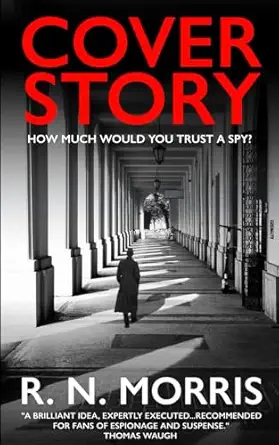
Col Newton is the author of the critically-acclaimed, if commercially underperforming, literary novel Solstice. You can get to know him better by reading Cover Story by R.N. Morris.
we are indebted to Roger for contacting Col Newton and although we couldn’t pin the elusive author to a contract we have got him to agree to write a regular column for us. He is currently working on the next piece.
COVER STORY RN Morris