
I write for two people.
That is the entire business plan, and I am aware this would get me escorted out of most business schools by campus security.
The first person is me. I make the thing I want to exist in the world, the thing that scratches my own strange little itch, with no committee in the room, no spreadsheet glowing in the corner, and no imaginary high-pressure marketing executive clearing his throat over my shoulder.
The second is my best friend, who has been the sole audience for the Marv Slocum books since the beginning. I send him chapters a few at a time and wait for the verdict. When he roars, I know I have it. When he goes quiet, I know I have to go back, burn the chapter to the foundation, salt the earth where it stood, and pretend I never thought that joke was acceptable in public.
There is no focus group on earth more honest than a bored friend. There is no review more precise than the sound of someone you love putting their phone down because the book has beaten the phone. In the modern world, that is not a compliment. That is a miracle, truly water into wine.
And beyond those two people?
Whatever.
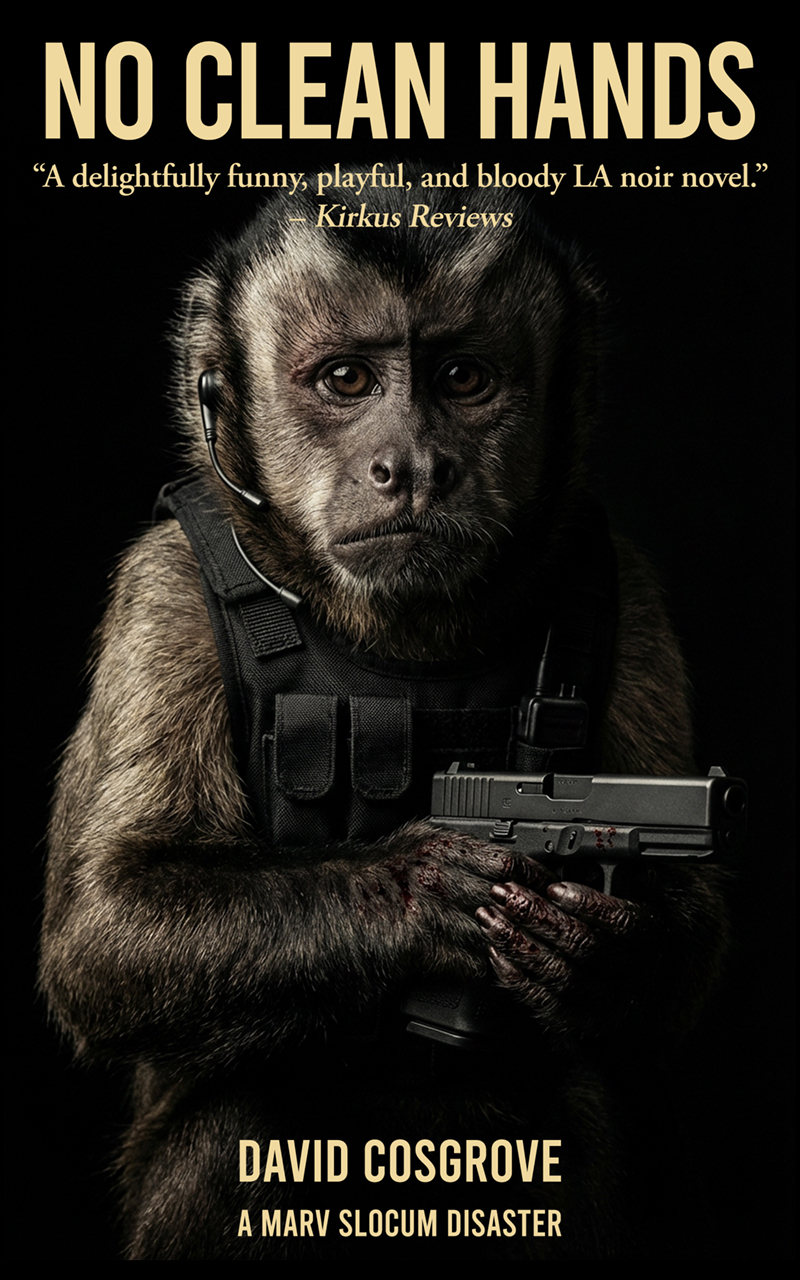
The current result of this terrible business model is No Clean Hands, a darkly comic LA noir novel about a disaster-prone survivor named Marv Slocum.
If the wider world finds the books and loves them, wonderful. I am thrilled. The door is open. Come in. There may be snacks! But I did not build any of this for the wider world, and the instant I start to, I can feel the work go stiff and polite and dead in my hands. It starts wearing a blazer. It starts saying things like “target demographic.” It becomes the kind of prose that owns a ring light.
Two people are the entire intended audience.
Everything else is weather.
Quincy Jones put it better than I ever could: “The moment you start thinking about money in the creative process, God walks out of the room.” I have come to believe he was simply, flatly correct, about music and about everything else. The instant a royalty statement or a sales rank wanders into the room while I am working, something essential stands up, quietly gathers its coat, and leaves. You can feel the temperature drop.
So I keep that door shut while the work is happening. The commerce can wait out in the hallway with everybody else. It is, after all, only weather.
This is not a pose, and it is not modesty. I am not sitting here in a linen shirt pretending to be above earthly things while secretly refreshing Amazon rankings like a raccoon with a gambling problem. I care. Of course I care. Anyone who says they do not care whether people read their work is either lying, dead, or very successfully medicated.
Besides, I did not invent any of this. Every good artist is a magpie with various levels of taste and a guilty conscience. Mozart helped himself to Haydn. Beethoven helped himself to Mozart. Half the twentieth century let itself into Stravinsky’s house through a side window and walked out with the good silver. Giants standing on the shoulders of older giants, picking their pockets on the way up, and the only difference between the honest ones and the rest is that the honest ones wave on the way out.
But caring about what happens after the work exists is different from letting that concern into the room while the work is being made. That distinction matters. It may be the whole thing.
People assume you write a novel for The Reader, that vast imaginary jury you are forever auditioning in front of. That is exactly backwards. Write for the jury and you produce something careful, hedged, sanded down, focus-grouped into a fine gray paste. Write for one person you love and you produce something alive, because you are no longer trying to be respectable.
You are trying to be irresistible.
Those are very different jobs, and only one of them is any fun.
Here is the strange part. Writing for an audience of two does not shrink the work. It makes it braver. There is no version of Marv Slocum that survives a marketing meeting. He would be killed while slide two is loading, meeting adjourned.
Marv is a forty-seven-year-old disaster magnet who looks closer to sixty, and on certain mornings, older than some forms of sedimentary rock. He is perpetually sweating in a way that suggests his body has given up on the entire concept of temperature regulation and is now operating under maritime law. He wears a blue tie that has witnessed things it will be processing in therapy for years. His suits look slept in because they were, often under duress, and not always indoors.
Disaster radiates out from him in tidy concentric rings, like a stone dropped in a pond, if the stone owed money to the pond and the pond knew people.
No committee approves that man!
But one friend, laughing himself stupid at midnight, will follow him anywhere. So I follow the friend.
The genuinely funny thing about working this way is what happens when the work occasionally escapes its two-person quarantine. Because then the reactions arrive completely unmediated by any of the usual polite machinery, and they are spectacular.
One of my clients took No Clean Hands on a tropical vacation, the kind of trip where a book is supposed to lose, badly, to a turquoise ocean, an open bar, and a sunset behaving like it has an agent. He read the whole thing anyway, presumably to the mounting concern of everyone around him. Somewhere there was probably a loved one asking, “Are you coming in the water?” while he sat squinting at murder jokes under a palm tree.
When he finished, he emailed me, and the entire message was five words:
“who knew you had talent?”
I have received a great many notes about my work over the years, some from very serious people deploying very serious vocabulary. None has ever pleased me more. It is the perfect review: backhanded, astonished, and one hundred percent sincere. A compliment and an insult holding hands. I am considering having it tattooed somewhere visible, though perhaps not somewhere that would require an explanation at airport security.
Then there was the stranger. Not a friend, not a client, not anyone I have ever met. A complete unknown who picked up No Clean Hands — the same book, arrived at from the opposite direction — read it, and left a review on Amazon that went the opposite direction from my vacationing client entirely, and which I treasure just as much. It reads, in full:
“Sometimes it is necessary to get one’s hands dirty and herein the dirt rises as the disasters accumulate ankle deep, knee deep, neck deep… This is surely top-shelf writing, thoroughly and outlandishly engaging, memorable characters, descriptions that lock into one’s consciousness (seared in), nail-biting (with bloody fingers), mind-expanding (no hallucinogens necessary), gritty (check your shoes), bloody, gnarly, visionary (through a glass darkly), gonzo grotesque, surreal, nastily nihilistic, mesmerizing, prestidigitating, absurdly poetic, dark, highly-energized, a long and winding road of profound discoveries, sharp corners, and roiling mysteries. If one could put Kurt Vonnegut, Dostoyevsky’s ‘notes from underground,’ Percival Everett, Carl Hiassen, Edgar Allan Poe, Albert Camus, Franz Kafka, Michael Connelly, a ‘twenty first century schizoid man,’ J.S. Bach, the best of prog rock, Bartok, Edvard Munch, Jackson Pollock, Max Ernst, and George Carlin in a mixer, out would pour the outrageously masterful work of David Cosgrove and his utterly thrilling, roller-coaster rides over to the dark side with disaster-prone survivor Marv….looking forward to the next set of adventures… If anyone knows a major publisher, send them copies of the books by D. Cosgrove — a wide audience awaits…”
I have read that paragraph more times than I will admit. Bach and George Carlin and Edvard Munch in the same sentence, about a book I wrote, ending with a stranger volunteering, unprompted, to handle my distribution strategy. Here is what makes it land even harder: they had read the very same book my vacationing client did, and come out the far side sounding like an entirely different person had a stroke of genius. One friend, astonished I pulled it off. One stranger, mid-sentence, drafting the marketing plan. Same book, opposite doors. I keep both notes where I can see them, because between them they map the entire deranged territory of doing this. A friend cannot believe I pulled it off. A person I have never met has, entirely of their own accord, appointed themselves my head of distribution. Somewhere in the gap between “who knew you had talent” and a total stranger announcing that a wide audience awaits is the actual lived experience of writing these books.
Both of those notes mean the world to me precisely because I was not writing for either reader when I wrote the book. I was writing for the original audience of one, and for myself. The strangers and the clients and the someday-readers were weather the whole time: pleasant when it is nice out, irrelevant to the work itself.
You cannot write toward applause you have not received yet without the writing knowing. And the writing always knows. It can smell neediness through drywall.
So that is the confession, such as it is.
No grand theory of the market. I would love a bestseller as much as the next lunatic with a keyboard — I just refuse to write toward one. And if a major publisher happens to be reading, a complete stranger on Amazon has assured everyone a wide audience awaits, and who am I to argue with the reviews. Just two people, one of them me, and a sweaty man from Van Nuys whom we both find inexplicably worth following into one catastrophe after another.
Kirkus called No Clean Hands a “delightfully funny, playful, and bloody LA noir novel,” which I will happily take, because that particular collision is the entire thing I am chasing. Funny and bloody. Playful and horrible. A joke walking directly into a crime scene and realizing, too late, that it forgot to wear gloves.
But the review that actually runs the engine is shorter and ruder and arrives by text, usually after midnight, usually just the words:
“More!! Hurry!!”
And somewhere, my best friend is still laughing. Relentlessly, like a drum machine. Or the roaring ocean. Or an ulcer.
That was always the only forecast that mattered.

{“origin”:”gallery”,”uid”:”88AD4143-92D1-4725-BF38-545A6A839C60_1613436365482″,”source”:”other”}
NO CLEAN HANDS is published now.