

David Cosgrove is the author of The Disaster Files featuring hapless private eye Marv Slocum. The series kicked off with The Meridian Job and its out of the frying pan into the fire for a second outing in No Clean Hands.
I invited David to tell us about Marv and his new latest novel, No Clean Hands.
David, hello and welcome to Aspects of Crime.
Thanks for inviting me, Paul.
You have a very successful career in business — you’ve run a digital marketing consultancy for thirty years. A lot of people might be content with that, but you have your music and your writing. Have you always wanted to be a novelist as well?
In some form, yes. The itch was always there. I’ve spent thirty years in digital marketing, building campaigns and telling other people’s stories for global companies and platinum-selling artists, and that work is genuinely satisfying. But there’s a difference between being the architect behind someone else’s voice and finally using your own. The writing and the music are where I get to be myself, where I follow an obsession down a hole nobody asked me to dig. I think a lot of people who build careers in persuasion eventually need a place where they’re not selling anything. For me that’s both musical composition and words on the page.
Yes, it must be liberating. We at Aspects of Crime are crime lovers, but we’re not completely blinkered (blinders in the US), we read other genres too. Tell us about your sci-fi writing.
The Del Piombo and the Lost Masters series is the big one. It’s a two-part, roughly 1,200-page time-travel epic that’s a completely different animal from Marv Slocum. Where the crime books are vicious, out of control, over the top, brutal, grimy, and street-level, this is sweeping and strange, playing with the mechanics of time and the idea of lost art and lost people across history. It scratches a different part of my brain entirely. Crime fiction is about consequence catching up with you. The sci-fi is about whether you can outrun consequence altogether, and what it costs to try. Del Piombo and the Lost Masters is inspired by my life as a composer…more on that shortly.
I see the distinction, so when it comes to the crime writing and that sense of letting go completely, who would you say are your influences? What books inspired you?
Carl Hiaasen is the first name on the list, and probably the patron saint of the whole enterprise. He has an insanely sick sense of humor welded to genuinely brilliant storytelling, and nobody alive is better at the hairpin turn. One sentence you are admiring the light over the Florida Everglades, the herons, the saw grass, the whole postcard, and in the very next he is feeding some unsuspecting retiree to a crocodile, and somehow you are laughing before you have finished being horrified. That is the entire trick, executed at the highest level. He makes you complicit, gets you grinning at something genuinely monstrous, and leaves you to sort out your own conscience later. Then there’s Mick Herron, who showed me you can run real menace and laugh-out-loud comedy in the same breath without either one cheapening the other; the Slow Horses books are a master class in the lethal joke. And who could overlook Don Winslow, whom I’d put among the greatest living authors: his depth, his research, his gift for extreme and devastating detail are simply unparalleled, proof that the comic and the catastrophic both demand you actually know the world stone-cold before you have the nerve to set it on fire. Beyond all of them runs the LA noir tradition, in everything I do. That sun-bleached, morally exhausted California where everyone is running an angle and the light is always a little too bright for what it is illuminating. Because the conviction under all of it is this: the funniest moment and the bloodiest moment can be the same moment. Not alternating, dark then funny then dark. The whole trick is getting them to occupy the same square inch of the page.
I agree with you about Don Winslow and I see where you’re coming from but what was the idea that led to The Disaster Files?
It started as entertainment for an audience of one. I was writing these stories for my best friend, and he roared with delight at each new offering, which was the best fuel imaginable. The Disaster Files and Marv are, first and foremost, for my own amusement. That’s the engine. As for the premise itself, the disaster is the idea. Most crime fiction gives you a competent operator moving through chaos. I wanted the opposite, a guy who is himself a kind of slow-motion catastrophe, where calamity radiates outward from him in concentric rings. Once I had that, a man around whom bad things simply happen, relentlessly, almost cosmically, the books wrote themselves. It’s a disaster file in the literal sense. A case record of everything that goes wrong in his orbit.
Sounds like a great reader but I’m sure new readers are enjoying the dark humour and gonzo action too. Where did Marv Slocum come from? A lot of bad things happen around Marv.
Marv showed up almost fully formed, out of that same mysterious dimension that my music comes from. Forty-seven going on sixty, rumpled, perpetually sweating, a blue tie that’s seen things, suits that look slept in. He’s from Van Nuys, which tells you most of what you need to know. Perpetual middle-distance, neither glamour nor ruin. The “bad things happen around Marv” quality is the whole point. He’s not unlucky in a cute way. He’s a magnet for catastrophe, and part of the comedy and the tragedy is watching him absorb it, again and again, and keep going. He’s defeated but not destroyed. There’s something almost heroic in how thoroughly he endures.
I think you have to admire that ‘get knocked down but get back up again’ quality about Marv. Tell us about No Clean Hands, Marv’s second outing, please David.
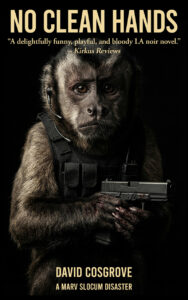
It’s bigger, meaner, and far more globe-spanning than the first. Kirkus Reviews called it a “delightfully funny, playful, and bloody LA noir novel,” which I’ll happily take, because that tonal mix is exactly what I was after. It’s a chunky thriller with conspiracy, action, music, and comedy all in play, but the spine is still Marv. This beleaguered figure trying to keep his footing while the ground keeps disappearing. The title says it all. Nobody in this book gets out clean, including, especially, the people who think they have.
I have to ask — who designed the brilliant cover?
That would be me. It’s another piston firing in the creative engine. I designed the cover art myself. That capuchin monkey exists to make a reader stop, look, and say “what is THIS now?” — and then, once they’re in and the joke detonates, burst out laughing. A great cover does what a great opening line does. It makes a promise about tone. This one promises you’re in for something playful, totally unhinged, and quite possibly insane, which is precisely right.
It’s a great introduction to a hyper-thrill ride. We mentioned music earlier — you’re a composer too. There are music references in your books, so I guess it’s important in setting the tone?
Very much so. I compose and perform music under the name Del Piombo, with my catalog of cinematic orchestral music “Silver Screen Dreams” mastered at Abbey Road Studios. Music isn’t decoration in the books. It’s tonal architecture. A specific song or artist reference can do in one line what a paragraph of description can’t. It sets a mood, dates a scene, tells you who a character is by what they can’t stop listening to. I hear the books as much as I write them. There’s a rhythm to a good crime sentence that’s closer to music than to prose.
No Clean Hands is a chunky thriller, an epic. How would you describe the style? I know we’ve already touched on this. There’s a bit of comedy, conspiracy, action, globetrotting.
Maximalist noir, maybe. Over the top on purpose. It’s an epic that refuses to behave, with comedy crashing into conspiracy crashing into a genuinely globetrotting plot, all anchored by a man who is profoundly not equipped for any of it. I never wanted the comedy to undercut the stakes. I wanted both turned up to full until the knob snapped off. The model is that feeling where you’re laughing and then suddenly you’re not, and you’re not sure when the floor gave way. If a reader finishes a chapter unsure whether to grin or wince, I’ve done my job.
Thrills on the page but what’s your idea of a great night — out or in, a good book, the theatre, a meal, or the pictures?
Oh, a great night in. Nowhere I have to be, nobody I have to become. After thirty-plus years of deadlines and other people’s emergencies, the real luxury is an evening that belongs to no one but me. Because here is my dirty secret: I enjoy boring. One of life’s great secrets, one it takes most people far too long to learn, and some never do, is that peak existence is boring. It is quiet. It is peaceful. It is at home, with nowhere to be and no one to impress. A cup of tea. Or out in nature: a long, pointless, gloriously uneventful walk in the woods. Early to bed, and smug about it. The whole frantic machine of ambition is chasing a feeling you can get, for free, by sitting still in your own kitchen. I have manufactured enough chaos on the page to last several lifetimes. Marv can have all of it. I’ll be asleep by ten.
No way Marv would be in bed by ten! No Clean Hands is out now. Are you working on book 3?
Book 3, Rock Bottom Express, is already out and available on Amazon right now, and I’m currently writing book 4, Shore Leave. Which brings up something I should clear up. This started life as a trilogy, that was the plan, but it grew into something much larger in scope. At this point I’m just calling balls and strikes over here, it’s out of my hands. Marv simply has bigger fish to fry than I ever intended for him. So his troubles are very far from over, and if anything the catastrophe is only widening its radius. I tend to be working on several things at once across a few different names and genres, so there’s always more in the pipeline than I can talk about. But yes, the Disaster Files are WIDE open.
Glad to hear that, thanks David.
My pleasure, Paul
No Clean Hands is published as an eBook now
https://www.davidcosgrove.com/
https://www.linkedin.com/in/davidcosgrove/