Summer Reads – Crime Fiction for the Get Away
With another super heat burst on the way we all need to think about ways of chilling out and relaxing, there’s ice-cream of course but also a good book helps. Here are some of the recent favourites reads of Aspects of Crime authors.

Paul Burke: given that few of us will be enjoying the soaring heat of July I thought I’d opt for reading outside my comfort zone too. The End of Vodka (Extraordinary Books) is a fascinating international read from a writer more familiar to British readers for his highly entertaining Frey and McGray mysteries set in Victorian Scotland. Oscar de Muriel’s new book reflects his Mexican roots, though the story takes us from late 1930s New York, via Mexico to WWII Europe. It begins with the suicide of Dorothy Hale in 1938, a huge scandal/tragedy of the day. Whatever really happened with Hale it is the jumping off point for de Muriel’s invention and that leads us to the art world, to Frieda Kahlo, Diego Rivera and Claire Boothe Luce, major figures in the cultural set of the day. Clearly Kahlo, now finally getting her due, inspires the author. This is a psychological drama with elements of mystery, betrayal, assassination, conspiracy and spying. The prose is lively, the characters striking and the storytelling is engaging. An ambitious and original novel that will appeal to those with more exotic tastes but I hope traditional readers consider expanding their pallet. The Toscanini Conspiracy by Filippo Iannarone is an intriguing historical thriller that was a critical success in his native Italy. A popular doctor is attacked in the street in 1930s fascist Italy. The investigation is poorly handled, is that cock-up or conspiracy? Fourteen years later as the new republic is establishing itself post-War, with communists and fascists still vying for power, a former resistance fighter, Colonel Luigi Mari is summoned to Rome for a special task. To unofficially investigate the pre-War attack on the doctor. He told to be discreet. Arturo Toscanini is about to play a big part in the new government but he is rumoured to have been there when the good doctor met his fate. Mari wades through lies and secrets to find an elusive and uncomfortable truth. All the while putting himself and his family in real danger. This is in partly based on a real incident which is a fascinating aspect of the novel. A minor drawback is the translation which is at times uninspired, perhaps because it attempts to match the original prose style too closely. Overall this is intriguing and well researched giving it an authentic feel. Boyd and Beth Morrison’s Duel of Beasts is an historical epic that would not normally come across my desk but I’m glad it did, it is an idiosyncratic and strange tale but a lot of fun for that. Boyd has written his own novels and worked with Clive Cussler too and Beth is a medievalist/archivist. Set in 1352 in Málaga this is the further adventures of Knight Gerard Fox and his wife Willa. They travel to the home of Madelena in Málaga to deliver bad news. Her brother has died, she does, however, stand to inherit the family fortune, making her extremely rich. The problem is her sister-in-law, Helvira, wants the wealth she believes is her due, she will stop at nothing to get it. Helvira also has to recover a document which proves she is a traitor, her actions would offend both the Christian and Muslim worlds and could get her killed. No one is safe from the terrors of Helvira’s wonderful and deadly menagerie. A well-crafted read that draws you in and slowly beguiles. For me the read of the Summer is The Venetian Redemption (Constable). Every year I look forward the latest Philip Gwynne Jones’ Nathan Sutherland novel. It’s a joy to spend time with the British Honorary Consul in Venice, his wife, Fede, and their mercurial cat, Gramsci. As well as dealing with the myriad of tourist problems Nathan has become adept at solving crimes with the help of his friend Dario and the Questura, police HQ. The night of the Festa de Redentore, the grandest of festivals in the city of festivals, which celebrates deliverance from the plague centuries earlier, Nathan is with the illustrious guests at a function at, of all places, the Tax Police HQ. The British ambassador has turned up and Nathan and Fede mingles with the guests. Suddenly Nathan is taken violently ill, he begins vomiting and the next thing he knows he wakes up two days later in hospital. he suffered a near fatal case of food poisoning, specifically aconite poisoning, commonly known as wolfsbane. Nathan soon realises it could not have been an accident, then he approached by Signora Petracca, convinced someone is trying to kill her businessman husband. perhaps the two things are connected, perhaps Nathan was not the intended target. I like Nathan and his relationship with Fede (Dottore Federica) is always fun, the humour and the film and music references add to the richness of a beautiful setting and well crafted storytelling. Jones has a deep understanding of Italian life and culture while retaining that outsider’s eye. The easy to read, highly entertaining style is perfectly judged. This may be the best in a very decent series. There is a heartfelt quality to the story that all readers will recognise and identify with, though this is poignant it is also uplifting and compassionate. I always feel better for the annual outing in Venice. see Philip Gwynne Jones’ article, also on this website.
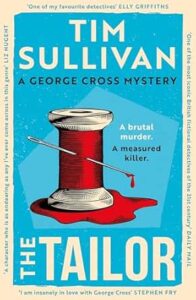
Mark Ellis: I’ve just read these recent crime books by 4 masters of their trade. I’m happy to recommend all as Great Summer Reads. The Bookseller by Tim Sullivan (head of Zeus). Tim Sullivan’s DS George Cross is a marvellous creation. The policeman is autistic which can cause problems with colleagues and people involved in his investigations, but his autism enables him to have unique insights which help make him a brilliant detective. In this book, as the title indicates, he investigates murder in the bookselling trade which is not quite as genteel as one might suspect. Another winner! The Mysterious Case of The Missing Crime Writer by Ragnar Jonasson (Penguin). Ragnar Jonasson has become one of my favourite crime authors. He writes mysteries set in Iceland. He has a number of different detective protagonists who sometimes, as in this book, overlap. A famous Icelandic crime-writer goes missing and Reykjavik police detective Helgi Reykdal investigates. Most of the Jonasson books I’ve read are quite short but the author always manages, as here, to pack them with a good deal of ingenious plot. Side by side with the main criminal storyline, the personal lives of Jonasson’s protagonists feature prominently and often heighten the tension in unusual ways. An excellent Nordic noir mystery. Ironwood by Michael Connelly (Orion). I have been reading and enjoying Connelly thrillers for years. I think the first I read was the stunningly good The Poet some time in the 1990s. Since then I guess I’ve read well over half of his prodigious output, and can’t remember ever being disappointed. Connelly has now started a new series featuring a police detective on the picturesque island of Catalina off the coast of California. Ironwood is in fact the 2nd in this new series. (I’m reading the first, Nightshade, now.) The detective, Sergeant Stilwell (his first name is never revealed) loses one of his deputies in a drug-related shoot-out, then a long-lost backpack turns up and reveals some disturbing secrets. Connelly is a brilliant writer and this is another brilliant book. Hunter Class by Alan Bardos is the second in a terrific series of wartime spy thrillers featuring intelligence officer cum special operations executive Daniel Nicholls. In this book it is the summer of 1943 and Nicholls is an officer in an elite Commando group established by James Bond’s creator Ian Fleming (who in real life had a very good war as a military intelligence officer). In July the Allies invade Sicily, then make rapid progress through Italy forcing the Nazis onto the retreat and provoking the fall of Mussolini. Nicholls arrives with the invading forces and is given the task with his unit of collecting as much Nazi and Italian secret information, documentation and equipment as possible, including the highly valuable Type 52 Geheimschreiber teleprinter with its direct access to Nazi High Command in Berlin.The plot is full of gripping action and thrilling twist and turns. The author is a master of historical detail and pacing and has a deft hand with characterisation. His plot is populated with an engaging cast of fictional characters with the odd real character, like the iconic Paddy Mayne, thrown in. All in all a compelling and entertaining story.
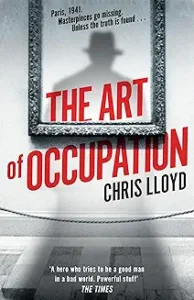
GJ Williams: The Art of Occupation by Chris Lloyd (Orion). We are back with Eddie Giral – a man trying to enforce justice in the cruelty and corruption of German-occupied Paris. In this novel, Eddie investigates the murder of a corrupt art dealer and is forced into a murky underworld in which thieving, lying, concealment, cheating and greed rule. Not knowing who he can trust or even who is who, Eddie has to combine guile and guesswork until he uncovers the twists and deceptions behind the deaths. But success brings the worst of dilemmas. The brilliance of this series is in no small part due to the research behind it. Every step with Eddie is a walk-through real history. The dismal despair of occupied Paris is palpable and the behaviours of Parisians doing anything they can to survive are brilliantly drawn. Characters are richly portrayed to the point you feel you are there with them. I’m sure I could smell Hochstetter’s cigarette’s and taste the bitterness of false coffee. But this is not a novel to bring you down. The pace is fast, and the story unfolds and twists in every chapter – and then there are the laugh-out-loud lines of Eddie’s sardonic wit. The Art of Occupation is published by Orion.
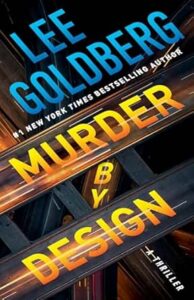
Kevin Joseph: Readers have an endless fascination with sleuths inspired by Sherlock Holmes, and my three summer reads tap into this ready-made audience in a fresh way. Lee Goldberg’s Murder by Design, narrated in the first person by struggling actor Wally Nash in a humorous voice that playfully breaks the fourth wall at just the right times, follows the over-the-top exploits of Edison Bixby. Impossibly handsome and wealthy, Bixby suffers from a brain injury that makes him blurt out offensive remarks and ends his career as an LAPD detective. But he’s still a crime-solving whiz, so an insurance company hires him to investigate claims, pairing him with Wally to run damage control on his inappropriate banter. Together, they solve seemingly unconnected murders that everyone except Bixby dismisses as accidents. Bixby sees every murder as a design in which the victim’s environment is an accomplice, allowing him to identify foul play and often the killer’s identity by observing the design features of the crime scene. The crisp prose, clever concept, and winning chemistry between Bixby and Wally make this book just plain fun. Cold Castle by Iain Landles (IP), is another clever Holmesian mystery. It’s 1922 when Captain Rider Garforth and his sidekick, Sergeant Martins, are cajoled into attending a New Year’s Eve gathering at a remote castle in the Scottish Highlands. The guests are a collection of hard-drinking aristocrats, several of whom are embroiled in illicit affairs and blackmail schemes. A snowstorm and downed phone lines create a perfect closed-room setting for murder. When a guest is shot in the smoking room, and another is severely bludgeoned, Rider and Martins launch a desperate investigation to find the culprit (or culprits) before they strike again. The witty dialogue, well-drawn characters, and clever plot keep the pages turning, while the resolution achieves that difficult balance between the surprising and the plausible. Michael Crichton‘s thought-provoking sci-fi thrillers have influenced my own writing, so I was curious to see how this previously unpublished novel, written in the early 1970s under the pen name John Lange, would compare with his later works. A Murder in Hollywood (Blackstone Publishing) is a classic murder mystery with a twisty plot, a closed-room setting, and multiple characters with plausible motives. Harvey Jason is a studio publicist assigned to generate buzz during the filming of a western. His role also includes tamping down rumors and gossip among the unruly actors, studio executives, and film crew at the filming location. The story begins when the film’s scriptwriter, Arthur McDougall, is found dead in a bathtub. Jason’s duties expand to include shadowing Harlow Perkins, an insufferably brilliant insurance investigator dispatched to probe the death while filming resumes. Cast from the same mold as Holmes and Watson, Perkins and Jason uncover a web of jealous lovers, substance abusers, and blackmailers as they piece together clues that seem to rule out accidental death. The writing has a tight, noirish quality and a cinematic flair. I’m also impressed by Crichton’s knowledge of 1970s filmmaking, which makes the story feel authentic and believable.
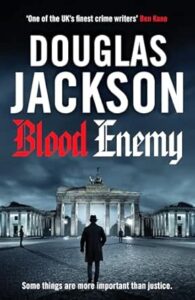
Alan Bardos: Blood Enemy, by Douglas Jackson (Canelo). Douglas Jackson’s latest instalment in the Warsaw Quartet delivers a powerful and gripping conclusion, placing investigator Jan Kalisz firmly at the centre of an impossible moral struggle. A member of the Warsaw Kripo and a covert operative for the Armia Krajowa, the Polish Home Army, Kalisz is a man living in the shadows, forced to choose between loyalty to his country and the safety of his family. Set in June 1944, in the tense days following the D-Day landings, Warsaw is a city alive with both anticipation and danger. Hope grows as news spreads of the advancing Soviet offensive, Operation Bagration, which is steadily destroying German forces on the Eastern Front. Yet for the Polish resistance, liberation comes with its own dilemma. If they rise too early, they risk annihilation at the hands of the Germans; too late, and the Soviets will seize control, denying Poland its independence. This precarious balance gives the novel a constant, underlying tension. Against this volatile backdrop, Kalisz is tasked with investigating the killing of a Wehrmacht war crimes investigator, a case that quickly proves far more complex than it first appears. As he pursues the truth, his journey takes him across a war-ravaged Europe, from the shattered streets of Berlin to the horrors of the Eastern Front. Along the way, he uncovers a brutal war crime committed against a crack Hungarian unit, exposing the darker, often overlooked aspects of the war. The investigation ultimately drives Kalisz into the most terrifying depths of Nazi brutality. In his search for answers, he is forced to confront the unimaginable within Auschwitz-Birkenau itself. There, he comes face to face with a figure from his past, Josef Mengele—an encounter that is as personal as it is chilling. He must also survive in a camp synonymous with suffering and death, where atrocities are committed all around him. This confrontation adds both emotional weight and a sense of dread to an already intense narrative. Jackson brings the series to a close with remarkable force. The novel combines a compelling murder mystery with fast-paced action and relentless suspense, all grounded in meticulous historical detail. The atmosphere is richly drawn, capturing both the desperation of occupied Poland and the bitter fighting of the Warsaw Uprising. Particularly striking are the scenes set in Auschwitz, which are deeply unsettling and linger long after reading. Overall, this is a great conclusion to the Warsaw Quartet. It offers not only a gripping story but also a vivid exploration of a complex and often underrepresented chapter of the Second World War, ensuring it resonates as both a thriller and a powerful piece of historical fiction.
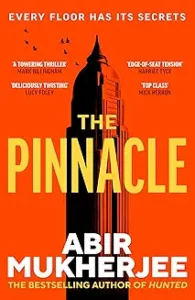
Junkyarddog: The Pinnacle by Abir Mukherjee It’s a whole new type of thriller. Set in a high rise tower, where opulence is standard and a microcosm of Mumbai society is squeezed together, the wealthy and their servants each have a story to tell – a story on every torey (I stole that!). Think A Star is Born, there is this fading male Hollywood legend, now a drunk running to seed, George Abercrombie, the husband of an upcoming Bollywood superstar, Sweetie Sahota, beloved by all India, gorgeous and glamorous and not long for this world. Abercrombie wakes up with no memory of the night before, not unusual, but next to him is the body of Sweetie, she has been murdered, did he do it? As No.1 suspect he is now reviled by a whole nation but he is not the only character we have to ask questions of, what is her ex-assistant up to for instance? Up against the clock, in the sweltering heat of summer, the mystery unfolds. All life is here Mumbai style. This is a satire, a social commentary, and a thrill ride, more than anything it’s a fun adventure. Atomic Coffin by Benedict Anning couldn’t be more different in style. This is a strong original debut novel. A spy story that morphs into a horror story and even if you wanted the former you will go along with the chilling ride. At the height of the Cold War in 1984 SIS agent Heidi Sperling is recalled from a successful mission in East Germany to investigate a strange turn of events. The re-emergence of an experimental Russian nuclear ballistic missile submarine TR-15 assumed lost in the seas between Iceland and Scotland three years earlier. Sperling joins a British boat, HMS Viking, to find and investigate the Russian sub, ultimately rather than allow the Russians to get their tech back the boat is to be destroyed. There are tensions on board the British boat from the get go, Sperling as a woman is not exactly welcome at sea. Things take a different, even darker, turn when something boards HMS Viking from TR-15, death soon follows. This is a claustrophobic and tense story that delights and chills in equal measure. Antihero by Gregg Hurwitz is the latest Orphan X novel and fans will love it, it’s a cracker. A friend of Evan Smoak is killed, although it’s a case of mistaken identity but once he knows too much the killers can’t afford to let him leave. What follows is brutal, Orphan X arrives, which is bad for the five attackers but too late to save Lesandro. The ex-hitman for the Orphan programme, covert killers groomed for the task of sanctioned murder, has two problems here. A young woman returning home late at night is attacked and brutalized, she is held and abused and finally discarded like trash. Even takes up her cause but Anca is clear about one thing she does not want Evan to use lethal force. Then there’s Devine, a billionaire tech giant who has gone off the rails. Fast and gritty, the very definition of a beach read.
Peter Tonkin: Last autumn I reviewed Alex Marsh’s gripping Cut and Run (Sharpe Books), but the review was lost. I am, therefore, pleased to put things right. Cut and Run is a gripping murder mystery set during WWI. Alex Marsh takes us not only into the trenches and the ruined towns immediately behind the lines, but also in an eye-opening journey through arrangements made for the ‘comfort’ of the senior officers of the Allied High Command, with their own exclusive brothels and ‘anything goes’ orgies. It is into this shocking milieu that Frank Campion, invalided out of the army, is thrust when he investigates the murder of a girl from one of the officers’ brothels in the British garrison town of Bethune. And hers is only the first death. Campion is as aware as we are of the irony of his orders to stop the wrong sort of killing in the middle of a war-zone. I am pleased also to celebrate the re-issue of the works of Dashiell Hammett. Red Harvest (IP) is a simply astonishing work, set in ‘Poisonville’ a town run by various ‘mobs’ including the Police Department. The infamously gangster-ridden era is brought vividly to life as the nameless ‘Continental Op’ sets out to clean up the town by setting one group of thugs against another. The resulting mayhem goes far beyond anything in The Untouchables while Hammett’s racy, slangy, hard-boiled style set a high bar for all those who followed. My final recommendation is The Final Problem by Arturo Perez-Reverte (Atlantic Books). As anyone might infer from the title, it is a Sherlock Holmes story – but not as we know it! It is set on a small Mediterranean island during the late sixties. When a storm cuts off all communication, the murders start. But Holmes is one of the guests – or, rather, an actor who has built a career playing Holmes. Our hero, at first reluctantly, sinks into character as the great detective fighting to solve one killing after another. This is a treat for film-buffs as well as Holmes enthusiasts as the actor peppers his increasingly impressive deductions with tales of crossing swords with the great stars of Golden Age Hollywood. Perez-Reverte has used Basil Rathbone as his Holmes so anyone with a quick eye will recognise his other great roles and co-stars. I found it a simple joy to read and could not recommend it more highly.