
I think I’ve always been drawn to an antihero.
As a teenager, I devoured the glamorous Gatsby, who lied about pretty much everything, and I was secretly taken with the dark and brooding Heathcliff. I had a lesson in cynicism from Holden Caulfield in The Catcher in the Rye and learnt gratuitous cruelty from Frank in The Wasp Factory, then along came Renton, the charismatic heroin addict in Trainspotting. More recently, I found Sebastian Faulks’ Engleby in equal parts disturbing and gripping, Mick Herron’s Jackson Lamb a triumph and Henry in The Secret History chilling.
None of these characters are cartoon villains. Unconventional, yes, but fully formed and, although flawed, still relatable as people. This is undoubtedly part of the allure. Following outwardly ordinary people who end up straying into unacceptable territory brings the possibility of your own neighbour, your friend, your doctor doing the same. I don’t know if this delight in depravity taps into my own dark side but, as a reader, it seems, I am able to forgive even the most heinous of atrocities if I am allowed to see inside the head of the perpetrator. Context is everything.
For me, Patricia Highsmith is the master of the antihero. She created a cast of characters who could all carry the label, of which the most famous is, of course, Tom Ripley. When we meet Tom, he is a nervous young man living in a shabby, shared apartment in New York, flirting with low-level crime. Please note, he has no intention of murdering anyone; it is happenstance which changes that. If he had never been invited into the life of privilege enjoyed by his foil, Dickie Greenleaf, he would not have felt compelled to kill Dickie in order to keep that life when Dickie tired of him. Walking around as Dickie, wearing his shoes and spending his money, Tom is the happiest he has ever been. When Freddie Miles – who Highsmith deliberately paints as arrogant, overweight and carrot-haired – threatens to expose Tom’s deceit, he too has to die. This is not cruelty but necessity. We need Tom to survive and we do not give a jot about Freddie because he is hideous – we know this because Highsmith herself has told us so. This is the genius in her storytelling. Despite writing in the third person, she liberally shares Tom Ripley’s thoughts and feelings, inviting us to collude. And colluding is all too easy.
Although none of her other antiheroes can compete with Tom Ripley for his bluff and swagger, Highsmith has a gift for persuading us to root for the wrong side. In Strangers on a Train, she takes an upstanding architect and through a random encounter turns him into a murderer. In The Glass Cell she gives us a wrongly convicted felon who, on his release, lets his jealousy and bitterness lead to murder. In Deep Water, a man whose wife has a series of flagrant affairs enjoys allowing his community to believe he killed her lover, but, in true Highsmith style, when the real guilty party is found he perversely commits a murder anyway. In The Blunderer, our antihero wants his wife to die, he plans her death, but he doesn’t kill her. He does however end up killing someone else.
The plausibility of these plots and her many others lies in the talent Highsmith has for beguiling the reader into identifying with her antihero and believing in their world view. If the protagonist doesn’t like someone, we don’t like them either. If the protagonist believes his actions to be reasonable, so do we. Highsmith’s success in persuading her audiences to, if not forgive, at least empathise with her unheroic, often unlikable murderers is surely the reason her books, and the many adaptations, continue to entertain.
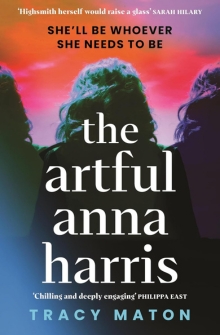
My love of Highsmith’s antiheroes was instrumental in deciding to write my own. Like Ripley, Anna Harris, can mould herself to fit any situation, thinks on her feet and remains untouched by guilt. I hope she’s likeable. She’s certainly attractive. We catch up with her settled in a sleepy Somerset village having cut ties with a London that has become toxic. On the surface, all is well, but she is about to encounter the charismatic Sofia, whose heady friendship will provide the catalyst to unleash the side the artful Anna Harris has tried so hard to keep hidden. What follows is not gratuitous but necessary violence.
In homage to Patricia Highsmith, Anna Harris invites us into her internal world with all its richness and ugliness, and there is plenty of both. My question for the reader is: can I persuade you to collude?
The Artful Anna Harris is published on March 5th by Viper Books.