
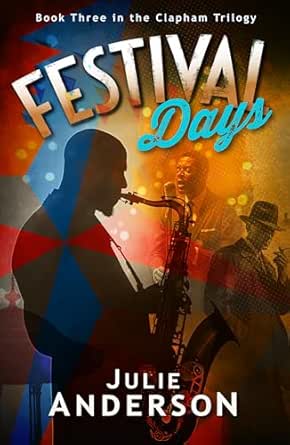
With the release date of Julie Anderson’s new historical crime thriller approaching, we asked Julie to tell us about the origins of her first novel in the Clapham series, The Midnight Man:
I’ve lived in Clapham, South London for thirty-five years. During that time, like most Londoners, I travelled to work using the underground and, every day, on my way to the station, I passed a large, derelict building, half hidden behind hoardings, which had used to be a hospital.
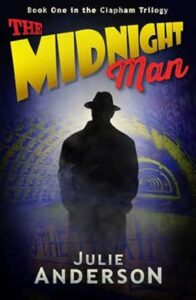
Fast forward to 2022. Having finished writing a trio of contemporary thrillers set in Whitehall I was casting around for my next idea and I decided to return to my first love, of writing fiction set in the past. It was the time immediately following the end of World War Two which attracted me, in part because of modern parallels and because of the immense and positive changes which society underwent at that time. I wanted to focus particularly on the changing role of women, especially that generation of women and girls who, having enjoyed new freedoms and new responsibilities during wartime, were expected to return to hearth and home once the war was over. Approximately my own mother’s generation (she’s ninety-nine this April).
The obvious location for the book was London, the country’s capital and one of the places most adversely affected by the war. Given that I wanted to reflect the experiences of all women, I wasn’t going to set the book in Knightsbridge or Chelsea, but an area with a mix of classes, as Clapham was then. I knew my own bailiwick and its history, and the many physical sites still in existence which would feature in a post-war era novel. In setting my book here, I would also be following in the footsteps of celebrated writers and Clapham residents, Graham Greene and Noel Coward, who set their works, The End of the Affair and This Happy Breed, respectively, in Clapham during WWII. Thus, The Midnight Man, set in Clapham, was born.
So far, so good, but I needed a specific location, somewhere where women congregated, worked and lived their daily lives. I considered centring the story on Clapham Common but, while the Common does feature strongly in the book, it wasn’t suitable as the central location. Not least because the winter of 1946/47 was the coldest then on record.
Then my thoughts returned to the derelict hospital. This, I discovered, had been the South London Hospital for Women and Children and it was highly unusual. Founded in 1912 by two pioneering women surgeons, it was a hospital run by and for women – the largest of its kind in the world. All who worked there, from the highest consultant to the lowliest porter, were women (the only male name in a list of hospital officials of 1917 was that belonging to the chaplain). It was ideal. I had found my book’s central location.
This place was special, too, for its proximity to Clapham’s Deep Shelters. Constructed beneath the Northern line, these were built to provide protection for the people of Clapham from aerial onslaught. The shelters featured in all three of the Clapham books, for different reasons.
And my protagonists? Women working at the South London. Not medics, I have no medical expertise to bring to such characters, but ancillary or administrative staff. The hospital canteen was an obvious setting, as the place where everyone congregated, and it was very indicative of the ethos of the South London in real life; there were no consultants dining rooms in the SLH, everyone dined together.
So, Faye Smith, canteen manager, a working class, south London girl, sprang almost fully formed on to the page. The daughter of a Nine Elms depot railwayman and a housewife, sister to four brothers and Pheobe, a young tuberculosis sufferer, Faye runs the canteen like clockwork and is nobody’s fool. The story begins when she spots an interloper trying to cadge food, strictly rationed even after the war. The interloper is Eleanor Peveril, horribly down on her luck. From a privileged county background, Ellie has been swindled out of her money and luggage and, desperate to find food and warmth, is reduced to stealing leftovers.
From these inauspicious beginnings, the central relationship of the book forms. Neither woman wants to return to the path mapped out for them pre-war, they are determined to make their own way. The friendship is cemented further after the body of a young nurse is found, behind a locked door, in the deep shelters building on the Common. When the police blame the killing on an itinerant the two women, aided by Beryl McBride, Glaswegian nurse and champion of the downtrodden, decide to investigate. They follow a trail which leads to danger, organised crime and some life-changing decisions for each of them.
The consequences of this become evident in the remaining books, when we enter the hidden world of London’s criminal gangs, which thrive as the black market continues post war. Corruption is endemic and the gangs acquire allies in society’s highest echelons, including the Metropolitan Police and the judiciary. Meanwhile, postwar changes begin to have an impact; the creation of the National Health Service, the nationalisation of infrastructure and, in 1948, the arrival of the HMS Empire Windrush. All this plays out in Clapham.
The latest in the series, Festival Days, is about to be published on 28th April. This is set in 1951, as London and the whole country prepares to let down its hair and celebrate the Festival of Britain. Yet the underworld too has plans for the festivities and Faye and Ellie find themselves caught up in crimes which stretch far beyond a local killing, embroiled in a vile trade which still continues today. Will they rise to the task? You betcha!
If you want to know more about the South London Hospital read my article at A Responsibility to the Past – Aspects of Crime and if the Deep Shelters interest you try What Lies Beneath… – Aspects of Crime
Festival Days is published by Hobeck Books on 28/4/2026