
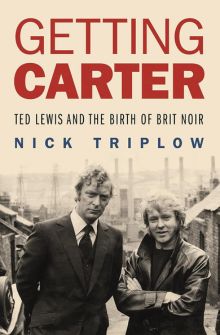
This year sees the 55th anniversary of the publication of one the great post-war crime novels. After Jack’s Return Home, nothing would be quite the same again. Novelist and Ted Lewis biographer, Nick Triplow, revisits how this ground-breaking British noir came to be written and traces its journey to the screen.
‘Aristotle, when he defined tragedy, mandated that a tragic hero must fall from a great height, but Aristotle never imagined the kind of roadside motels James M. Cain would conjure up or saw the smokestacks rise in the Northern English hell of Ted Lewis’s Get Carter.’
Dennis Lehane
By summer 1968, Ted Lewis was in the final stages of work as animation clean-up supervisor on the Beatles’ Yellow Submarine film. He and his team had corrected somewhere in the region of 250,000 animation cells and now they were pulling long days and all-nighters to get the work finished with money running out.
Aged 28, married with a baby girl, Nancy, and bills to pay, commuting between Soho and the family’s cottage in rural Essex, he was desperate for something new that could make money.
Ted Lewis with Sir Michael Caine 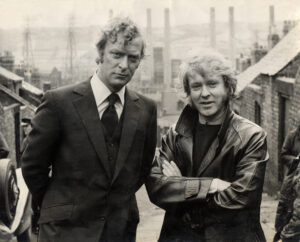
Lewis was encouraged to write by his English teacher, the poet and novelist, Henry Treece. Treece, who’d been the first to recognise Lewis’s creative talent, helped make the connections that led to publication of his first novel, All the Way Home and All the Night Through in 1965. A more or less faithful retelling of his final year at Hull School of Arts and Crafts, published under the Hutchinson New Author imprint, the narrative centred on relationships, beer and jazz and art school life. It had Lewis’s dark consciousness at its heart. Reviews were mostly positive, but it wasn’t commercially successful.
Years later, Lewis would talk about the idea for the book that followed feeling as though it had come from ‘absolutely nowhere’.
‘I was sitting on a train, looking out of the window at the idyllic rural landscape, when I thought, for no good reason whatsoever: “Suppose I wrote a book about this criminal whose brother is murdered, and the criminal sets about finding the murderer, one of his own fraternity, perhaps even an acquaintance, or even his own boss.” The idea, a simple, unoriginal sort of idea, exhilarated me enormously, to write an English version of the American crime novel.’
The working-class enforcer returning to his unnamed home town to find his brother’s killers was a perfect fit for Lewis, a devotee of American crime fiction and classic noir films. He drew heavily on his lived experience:nights out in the steel town of Scunthorpe and time spent in Soho’s pubs and clubs rubbing shoulders with fringe underworld figures. Looking back on early inspirations, B-movies and the novels of Raymond Chandler, he later recalled his reaction when Treece lent him Chandler’s novels:
‘I loved every word of them. I’d read Hemingway, but at that time Chandler seemed to me to be vastly superior. Chandler was more subtle, less sentimental, wittier. There was a satisfying morality to his work…’
He tried out ideas for a title: Weekend in Scunthorpe; Red Weekend (a nod to Dashiell Hammett); Funeral in Scunthorpe (referencing Len Deighton – Michael Caine already in mind); Return of the Gangster; The Gangster’s Return. He admitted they were ‘ludicrous’, but they helped settle the terms for Carter’s story. He decided on Jack’s Return Home, an ‘ironic joke’ at the expense of Victorian melodramas in which an errant son comes home to save the family from ruin. (It was also the title of a spoof play in a 1958 episode of Hancock’s Half Hour.)
Lewis grew into the idea, writing about a world he knew populated by characters drawn from life. It felt fresh and exciting. He wrote the first third of the book and sent it to his agent, John Johnson.
‘I showed what I’d written to the man who was then my agent, who, to say the least, was unimpressed by what I’d written and suggested I abandon the project.’
Johnson thought the novel too dark, too violent. He could see no place for it. Lewis was devastated. Enter literary agent, Toby Eady.
Eady’s colourful past could hardly have been more different to Lewis’s stolid provincial roots. The second son of the novelist, Mary Wesley, he’d initially set out on a career in banking before becoming enthused by emerging ideas in language and culture, setting up Toby Eady Associates as an independent agency in 1968.
After a chance meeting, Lewis sent Eady the manuscript. He didn’t have to wait long for a response:
‘He phoned immediately after reading, full of enthusiasm and asking to read the rest. I promised him the finished book inside three weeks. I must have been mad.’
Lewis sat down with his wife, Jo, and together they worked out the remainder of the book – it was Jo who suggested having Jack start to throw Cliff Brumby off the balcony outside Glenda’s apartment. She typed each handwritten page as soon as it was finished. Lewis was adamant nothing should be changed. He’d read out the typed versions and ask her opinion, but never rewrite. ‘He thought it would suffer if it was overworked, if it wasn’t spontaneous.’ Lewis attributed the energy of Jack’s Return Home to the deadline:
‘I’m sure that final two-thirds of the book benefitted from the pressure I was under. I think pressure sharpens a writer’s mind and unlocks compartments in his mind that might stay closed without the pressure turning the key. I usually find that when there’s no-one breathing down my neck my mind stays its usual sluggish self and I produce material to match.’
The completed manuscript that arrived on Eady’s desk was an uncompromisingly violent crime novel. At its dark heart, Jack Carter, the definitive antihero, taking on small-town pornographers, civic gangsters and the hard men sent to bring him back to London. This is Jack’s world – and Lewis’s – the steelworks glow on the horizon, ‘like the Disney version of the Dawn of Creation’; a barman with a hairstyle that’s ‘Irish Tony Curtis’;Carter tormented by the ghost of the brother he betrayed and the daughter he discovers has been abused as part of a pornography ring. Lewis dares you to see what Jack sees and feel how he feels and not turn away.
Keeping faith, in spite of the resistance towards Jack’s Return Home, Eady pitched the book to Peter Day, editor at Michael Joseph. Day, who was having to contend with a reader’s report on Lewis which said ‘he couldn’t write English’, later acknowledged that the university educated publishers’ readers simply weren’t ready for a novelist who ‘writes as he speaks’.
Lewis was devastated by the criticism. Eady persisted: ‘We read it aloud to the editors. It was Ted’s language and you couldn’t muck about with it.’ Peter Day was won round and Michael Joseph decided to publish.
By the time Jack’s Return Home appeared on bookshop shelves in March 1970, the novel had been optioned by film producer, Michael Klinger, for £10,000. Klinger had been searching for something home-grown, gritty and honest for a British crime thriller in the wake of revelations in witness testimonies at the trials of the Richardsons and Krays. He sent first time feature director, Mike Hodges, a proof of Lewis’s novel with a note asking him to ‘consider turning the book into a film that he might like to handle.’
With Michael Caine agreeing to take on the role of Jack Carter, Klinger convinced MGM to back the project and was able to raise the necessary funds. Mike Hodges worked on the script through the spring of 1970, ‘decoupling’ from Lewis’s novel in key places, remaining faithful in others, at times including Lewis’s scenes and dialogue virtually unaltered in the screenplay. He and Klinger scouted locations, settling on Newcastle, Gateshead, Belmont and Blackhall, places Hodges knew well that were some 200 miles north of Lewis’s Scunthorpe. Filming took place between July and September 1970. Get Carter was in the can in 37 weeks. Released in March 1971, Lewis’s life would never be the same again.
Get Carter is a landmark in British cinema for many reasons. Michael Caine’s superb performance as the character he might have become had his life taken a different turn; Hodges’ script and direction, informed by his experience as a documentary maker, depicting Newcastle and the north east so vividly and memorably, aided by Wolfgang Suschitzky’s outstanding cinematography; Roy Budd’s score and that theme. But it’s through Lewis’s original novel and Hodges’ vision that Get Carter finds its truth. In 1971, a month before the film went on general release, Humberside police discovered a stash of 1,300 pornographic films on a ship in Grimsby Docks and 96 sets of obscene slides, hidden in a cargo of animal offal. Interviewed for the Get Carter press pack, Lewis was asked about his novel, the characters and their origins. He said that he’d tried to ‘make it real’.
Mike Hodges would later acknowledge that Lewis’s modest credit in the film’s title sequence, ‘Based on the novel Jack’s Return Home by Ted Lewis’ did not give sufficient recognition to his contribution.
Asked about the creative process in a 1975 interview, Lewis would reflect on the nature of artistic vulnerability. Writing at a time when his longstanding alcohol dependence had tipped into full-blown alcoholism, in part a result of the failure to repeat the commercial success of Jack’s Return Home / Get Carter, his insights are telling:
‘…this is what any creative artist does … he publicly lays it on the line that he has intended people to judge him by offering something he’s created: setting up himself, through his work, to be knocked down or accepted the way he would like himself to be accepted. If he fails, his failure is public. Although the presentation of himself is a willing act, it is nevertheless, for the artist, an anxious and frightening process.’
It was a process Lewis drove himself to repeat several times until his final novel, GBH, was published to a largely indifferent reception in 1980. Once more, his writing tested boundaries. In an echo of John Johnson’s reaction to Jack’s Return Home, the darkness of the novel disturbed Toby Eady. ‘I remember when I first read the manuscript of GBH, I said, you’ve got to meld this down a bit, because it’s not going to get published. It’s too claustrophobically violent in people’s minds. I think he’d reached that point in his own life when he wrote the book.’
Researching Ted Lewis’s life and work and writing the biography was like taking on a particularly complex cold case. Piece by piece, one verifiable fact at a time, the story emerged and Lewis, who for so long was absent,took shape and form. It’s hard to let go of the unresolvable questions. Life was difficult for him, that much is clear. He was an immense talent as a writer, artist and musician. He loved his family and their separation was the tragedy of his later years. It’s testament to his creative instinct and determination that, through it all, he produced the work he did. Aside from the two great and a handful of very good novels and Z-Cars scripts, his influence is most keenly felt in the tradition he helped establish: the tough, violent, social realist British noir novel. It’s there in William McIlvanney’s Laidlaw novels, Derek Raymond’s Factory novels, David Peace’s Red Riding Quartet, Ian Rankin’s Rebus novels and many others. But on reflection, what’s most important is that Ted Lewis wrote with integrity. For a time, he seemed destined to become an obscure footnote, a ‘based on the novel by’ in the credits of a classic film. That’s no longer the case.
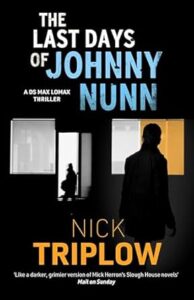
Nick Triplow’s latest novel.
Getting Carter: Ted Lewis and the Birth of Brit Noir by Nick Triplow is published by No Exit Press Bedford Square Publishers | Getting Carter