
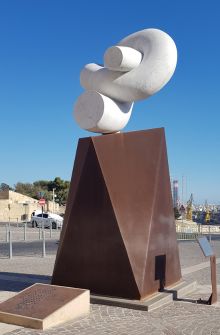
The Knot
Standing in front of the baroque 16th-century Auberge de Castille, the office of Malta’s Prime Minister, in pride of place, is a contemporary sculpture of twisted marble, known as the Knot – or, more colloquially, the dog-turd! The sculpture marks the opening ceremony of the Valletta Summit on Migration in 2015, where EU and African leaders met to discuss the European migrant crisis of the mid-2010s. Such was the goodwill and good intentions of the participants that it was felt the occasion was worthy of a memento in the most prominent of all Malta’s public places.
At that time, Malta and Italy were suffering a significant ‘small boats’ crisis, as gangs and militias in Libya exploited the proximity of the Italian island of Lampedusa to the Libyan coast as well as Malta’s Search and Rescue obligation under the International Convention, to smuggle people into the EU.
Its obligations under international treaties required Malta to provide and maintain a search-and-rescue service over a vast area of the ocean stretching from Tunisia to Crete. It was obligated to assist any vessel or person in distress within that zone, regardless of their nationality or status. Of course, this included crowded inflatable boats carrying people from Libya, heading towards Europe.
UNCHR records show that between 2010 and 2020, Italy received over 800k migrants, who arrived by sea, mainly from Libya. In that same period, Malta tellingly received only 14k.
There are many understandable reasons why Italy received so many more migrants than Malta. The smugglers’ strategy was to get their human cargo into Italy – Lampedusa was the closest EU territory to Libya – and the migrants themselves wanted to enter mainland Europe to join relatives or to find work more easily. Also, the Italian ships involved in the rescue operations had home ports in Sicily and on the Italian mainland, so many migrants were offloaded directly onto Italian territory.
However, Malta also pursued a highly effective and often illegal deterrence policy, frequently closing its ports to NGO rescue vessels, leaving migrants stranded at sea for days or weeks on end until other EU states agreed to relocate them. Human rights organisations (such as Amnesty International and Alarm Phone) have repeatedly accused the Maltese authorities of adopting a systematic ‘non-assistance’ policy in their massive Search and Rescue zone, involving delaying or ignoring distress calls, hoping a migrant boat will drift towards Italian waters (even providing them with fuel and provisions to help them on their way!) or directing merchant vessels to take migrants to Italy instead of Malta.
Most controversially, Malta has worked with Libya since 2017, passing information on migrant boat locations to the Libyan Coast Guard. The Libyans then intercept the boats and forcibly return the migrants to Libya, where they are held in notorious detention centres. There are also numerous serious allegations that Malta has engaged in illegal ‘pushbacks’ and the unlawful return of migrants to Libya, including cases where boats were clearly within Malta’s Search and Rescue zone.
This strategy has effectively reduced arrivals in Malta by intercepting them before they enter Maltese territorial waters. To this extent, the management of Malta’s border has been outsourced to the Libyans.
These arrangements were ratified, without ceremony (or sculptures!), in a 2020 Memorandum of Understanding between Malta and Libya, secretly signed in Tripoli. In fact, until investigative journalists brought the truth to light, the government denied it even existed. The agreement had been signed without any prior public debate, parliamentary discussion, or notification to the public or civil society organisations. This lack of transparency fuelled suspicion that the government was trying to avoid scrutiny over its contents, particularly given the severe human rights implications.
The Killing
For those migrants who arrived in Malta and did not move on to mainland Europe, it is fair to say things are not easy. EU reports that interpersonal prejudice and systemic/structural discrimination, particularly against Black African and Muslim communities, are prevalent. In areas like housing, employment, hate speech and violence, trust in the Police and popular rhetoric, there is evidence that racism abounds. It is safe to saya policy of extending the hand of welcome to migrants from Africa has not been universally adopted. As a resident in Malta for over 10 years, I can anecdotally confirm this is the case.
I was discussing this with a friend of mine, an Irish author also resident in Malta, Maurice O’Scanaill, who directed me to another public memorial that contrasts neatly with the hypocritical and hubristic dog-turd sculpture outside the Office of the Prime Minister.
He had recently visited the wonderful St George’s Basilica in Rabat, Gozo, the capital of Malta’s sister island. He told me about a painting high in a corner of a side aisle depicting Lassana Cisse Souleymane, a 42-year-old father of three and an immigrant to Malta from the Ivory Coast.
Lassana Cisse Souleymane and two of his friends, Ibrahim Bah and Mohammed Jallow, also migrants, were walking along a road in southern Malta, at about 23:00 one evening, returning to the Hal Far openmigrant centre after watching a local football match. Without provocation, they were fired at from a passing car, believed to be a white Toyota Starlet, in what was a racially motivated drive-by shooting.
Lassana Cisse Souleymane was shot and killed. His two friends were also shot, but survived their injuries.
It later became apparent that a fourth migrant, May Malimi, from Chad, had also been injured in a separate, racially motivated hit-and-run attack in the same area, two months earlier.
Justice Delayed
Two young Maltese men were later arrested in connection with both events, Francesco Fenech and Lorin Scicluna, aged 21 and 22 respectively, who were with the Armed Forces of Malta. They were soldiers, taking potshots at migrants, for sport.
These attacks all occurred in 2019. That is six and a half years ago. The fourteen charges against them explicitly state that the crimes were racially motivated and intended to terrorise the black migrant community.By the end of 2019, the soldiers had been suspended from the Army, released on bail, and are walking among us today, while awaiting trial.
In Malta, the first stage in a criminal process is that a Magistrate must compile the evidence against the accused. The English Courts’ equivalent of committal proceedings. This took two years, given thebottlenecks in the Maltese system, but was completed in June of 2021. The case was then transferred to the Attorney General, who issued the Bill of Indictment, so the case could be sent for trial.
As of today, over six and a half years after the shooting, there is still no date set for trial, and the accused are still out on bail. Such a delay is not uncommon in cases awaiting trial in Malta’s Superior Courts. However, given the unique circumstances of this case, and the sensitivities involved, it is still remarkable that there is so little will to see the matter resolved.
It was also a cause for concern that Lassana Cisse’s remains were kept in Malta for over three years before being repatriated to the Ivory Coast. At least the government eventually had the good grace to bear the expense of transporting his body.
The Portrait.
The decision to commission a portrait of Lassana Cisse Souleymane in St George’s Basilica in 2021 was a deliberate and symbolic gesture initiated by the parish priest, Archbishop Canon Joseph Curmi. The portrait is part of a larger ongoing initiative by the Basilica on the theme of ‘Where is your brother?’ – a reference to the question the Lord asked Cain after he had murdered Abel.
The Gozitan artist, Manuel Farrugia, was inspired to choose Lassana Cisse’s smiling face to remind people of a line from the book of Matthew:
‘I Was a Foreigner and You Welcomed Me’.
Some welcome! However, the Bishop explained that the painting aimed to create awareness and prevent people from turning away from those in need. The figure in the background, busy with his phone, is a warning not to become distracted or to cease caring. The face of Lassana Cisse represents all those around the world who are considered foreigners or persecuted because of their race, ethnicity, religion or background.
It’s worth reflecting on the massive irony of these two significant and symbolically opposing images –The Knot and the Portrait. I want to thank my friend, Maurice O’Scanaill, for the conversation that gave rise to this article. How easy it is to forget the evil done when justice is delayed.
And to those like Lassana Cisse, go carefully. Not everybody will get the Bishop’s message.