
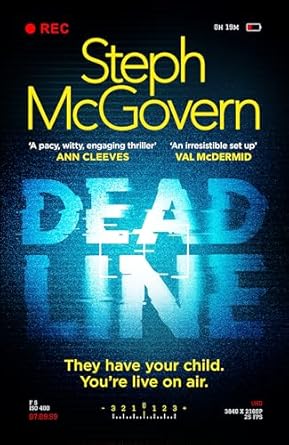
“I kept coming back to the same question when I was out on location for BBC Breakfast; ‘What if this broadcast got hijacked?’ My mates, who I was working with, would then discuss the different ways you could do it…”

Welcome to Aspects of Crime, Steph and Congratulations on Deadline. You’ve been around the crime writing community, interviewing authors at crime festivals. Did that inspire you or did you always harbour an ambition to be a crime writer?
Thank you, it still feels surreal to be congratulated for writing a crime novel. Despite stalking my favourite authors for many years now, it’s not something I ever expected to become myself. The person to blame is Ann Cleeves. I am very lucky to be able to call Ann a mate and it was in 2015, when she was chairing the Theakston Old Peculiar Crime Writing Festival in Harrogate, that she asked me along to interview Paul Abbott. I am a huge fan of Paul’s writing and loved his shows like Cracker, Shameless and No Offence. That trip also made me fall in love with the whole crime fiction festival vibe. It blew my mind that readers could so easily interact with authors. One minute you’re listening to Mick Heron on a panel session and the next you’re stood next to him and Abir Mukherjee having a chat in the festival bookshop. I loved the inclusivity of it all, so I’ve been a regular ever since and was lucky enough to join the judging panel for the Harrogate festival Crime Book of the Year Award six years ago too.
In a fortunate stroke of serendipity, it was one year at the festival that I heard the brilliant Harlan Coben talk about the inspiration for his books coming from constantly asking himself ‘what if’ in different situations. So that’s what I started doing at work. I kept coming back to the same question when I was out on location for BBC Breakfast; ‘What if this broadcast got hijacked?’ My mates, who I was working with, would then discuss the different ways you could do it, as well as why someone might do it and how we’d react if it happened. Back then it was simply a way to pass time while we were waiting to go on air. But my crime writing mates got wind of it and convinced me to have a go at turning it into a book.
Fascinating, glad you took up the challenge. I’d imagine there’s no end of support if you want to talk to people about writing?
It’s interesting isn’t it, crime authors murder people (fictionally) for a living and yet are dead nice in real life. Perhaps getting all your dark thoughts out in fiction makes you a more well-rounded person…..who knows? Anyway, you are right, the crime writing community is incredibly welcoming and supportive. Of course there is healthy competition, but I think there’s an appreciation that readers don’t just read one author’s work, so new writers/books can bring new readers and that’s got to be a good thing. And although the physical writing of a book is a solo profession, I can honestly say I never felt lonely writing Deadline. Not only did I get to hang out with all the characters I’d created in my head, who became my new dysfunctional colleagues/friends, but also, once the first draft was done, I was then into the editing process which really is a team effort. And then when the book tour starts you get to chat with inquisitive readers and listen to loads of cool authors.
So who were your early favourites, who turned you on to crime fiction?
Steph: My love of reading started with Roald Dahl, not your classic crime author I know, but his stories were thrilling to me and had all the things I now love in a good crime book…..twisty tales full of dark and complex characters. Then in my teenage years it was Ruth Rendell and Colin Dexter who I became obsessed with, alongside Agatha Christie’s Miss Marple. Now as a grown up it’s MW Craven, Harlan Coben, Lisa Jewell, Gillian McAllister, Steve Cavanagh, Araminta Hall, Sarah Vaughan…..the list goes on. Not only do I adore the characters and world’s these amazing authors create, I also love how they cover big societal issues. Take, for example, Louise Candlish’s latest book ‘A Neighbour’s Guide to Murder’ it’s not only a cracking thriller, but also an exploration of the country’s rental crisis. Or Ann Cleeves’ book ‘The Dark Wives’, a classic Vera mystery, but also an expose on the profiteering of children’s homes. I ended up doing an investigative series about children’s care after reading Ann’s book.
Ann is so good. Talking of Ann Cleeves, there’s a new Jimmy Perez novel coming next month. What were the challenges of writing a novel? Readers will know you are a financial journalist/broadcaster but it is different inventing a world.
Steph: I think for me it was confidence……I am a storyteller by trade, but never in the written word, I’ve always shied away from it. However in lockdown I started writing for escapism. I’d just had a baby, was having to do a TV show from my house because the studios were closed and weirdly I found writing a story about a TV show being hijacked quite calming in all the madness. I wrote about 10,000 words and got Ann Cleeves to read it. I knew she would tell me the truth if she thought it was rubbish. Thankfully she didn’t say that! It was another two years before I signed a book deal. I was too nervous to commit to anything formal, but the brilliant commissioning editor Francesca Pathak persevered with me, turning up at my house on the North East Coast, hundreds of miles from her own, to convince me to finish the book and publish it. Fran held my hand through the writing process and her notes along the way made this book so much better than it would have been.
That’s lovely to hear. Deadline is set in the world of TV and politics and you mentioned that you batted around ideas with colleagues. How much of Deadline was inspired by real events and people at work?
Everything that happens in Deadline has been inspired by things I have experienced, seen or thought about in my career. The characters you meet are a wonderful mix of the colourful people I’ve spent time with over the years, from political leaders, to CEOs, to factory workers. Also the settings in the book, like the money printing factory the hijack happens in, are based on real places I’ve been to. As a financial journalist I’ve visited hundreds, if not thousands, of businesses over the years and they are fascinating. I love a locked room mystery which is why I picked the money factory, one of the most secure businesses in the world. It couldn’t possibly be hijacked could it?!
I love the way writers are always looking for that ‘crime’ in an innocent setting. Everything in the novel feels so authentic too, you go e readers a real insight into what happens in TV.
It was really important to me as a TV insider to break the fourth wall and show people that television news is not as polished or as secure as you might think it is. I wanted to explain what really happens behind the scenes and answer the common questions I get asked, like ‘how do you manage to talk on telly while someone else is talking in your earpiece’ and ‘what is it really like to interview a politician’.
Yes, I didn’t need to ask those questions after reading the book. Rose is about to do the biggest interview of her life when a voice in her earpiece shatters her world. Her family has been kidnapped and she’s at the mercy of the voice in her ear telling her what to do. You mentioned Harlen Coben’s ‘what if?’ and that ked to this idea but did you know what was behind it?
When I first started writing the story I had no idea why it was happening. I knew who was behind the hijack, but I didn’t know why they wanted to do it. It was only as the characters developed that I realised what I wanted this to be about. Essentially it’s a story about power, wealth and corruption, something I have reported on extensively in my twenty years as a journalist.
I guess the central thing it all revolves around is what would you do for your family, for your loved one.
I think most people will tell you that they would do anything for their kids and I needed that kind of motivation in order for my hijack to be taken seriously and be believed by the reader. My reporter Rose is already in an incredibly intense situation, and I wanted to push her to her limits to see how she would cope. I do that to lots of other characters too….but I can’t tell you more than that as it would give too much away!
Yes, thanks – no spoilers. There are themes you reflect on in Deadline are they the things that bother you; grooming, fake news, #MeToo, privilege, prejudice. I mean, crime fiction is great for looking at society’s ills.
I guess there’s loads of my politics in this book. Not party politics, but life beefs. I am someone who grew up in a town always slated by the media. I wanted to challenge the common misconceptions and look a bit at why those places struggle. It’s often not about the people in them, but about the way they are controlled. I don’t do this in a big worthy way. Plus I think the underlying message is about people being underestimated and how actually that can become a superpower.
And, it’s good to see the diversity of society represented in fiction.
I think diversity naturally comes from being interested in people. I have had the great privilege as a journalist to meet people from all walks of life and by far the most interesting people to talk to are those we might think are ‘ordinary’ but have experienced something ‘extraordinary’. Plus, I think every good crime book should introduce you to characters that challenge your unconscious bias. It’s what makes for the best twists.
I guess readers will wonder how much of Rose is you?
So my protagonist is called Rose Steedman, who is a national reporter, with a Teesside accent and has a child with a female partner. My middle name is Rose and my mam’s maiden name is Steedman. I think it’s safe to say there is a lot of me in the character. I remember my mate Val McDermid (sorry for all the name dropping!) telling me that authors often put a lot of autobiography in their first novel and that is definitely true of Deadline. Most of the things in the book, apart from the hijack, are things I have experienced in my life. From big stuff like having a stalker, to the little stuff like being bitten live on air by a pig. Weirdly though, when I was writing Rose, I wasn’t thinking about me being her. I think that’s probably because when I was a reporter on the telly I was at a very different stage of my life to Rose. I hadn’t had my child for a start and I think that completely changes how you view the world and react to things. So I guess Rose is me, but with lots of other women I know thrown into the mix too.
Did you enjoy the game with the readers, the touch of humour, seeding clues and the ticking clock, all part of a good thriller.
Oh yes, I loved thinking of all the twists to put in. Also, humour has always been key to my work. I’ve had to cover some dark stuff in my time as a journalist and also seen some tough stuff growing up. Humour can often be the thing to help you get through it.
And finally, I hope you’re writing a follow up novel?
I am. Book two is well underway. It’s not set in the TV world like Deadline but I am keeping some of the same characters. I’ll also be doing more telly and will be popping up quite a bit on the BBC, but that’s all I can tell you about that, at this stage!
Something to look out for. Thanks so much, Steph.
DEADLINE BY STEPH MCGOVERN IS PUBLISHED BY MACMILLAN, OUT NOW.
TV Presenter Steph McGovern will be very familiar to readers. She has long been a champion of crime fiction and loves a crime writing festival. You may seen Steph at Capital Crime or, maybe, the Theakston’s Crime Writing Festival in Harrogate.
Steph was a respected BBC producer before stepping up to the mic. and has since become a TV regular, including shows like Steph’s Packed Lunch on Channel 4 and she presents The Rest is Money podcast with Robert Peston. A proud Northerner, Steph has a cameo in Middlesbrough set sitcom Smoggie Queens. Most recently Steph has proven her crime writing chops by publishing Deadline, set in the world of politics and TV, praised by Val McDermid as ‘fascinating and authentic…’ and by Ann Cleeves as ‘a pacy, witty engaging thriller, entertaining and delightfully authentic…’